## Diagram: Dependency and Action Correction Framework
### Overview
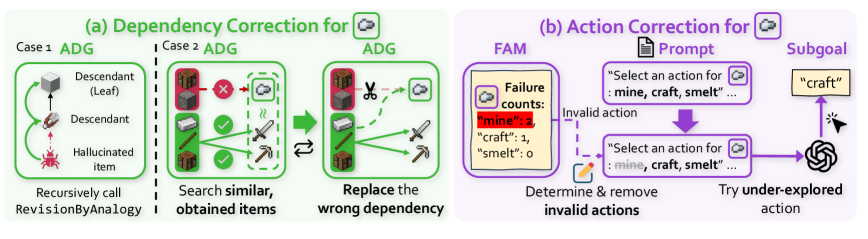
The image depicts a two-part technical framework for correcting dependencies and actions in a system, likely related to game mechanics or automated processes. It combines dependency resolution (ADG) and failure analysis (FAM) with visual workflows and decision logic.
---
### Components/Axes
#### Part (a): Dependency Correction for ADG
- **Case 1 (ADG)**:
- **Components**:
- "Descendant (Leaf)" (green box with leaf icon)
- "Descendant" (green box with tool icon)
- "Hallucinated item" (red box with bug icon)
- **Flow**:
- Arrows indicate recursive calls to `RevisionByAnalogy`.
- Hallucinated item triggers dependency correction.
- **Case 2 (ADG)**:
- **Components**:
- "Search similar, obtained items" (green checkmarks)
- "Replace the wrong dependency" (red X and green checkmarks)
- **Flow**:
- Invalid dependencies (red X) are replaced with valid ones (green checkmarks).
#### Part (b): Action Correction for FAM
- **Components**:
- **Prompt**: "Select an action for: mine, craft, smelt..."
- **Failure Analysis (FAM)**:
- Failure counts:
- "mine": 2 (red highlight)
- "craft": 1
- "smelt": 0
- **Subgoal**: "craft" (highlighted in yellow).
- **Flow**:
- Invalid actions (e.g., "mine") are removed.
- System suggests trying under-explored actions (e.g., "craft").
---
### Detailed Analysis
#### Part (a): Dependency Correction
- **Case 1**:
- Recursive dependency resolution (`RevisionByAnalogy`) addresses hallucinated items.
- Hallucinated items (red) are flagged for correction.
- **Case 2**:
- Similar items are searched (green checkmarks) to replace invalid dependencies.
- Visual contrast between red X (invalid) and green checkmarks (valid).
#### Part (b): Action Correction
- **Failure Analysis (FAM)**:
- "mine" has the highest failure count (2), marked as invalid.
- "craft" is prioritized as the subgoal (yellow highlight).
- **Action Selection**:
- System iteratively selects actions (mine, craft, smelt) and removes invalid ones.
- Final step: "Try under-explored action" (craft).
---
### Key Observations
1. **Dependency Correction**:
- Hallucinated items and invalid dependencies are resolved through recursive analysis and replacement.
2. **Action Correction**:
- Failure counts directly influence action prioritization (e.g., "mine" is deprioritized).
- Subgoal alignment ("craft") suggests adaptive decision-making.
---
### Interpretation
The framework combines **dependency resolution** (ADG) and **failure-driven action correction** (FAM) to optimize system behavior.
- **ADG** focuses on structural integrity (e.g., fixing invalid item dependencies).
- **FAM** uses failure metrics to guide action selection, favoring under-explored or high-priority subgoals.
- The use of color coding (red for errors, green for valid steps) and hierarchical flowcharts emphasizes a systematic, reactive approach to errors.
- The subgoal "craft" being prioritized despite lower failure counts suggests a strategic bias toward resource generation or crafting in the system’s objectives.
This framework likely applies to scenarios requiring robust error handling, such as game AI, automated workflows, or dependency management systems.