## Table: Operation Latency Analysis
### Overview
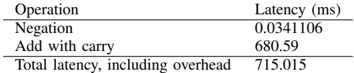
The image displays a simple two-column table presenting latency measurements for specific computational operations, along with a total latency figure that includes overhead. The table is presented in a clean, monospaced font on a plain background, typical of technical documentation or performance benchmarking results.
### Components/Axes
- **Columns:**
1. **Operation:** Lists the names of the computational tasks.
2. **Latency (ms):** Lists the time taken for each operation, measured in milliseconds (ms).
- **Rows:**
1. **Header Row:** Contains the column titles "Operation" and "Latency (ms)".
2. **Data Row 1:** "Negation" | "0.0341106"
3. **Data Row 2:** "Add with carry" | "680.59"
4. **Summary Row:** "Total latency, including overhead" | "715.015"
### Detailed Analysis
The table provides precise latency figures for two distinct operations:
1. **Negation:** This operation is extremely fast, with a latency of approximately **0.034 milliseconds** (34.11 microseconds). The value is given to six decimal places, indicating high-precision measurement.
2. **Add with carry:** This operation is significantly slower, with a latency of **680.59 milliseconds**. This is over 19,950 times slower than the Negation operation.
3. **Total latency, including overhead:** The final row reports a total of **715.015 ms**. This value is greater than the sum of the two individual operations listed (0.0341106 + 680.59 ≈ 680.624 ms). The difference of approximately **34.391 ms** represents the unlisted "overhead" mentioned in the label.
### Key Observations
- **Extreme Performance Disparity:** There is a massive, orders-of-magnitude difference in latency between the two listed operations. "Negation" is a near-instantaneous bitwise or arithmetic operation, while "Add with carry" appears to be a much more complex or resource-intensive task.
- **Presence of Significant Overhead:** The total latency is not simply the sum of the component latencies. A substantial overhead component (~34.4 ms, or about 4.8% of the total) is incurred, which is not broken down into specific operations in this table.
- **Precision Reporting:** The "Negation" latency is reported with very high precision (7 significant figures), while the other values are given to 3-6 significant figures. This may reflect the measurement tool's resolution or the inherent variability of the operations.
### Interpretation
This table likely comes from a performance profiling or benchmarking report for a computing system, possibly at a low level (e.g., CPU instruction timing, cryptographic primitive analysis, or financial transaction processing logic).
The data suggests that the system or algorithm being profiled is dominated by the cost of the "Add with carry" operation. The "Negation" operation, while precisely measured, is negligible in the overall time budget. The critical insight is the **overhead**. This overhead could represent context-switching time, memory allocation, function call latency, I/O wait, or other system-level costs that are incurred when executing these operations as part of a larger process. The fact that the overhead itself is an order of magnitude larger than the "Negation" operation indicates it is a non-trivial factor in system performance.
For a technical audience, this table highlights that optimization efforts should focus on the "Add with carry" operation and, crucially, on identifying and reducing the sources of the ~34 ms overhead, as these together account for over 99.9% of the total measured time. The precise value for "Negation" may be important for theoretical analysis or in contexts where it is executed billions of times, but in this specific measured scenario, it is a minor contributor.