## Diagram: Transformer Block Architecture
### Overview
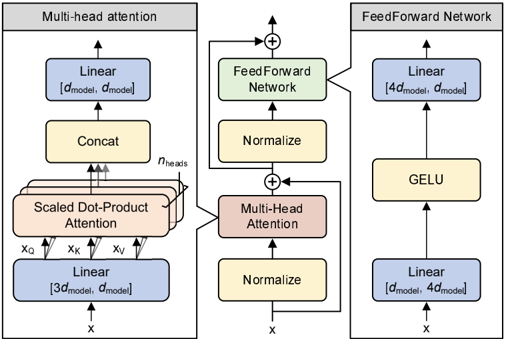
The image depicts a technical diagram of a transformer block architecture, illustrating the flow of data through multi-head attention mechanisms and feedforward networks. The diagram uses color-coded blocks to represent different computational steps, with arrows indicating data flow.
### Components/Axes
1. **Multi-head Attention Block (Left Section)**
- **Linear Layers**:
- Input: `[3d_model, d_model]` → Output: `[d_model, d_model]`
- Output: `[d_model, d_model]` → Output: `[d_model, d_model]`
- **Concat**: Combines outputs from multiple attention heads.
- **Scaled Dot-Product Attention**:
- Inputs: `x_q` (queries), `x_k` (keys), `x_v` (values).
- Dimensions: `[d_model, d_model]` for all inputs.
- **Normalize**: Applied after attention computation.
- **n_heads**: Number of attention heads (not quantified numerically).
2. **FeedForward Network (Right Section)**
- **Linear Layers**:
- Input: `[d_model, 4d_model]` → Output: `[4d_model, d_model]`.
- **GELU Activation**: Applied after the first linear layer.
- **Normalize**: Applied after the GELU activation.
3. **Residual Connections**:
- "+" symbols indicate residual connections between blocks (e.g., input + output of attention/feedforward).
### Detailed Analysis
- **Multi-head Attention Flow**:
1. Input `x` is linearly transformed into queries (`x_q`), keys (`x_k`), and values (`x_v`).
2. Scaled dot-product attention computes relationships between queries and keys, then applies softmax to weight values.
3. Outputs from all attention heads are concatenated and linearly projected back to `[d_model, d_model]`.
4. Normalization stabilizes the output.
- **FeedForward Network Flow**:
1. Input `x` is linearly expanded to `[4d_model]` using GELU activation for non-linearity.
2. A second linear layer projects the output back to `[d_model]`.
3. Normalization is applied to stabilize gradients.
- **Residual Connections**:
- Data is added to the input of each block (e.g., `x + attention_output`), enabling deeper networks by mitigating vanishing gradients.
### Key Observations
- **Dimensionality Changes**:
- Attention heads reduce dimensionality via linear projections (e.g., `[3d_model, d_model]` → `[d_model, d_model]`).
- Feedforward network expands and contracts dimensions (`[d_model, 4d_model]` → `[4d_model, d_model]`).
- **Activation Functions**:
- GELU (Gaussian Error Linear Unit) introduces non-linearity in the feedforward path.
- **Normalization**:
- Applied after both attention and feedforward steps to ensure stable training.
### Interpretation
This diagram represents a core component of transformer models (e.g., BERT, GPT). The multi-head attention mechanism allows the model to focus on different parts of the input simultaneously, while the feedforward network adds non-linear transformations. Residual connections and normalization are critical for training deep networks by preserving gradient flow and stabilizing activations. The architecture balances computational efficiency (via attention heads) and representational power (via feedforward expansions).
No numerical data or trends are present in the diagram; it focuses on structural relationships and component roles.