## [Chart Type]: Dual Cross-Section Line Plots of a Convex Function
### Overview
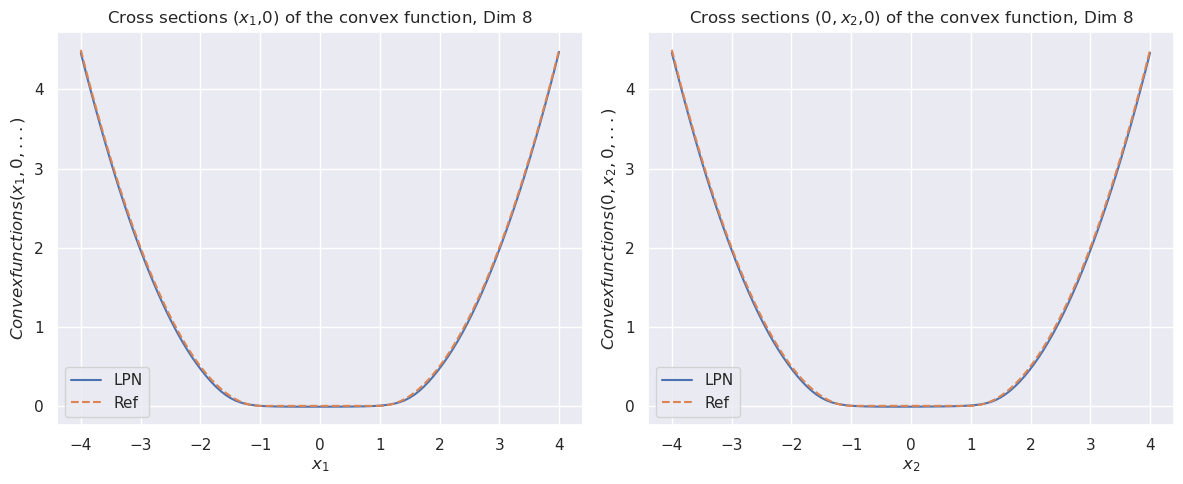
The image displays two side-by-side line charts, each showing a cross-sectional slice of an 8-dimensional convex function. Both plots compare two data series: "LPN" (solid blue line) and "Ref" (dashed orange line). The curves in both plots are nearly identical, forming symmetric, U-shaped parabolas centered at zero, indicating the function's convex nature along the plotted dimensions.
### Components/Axes
**Left Plot:**
* **Title:** `Cross sections (x₁,0) of the convex function, Dim 8`
* **Y-axis Label:** `Convexfunctions(x₁, 0, ...)`
* **X-axis Label:** `x₁`
* **X-axis Range:** -4 to 4, with major tick marks at intervals of 1 (-4, -3, -2, -1, 0, 1, 2, 3, 4).
* **Y-axis Range:** 0 to 4, with major tick marks at intervals of 1 (0, 1, 2, 3, 4).
* **Legend:** Located in the bottom-left corner of the plot area.
* `LPN`: Solid blue line.
* `Ref`: Dashed orange line.
**Right Plot:**
* **Title:** `Cross sections (0, x₂, 0) of the convex function, Dim 8`
* **Y-axis Label:** `Convexfunctions(0, x₂, 0, ...)`
* **X-axis Label:** `x₂`
* **X-axis Range:** -4 to 4, with major tick marks at intervals of 1 (-4, -3, -2, -1, 0, 1, 2, 3, 4).
* **Y-axis Range:** 0 to 4, with major tick marks at intervals of 1 (0, 1, 2, 3, 4).
* **Legend:** Located in the bottom-left corner of the plot area.
* `LPN`: Solid blue line.
* `Ref`: Dashed orange line.
### Detailed Analysis
**Left Plot (x₁ cross-section):**
* **Trend Verification:** Both the `LPN` (blue) and `Ref` (orange) lines form a symmetric, upward-opening parabola. They slope downward from the left edge (x₁ = -4) to a minimum at the center (x₁ = 0), then slope upward symmetrically to the right edge (x₁ = 4).
* **Data Points (Approximate):**
* At x₁ = -4: y ≈ 4.5
* At x₁ = -2: y ≈ 1.0
* At x₁ = 0: y ≈ 0.0 (minimum)
* At x₁ = 2: y ≈ 1.0
* At x₁ = 4: y ≈ 4.5
* The two lines (`LPN` and `Ref`) are visually indistinguishable across the entire range, indicating an extremely close match.
**Right Plot (x₂ cross-section):**
* **Trend Verification:** Identical to the left plot. Both lines form a symmetric, upward-opening parabola, sloping downward to a minimum at x₂ = 0 and then upward.
* **Data Points (Approximate):**
* At x₂ = -4: y ≈ 4.5
* At x₂ = -2: y ≈ 1.0
* At x₂ = 0: y ≈ 0.0 (minimum)
* At x₂ = 2: y ≈ 1.0
* At x₂ = 4: y ≈ 4.5
* The `LPN` and `Ref` lines are again perfectly overlapped.
### Key Observations
1. **Perfect Overlap:** The most significant observation is the near-perfect overlap between the `LPN` (solid blue) and `Ref` (dashed orange) lines in both plots. This suggests the `LPN` method reconstructs or approximates the reference convex function with very high accuracy along these cross-sections.
2. **Symmetry and Convexity:** The function exhibits clear symmetry around the origin (x₁=0 and x₂=0) and is convex, as evidenced by the U-shaped curves with a single global minimum at zero.
3. **Identical Cross-Sections:** The cross-sections along the `x₁` and `x₂` dimensions (with all other coordinates set to 0) appear to be functionally identical, suggesting the convex function may be isotropic or have similar curvature in these principal directions.
### Interpretation
The data demonstrates the effectiveness of the `LPN` method in capturing the behavior of a reference convex function in an 8-dimensional space. The plots serve as a validation, showing that the `LPN` output is virtually identical to the ground truth (`Ref`) for these specific 1D slices.
The identical, symmetric parabolic shapes imply that the underlying convex function has a quadratic-like form near its minimum, at least along the `x₁` and `x₂` axes. The perfect match between the curves is a strong indicator of model accuracy for this task. The absence of any visible deviation or outliers reinforces the conclusion that the approximation is highly reliable for these cross-sections. This type of visualization is crucial for verifying that a learned model (LPN) correctly captures the fundamental geometric properties (convexity, symmetry) of a target function.