\n
## Attention Heatmap Visualization: Word-Scene Alignment in a 3D Environment
### Overview
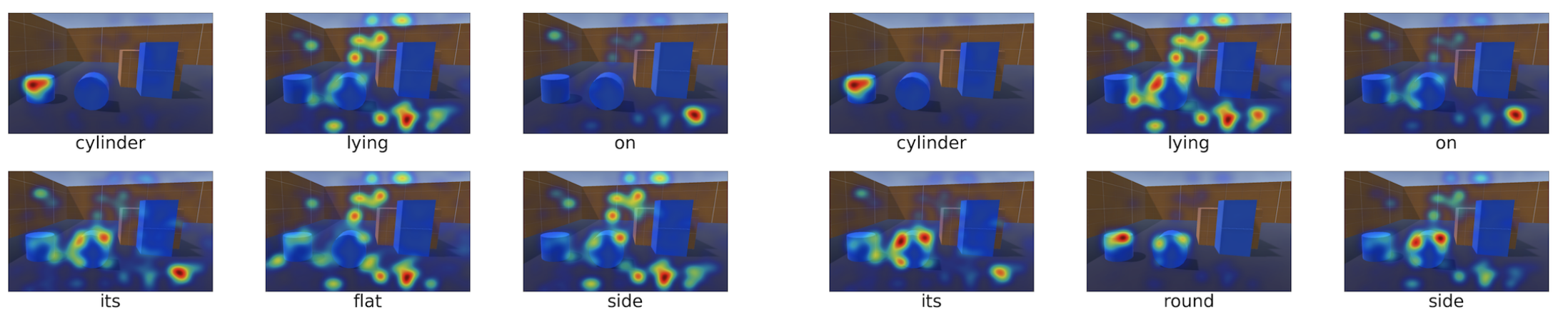
This image is a composite visualization displaying 12 attention heatmaps overlaid on a consistent 3D rendered scene. The visualization appears to demonstrate how a computational model (likely a vision-language model) allocates visual attention to different parts of a scene when processing specific words from a descriptive sentence. The panels are arranged in a 2x6 grid, with each panel showing the same base scene but a different heatmap pattern. Text labels below each panel indicate the word being processed.
### Components/Axes
* **Base Scene:** A 3D rendered room with a brownish floor and walls marked with a faint grid. The scene contains three primary blue geometric objects: a cylinder on the left, a cube in the center, and another cylinder on the right. A simple brown rectangular structure (possibly a door or panel) is visible on the back wall.
* **Heatmap Overlay:** A semi-transparent color layer indicating attention intensity. The color scale follows a standard heatmap gradient: **blue** represents low attention, transitioning through **green** and **yellow** to **red**, which represents the highest attention intensity.
* **Text Labels:** Each of the 12 panels has a single English word centered beneath it. Reading the top row left-to-right, then the bottom row left-to-right, the labels form two phrases: **"cylinder lying on cylinder lying on"** and **"its flat side its round side"**. This suggests the full sentence is likely "a cylinder lying on its flat side" and "a cylinder lying on its round side".
* **Layout:** The panels are organized in two horizontal rows of six. The top row contains the words: `cylinder`, `lying`, `on`, `cylinder`, `lying`, `on`. The bottom row contains: `its`, `flat`, `side`, `its`, `round`, `side`.
### Detailed Analysis
The heatmaps show distinct attention patterns for each word, indicating the model focuses on different visual features relevant to the word's meaning.
**Top Row Analysis:**
1. **Panel 1 (Label: `cylinder`):** Strong, concentrated red/yellow hotspot on the **leftmost blue cylinder**. Minor attention on the central cube.
2. **Panel 2 (Label: `lying`):** Scattered, diffuse attention. Multiple medium-intensity (yellow/green) hotspots appear on the **floor between objects**, on the **side of the left cylinder**, and on the **central cube**. This suggests "lying" relates to spatial orientation and contact with a surface.
3. **Panel 3 (Label: `on`):** Attention shifts to the **supporting surfaces**. Hotspots are on the **floor** directly beneath the objects and on the **top face of the central cube**.
4. **Panel 4 (Label: `cylinder`):** Similar to Panel 1, with a strong hotspot on the **left cylinder**, but also noticeable attention on the **right cylinder**.
5. **Panel 5 (Label: `lying`):** Diffuse pattern again, with hotspots on the **floor**, the **side of the right cylinder**, and the **central cube**.
6. **Panel 6 (Label: `on`):** Focus returns to **supporting surfaces**, primarily the **floor** around the base of the right cylinder and the central cube.
**Bottom Row Analysis:**
7. **Panel 7 (Label: `its`):** Distributed, low-to-medium intensity attention across **multiple objects** (left cylinder, central cube). The possessive pronoun "its" does not point to a specific feature.
8. **Panel 8 (Label: `flat`):** Very strong, focused red hotspot on the **flat top surface of the central cube** and the **flat circular top of the left cylinder**. Some attention on the flat floor.
9. **Panel 9 (Label: `side`):** Attention moves to **vertical surfaces**. Hotspots are on the **vertical side of the central cube** and the **curved side of the left cylinder**.
10. **Panel 10 (Label: `its`):** Pattern similar to Panel 7, with distributed attention on objects.
11. **Panel 11 (Label: `round`):** Strong, focused red hotspot on the **curved, round surface of the left cylinder** and the **circular top face of the right cylinder**.
12. **Panel 12 (Label: `side`):** Attention again on **vertical surfaces**, particularly the **side of the right cylinder** and the **side of the central cube**.
### Key Observations
* **Concrete Nouns vs. Abstract Words:** Concrete nouns (`cylinder`) trigger focused attention on the corresponding object. Abstract relational words (`lying`, `on`, `its`) trigger more diffuse or surface-oriented attention.
* **Adjective Specificity:** Adjectives (`flat`, `round`) trigger highly specific attention to the exact visual feature they describe (flat planes vs. curved surfaces).
* **Prepositional Focus:** The preposition `on` consistently directs attention to the supporting surfaces (floor, tops of objects) rather than the objects themselves.
* **Pronoun Ambiguity:** The possessive pronoun `its` results in the most scattered and least intense attention pattern, reflecting its referential ambiguity without further context.
* **Spatial Consistency:** The attention for `side` consistently targets vertical surfaces, whether flat (cube) or curved (cylinder).
### Interpretation
This visualization provides a Peircean investigation into the **grounding of language in visual perception**. It demonstrates how a model's internal attention mechanism maps linguistic tokens to specific visual features.
* **What the data suggests:** The model has learned a robust correspondence between words and visual concepts. It doesn't just associate "cylinder" with a blob of pixels; it understands that "flat" refers to a planar surface property and "round" refers to a curvature property, applying these correctly to different objects.
* **How elements relate:** The sequence of heatmaps acts as a "visual parsing" of the sentence. The shift in attention from object (`cylinder`) to spatial relation (`lying on`) to object property (`flat side`) mirrors the syntactic and semantic structure of the language. The repetition in the grid (two `cylinder`, two `lying`, etc.) shows the model's attention is context-sensitive; the second `cylinder` panel includes the right cylinder, possibly because the sentence structure implies a comparison between two states (flat side vs. round side).
* **Notable anomalies:** The attention for the first `lying` (Panel 2) is notably more scattered than for the second `lying` (Panel 5). This could indicate a difference in processing the phrase "lying on" when followed by "its flat side" versus "its round side," suggesting the model's interpretation of the scene is influenced by the full predicate.
* **Why it matters:** This type of analysis is crucial for **explainable AI (XAI)**. It moves beyond treating neural networks as black boxes and allows us to audit whether the model's "reasoning" aligns with human intuition. The clear, semantically sensible patterns here suggest the model has developed a meaningful internal representation that bridges vision and language, which is a foundational capability for advanced AI agents that need to understand and interact with the physical world.