\n
## Image Analysis: Visualization of Attention Maps
### Overview
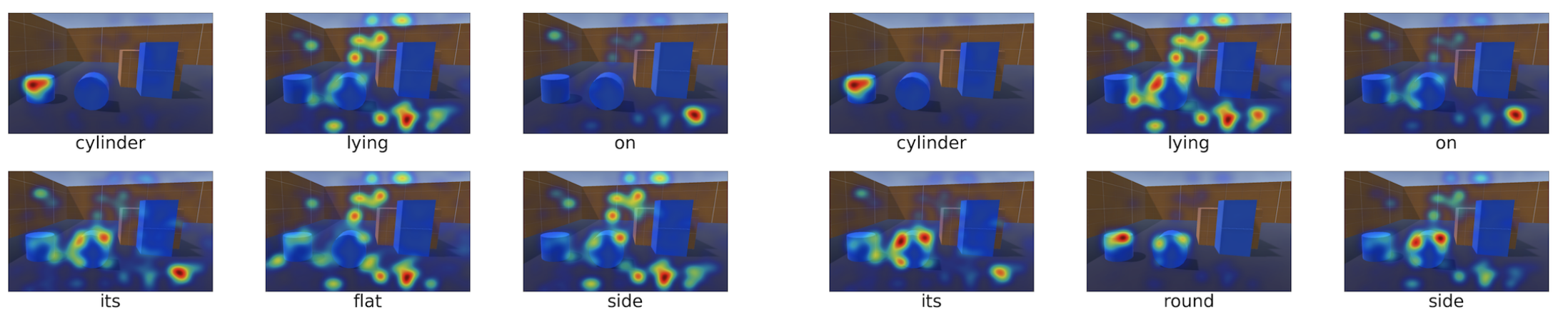
The image presents a 3x3 grid of visualizations, each depicting a scene with a blue block arrangement and a heatmap overlaid. The heatmap appears to represent attention, highlighting areas of focus. Each visualization is labeled with a description of the object and its orientation. The visualizations seem to demonstrate how an attention mechanism responds to different object shapes and orientations.
### Components/Axes
There are no explicit axes or legends in the traditional sense. The "axes" are defined by the scene elements (blocks, floor) and the attention heatmap itself. The labels below each image act as categorical descriptors. The categories are:
* **Object Shape:** cylinder, cylinder, cylinder
* **Orientation:** lying, lying, its
* **Position/View:** on, on, flat
* **Object Shape:** cylinder, cylinder, cylinder
* **Orientation:** lying, lying, its
* **Position/View:** on, round, side
### Detailed Analysis or Content Details
Each visualization shows a scene with a few blue blocks of varying sizes arranged on a surface. A heatmap is overlaid, with warmer colors (red, yellow) indicating higher attention and cooler colors (blue) indicating lower attention.
* **Row 1, Column 1 ("cylinder lying on"):** The heatmap focuses strongly on the top surface of the cylinder and the area where it contacts the surface. Attention is also present on the front edge.
* **Row 1, Column 2 ("cylinder lying on"):** Similar to the first, with strong attention on the top surface and contact point.
* **Row 1, Column 3 ("cylinder its on"):** Attention is focused on the side of the cylinder.
* **Row 2, Column 1 ("cylinder lying flat"):** Attention is distributed across the top surface of the cylinder.
* **Row 2, Column 2 ("cylinder lying round"):** Attention is focused on the curved surface of the cylinder.
* **Row 2, Column 3 ("cylinder its side"):** Attention is focused on the side of the cylinder.
The intensity of the heatmap varies across the visualizations, but generally, the areas of highest attention correspond to the visible surfaces of the cylinder.
### Key Observations
* The attention mechanism appears to be sensitive to the orientation of the cylinder. When the cylinder is lying flat, attention is focused on the top surface. When it's standing, attention is focused on the side.
* The heatmap consistently highlights the contact points between the cylinder and the surface.
* The attention is not uniform across the entire object; it's concentrated on the visible surfaces.
* There is a consistent pattern of attention focusing on the edges and corners of the cylinder.
### Interpretation
This image likely demonstrates the behavior of an attention mechanism in a computer vision system. The attention maps visualize which parts of the image the system is focusing on when processing the scene. The data suggests that the attention mechanism is learning to identify and focus on the salient features of the cylinder, such as its visible surfaces and contact points.
The variations in attention based on orientation indicate that the system is able to adapt its focus based on the object's pose. This is crucial for tasks like object recognition and scene understanding. The consistent attention on contact points suggests the system may be learning about physical stability or support relationships.
The image does not provide quantitative data, but the qualitative patterns in the attention maps offer insights into how the system is perceiving and interpreting the scene. The visualizations are useful for debugging and understanding the behavior of attention mechanisms. The fact that the attention is not uniformly distributed suggests that the system is not simply processing the entire image equally, but rather selectively focusing on the most relevant parts.