## Flowchart: Text Generation Process with Draft and Target Models
### Overview
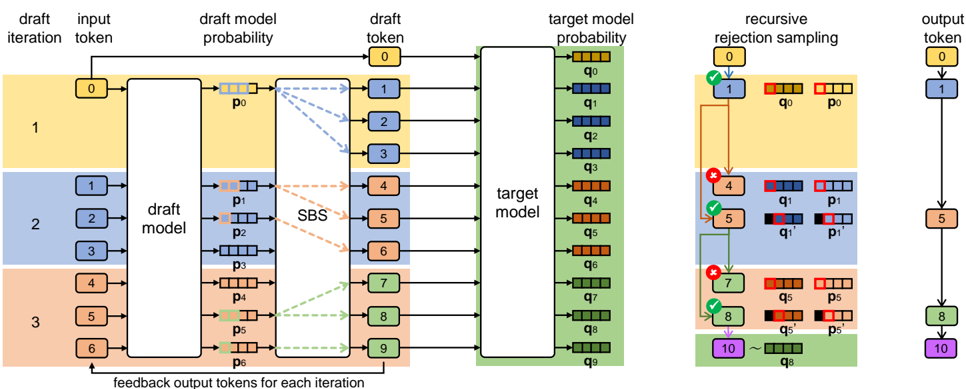
The image depicts a multi-stage text generation pipeline involving draft models, target models, and recursive rejection sampling. The process includes iterative refinement through feedback loops and probabilistic token selection.
### Components/Axes
1. **Left Section (Draft Iterations)**
- **Draft Iteration Blocks**: Three horizontal bands (yellow, blue, orange) labeled 1, 2, 3
- **Input Tokens**: Labeled 0-6 with color-coded blocks (yellow: 0, blue: 1-3, orange: 4-6)
- **Draft Model Probabilities**: p₀-p₆ with dashed arrows connecting to draft model
- **Feedback Output Tokens**: p₀-p₆ with green arrows pointing to target model
2. **Center Section (Target Model)**
- **Target Model Probabilities**: q₀-q₉ with colored blocks (yellow: q₀, blue: q₁-q₃, green: q₄-q₉)
- **Recursive Rejection Sampling**:
- Checkmarks (✓) and X marks (✗) indicating token acceptance/rejection
- Color-coded blocks matching draft/target model probabilities
3. **Right Section (Output)**
- **Output Tokens**: Labeled 0, 1, 5, 8, 10 with color progression (yellow → blue → green → purple)
- **Flow Arrows**: Connect rejection sampling to final output
### Detailed Analysis
1. **Draft Model Process**
- Input tokens (0-6) are processed through three draft iterations
- Each iteration generates draft model probabilities (p₀-p₆)
- Feedback loop returns probabilities to target model
2. **Target Model Evaluation**
- Target model generates probabilities q₀-q₉ for each token
- Recursive rejection sampling compares draft (p) and target (q) probabilities
- Acceptance (✓) occurs when draft and target probabilities align (e.g., p₁/q₁)
3. **Output Generation**
- Selected tokens (0,1,5,8,10) show progressive color change from yellow to purple
- Output sequence demonstrates iterative refinement through rejection sampling
### Key Observations
1. **Iterative Refinement**: Three draft iterations suggest progressive text generation improvement
2. **Probabilistic Gating**: Rejection sampling uses both draft and target model probabilities for token selection
3. **Color Coding**:
- Yellow (0-3) → Blue (4-6) → Green (7-9) → Purple (10) indicates increasing confidence
- Red X marks show rejected tokens (e.g., token 4 rejected in iteration 2)
4. **Feedback Mechanism**: Green arrows show continuous feedback from draft to target model
### Interpretation
This diagram represents a sophisticated text generation system combining:
1. **Draft Models**: For initial token generation with iterative refinement
2. **Target Models**: As quality benchmarks for token evaluation
3. **Rejection Sampling**: To ensure output quality through probabilistic comparison
The system appears to implement a reinforcement learning from human feedback (RLHF)-like architecture, where:
- Draft models generate candidate tokens
- Target models evaluate quality
- Rejection sampling optimizes the final output sequence
- Feedback loops enable continuous model improvement
The color progression and token selection pattern suggest a mechanism for balancing creativity (diverse draft tokens) with quality control (target model filtering), typical in modern language model architectures.