## Photograph: Hands Holding Polaroid Image
### Overview
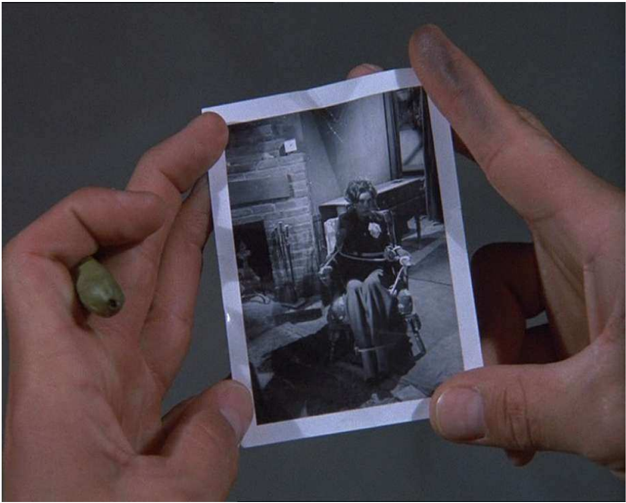
The image depicts two human hands holding a Polaroid photograph. The left hand grasps the photo with a small, green, oval-shaped object (possibly a bead or capsule) between the thumb and index finger. The right hand is visibly dirty, with smudged fingertips. The Polaroid itself shows a black-and-white scene of a person seated in a wheelchair in a room with a brick fireplace and a wooden cabinet. No textual elements, charts, diagrams, or data tables are present in the image.
### Components/Axes
N/A (No textual, numerical, or diagrammatic elements detected).
### Detailed Analysis
- **Hands**:
- Left hand: Clean, with short, unpainted nails. The green object is held between the thumb and index finger, positioned near the center of the photo.
- Right hand: Dirty, with darkened fingertips (possibly from soot, ink, or dirt). The thumb and index finger frame the Polaroid.
- **Polaroid Content**:
- Black-and-white photograph of a person in a wheelchair, facing slightly left. The individual wears dark clothing with a light-colored patch on the chest.
- Background: A brick fireplace with a dark hearth, a wooden cabinet, and a window with curtains. The room appears dimly lit.
### Key Observations
1. The green object in the left hand is distinct but lacks identifiable markings or context.
2. The dirt on the right hand suggests recent handling of a messy surface or material.
3. The Polaroid’s subject (wheelchair user) and setting (fireplace room) evoke a domestic or historical context.
### Interpretation
The image likely serves as a narrative or symbolic element rather than a data-driven visualization. The juxtaposition of the clean left hand (holding the photo) and the dirty right hand (holding the object) may imply themes of contrast—such as purity vs. corruption, memory vs. reality, or innocence vs. guilt. The Polaroid’s black-and-white aesthetic and the wheelchair user’s posture could symbolize vulnerability or introspection. The green object’s presence is ambiguous but might represent a key to understanding the scene (e.g., a clue in a mystery, a symbolic token, or a mundane detail overlooked in the narrative).
No factual or numerical data is present to analyze. The image relies on visual symbolism and contextual interpretation.