## Diagram: Recurrent Neural Network (RNN) Cell Architecture
### Overview
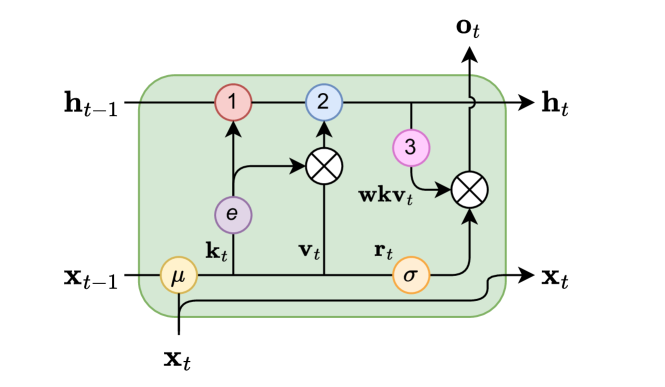
This diagram illustrates the computational flow of a standard RNN cell, showing how hidden states (`h_t-1`, `h_t`), inputs (`x_t-1`, `x_t`), and outputs (`o_t`) interact through gating mechanisms. The diagram includes activation functions, weights, and element-wise operations.
### Components/Axes
- **Inputs**:
- `x_t-1` (previous input) and `x_t` (current input), represented as yellow and orange circles, respectively.
- **Hidden States**:
- `h_t-1` (previous hidden state) and `h_t` (current hidden state), labeled in black text.
- **Gates**:
- **Input Gate (1)**: Red circle, computes `σ(wkv_t * [h_t-1; x_t])`.
- **Forget Gate (2)**: Blue circle, computes `σ(wkv_t * [h_t-1; x_t])`.
- **Output Gate (3)**: Pink circle, computes `σ(wkv_t * [h_t-1; x_t])`.
- **Activation Functions**:
- `σ` (sigmoid, orange circle), `μ` (mean, yellow circle), `e` (element-wise, purple circle).
- **Weights**:
- `wkv_t` (shared weights for gates), labeled in black text.
- **Output**:
- `o_t` (current output), labeled in black text.
### Detailed Analysis
1. **Flow of Information**:
- `h_t-1` and `x_t-1` are inputs to the RNN cell.
- `x_t` is combined with `h_t-1` via element-wise operations (`e`) and weighted sums (`wkv_t`).
- Gates (1, 2, 3) modulate the flow of information using sigmoid (`σ`) and mean (`μ`) activation functions.
- The output `o_t` is derived from the weighted combination of gate outputs.
2. **Key Equations**:
- Input Gate: `σ(wkv_t * [h_t-1; x_t])`
- Forget Gate: `σ(wkv_t * [h_t-1; x_t])`
- Output Gate: `σ(wkv_t * [h_t-1; x_t])`
### Key Observations
- **Gating Mechanism**: The three gates (input, forget, output) control the retention and update of information in the hidden state.
- **Activation Functions**:
- `σ` (sigmoid) ensures outputs are between 0 and 1, critical for gate operations.
- `μ` (mean) and `e` (element-wise) handle input transformations.
- **Weight Sharing**: `wkv_t` is shared across all gates, reducing parameter count.
### Interpretation
This diagram represents a **Gated Recurrent Unit (GRU)** or **Long Short-Term Memory (LSTM)** cell, depending on the specific gating logic. The gates address the vanishing gradient problem by regulating information flow:
- The **forget gate** (`2`) decides what information to discard from the cell state.
- The **input gate** (`1`) determines what new information to store.
- The **output gate** (`3`) controls what parts of the cell state to output.
The use of shared weights (`wkv_t`) and activation functions (`σ`, `μ`, `e`) ensures efficient computation while maintaining temporal dependencies. This architecture is foundational for sequence modeling tasks like language processing and time-series prediction.
**Note**: No numerical values or trends are present in the diagram; it is a structural representation of an RNN cell.