## Hierarchical Diagram: Climatology and Atmospheric Physics Syllabus Structure
### Overview
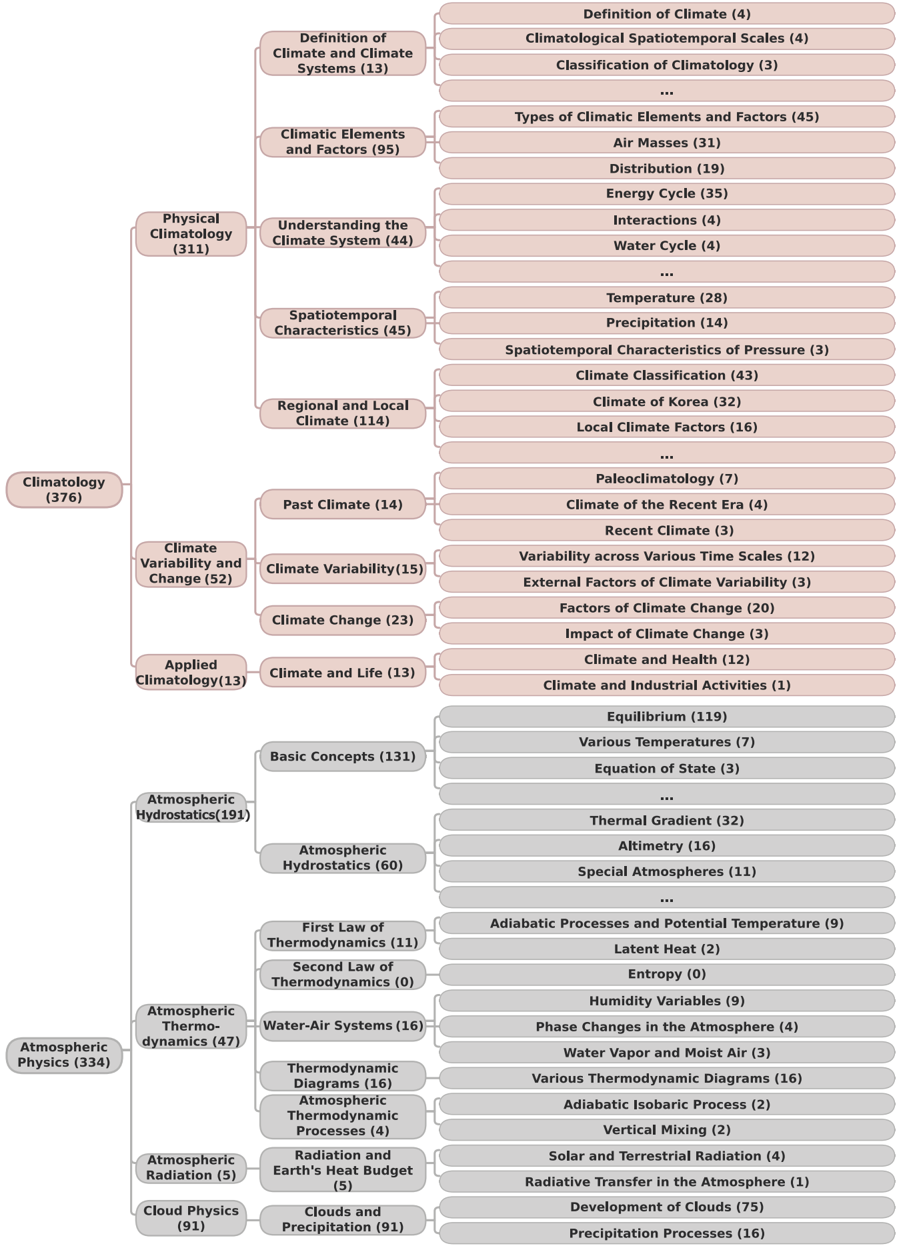
The image depicts a hierarchical diagram organizing topics in climatology and atmospheric physics, likely representing sections or chapters in a textbook or course syllabus. The structure is divided into two main branches: **Climatology** (left) and **Atmospheric Physics** (right), each containing subcategories with numerical values in parentheses, possibly indicating page numbers, section IDs, or topic weights.
---
### Components/Axes
- **Main Branches**:
- **Climatology** (376 total subtopics)
- **Atmospheric Physics** (334 total subtopics)
- **Subcategories**:
- Each main branch contains 3–5 hierarchical levels of subtopics, with numerical values in parentheses (e.g., "Definition of Climate and Climate Systems (13)").
---
### Detailed Analysis
#### Climatology (376)
1. **Physical Climatology (311)**
- Definition of Climate and Climate Systems (13)
- Climatic Elements and Factors (95)
- Air Masses (31)
- Distribution (19)
- Energy Cycle (35)
- Interactions (4)
- Water Cycle (4)
- Understanding the Climate System (44)
- Spatiotemporal Characteristics (45)
- Spatiotemporal Characteristics of Pressure (3)
- Regional and Local Climate (114)
- Climate of Korea (32)
- Local Climate Factors (16)
- Past Climate (14)
- Paleoclimatology (7)
- Climate of the Recent Era (4)
- Recent Climate (3)
- Climate Variability and Change (52)
- Climate Variability (15)
- Variability across Various Time Scales (12)
- External Factors of Climate Variability (3)
- Climate Change (23)
- Factors of Climate Change (20)
- Impact of Climate Change (3)
- Applied Climatology (13)
- Climate and Life (13)
- Climate and Health (12)
- Climate and Industrial Activities (1)
2. **Climate and Life (13)**
- Climate and Health (12)
- Climate and Industrial Activities (1)
#### Atmospheric Physics (334)
1. **Atmospheric Hydrostatics (191)**
- Basic Concepts (131)
- Equilibrium (119)
- Various Temperatures (7)
- Equation of State (3)
- Thermal Gradient (32)
- Altimetry (16)
- Special Atmospheres (11)
- Atmospheric Hydrostatics (60)
- First Law of Thermodynamics (11)
- Adiabatic Processes and Potential Temperature (9)
- Latent Heat (2)
- Second Law of Thermodynamics (0)
- Entropy (0)
- Humidity Variables (9)
2. **Atmospheric Thermodynamics (47)**
- Water-Air Systems (16)
- Phase Changes in the Atmosphere (4)
- Water Vapor and Moist Air (3)
- Thermodynamic Diagrams (16)
- Various Thermodynamic Diagrams (16)
- Adiabatic Isobaric Process (2)
- Vertical Mixing (2)
- Radiation and Earth’s Heat Budget (5)
- Solar and Terrestrial Radiation (4)
- Radiative Transfer in the Atmosphere (1)
- Cloud Physics (91)
- Development of Clouds (75)
- Precipitation Processes (16)
---
### Key Observations
- **Hierarchical Depth**: Subtopics are nested 3–4 levels deep, indicating detailed segmentation (e.g., "Climate Classification" under Physical Climatology).
- **Numerical Values**: Parenthetical numbers likely represent page counts, section IDs, or topic prominence (e.g., "Climate Change (23)" suggests 23 pages or sections).
- **Asymmetry**: Climatology has more subtopics (376 vs. 334), reflecting broader coverage in climate-related fields.
- **Interdisciplinary Links**: Topics like "Climate and Health" (12) and "Radiative Transfer" (1) highlight connections between disciplines.
---
### Interpretation
The diagram illustrates a comprehensive curriculum or textbook structure, emphasizing:
1. **Climatology’s Breadth**: Focus on variability, change, and applied aspects (e.g., industrial impacts).
2. **Atmospheric Physics’ Technicality**: Detailed coverage of thermodynamics, radiation, and cloud processes.
3. **Quantitative Segmentation**: Numerical values suggest a methodical approach to topic allocation, possibly for educational planning or content organization.
The hierarchy implies a logical progression from foundational concepts (e.g., "Basic Concepts" in Atmospheric Hydrostatics) to specialized applications (e.g., "Climate and Industrial Activities"). The absence of a legend or color-coding simplifies interpretation but limits visual differentiation between subtopics.