## Line Chart: Solar-10.7B-Chat Loss vs. Epoch
### Overview
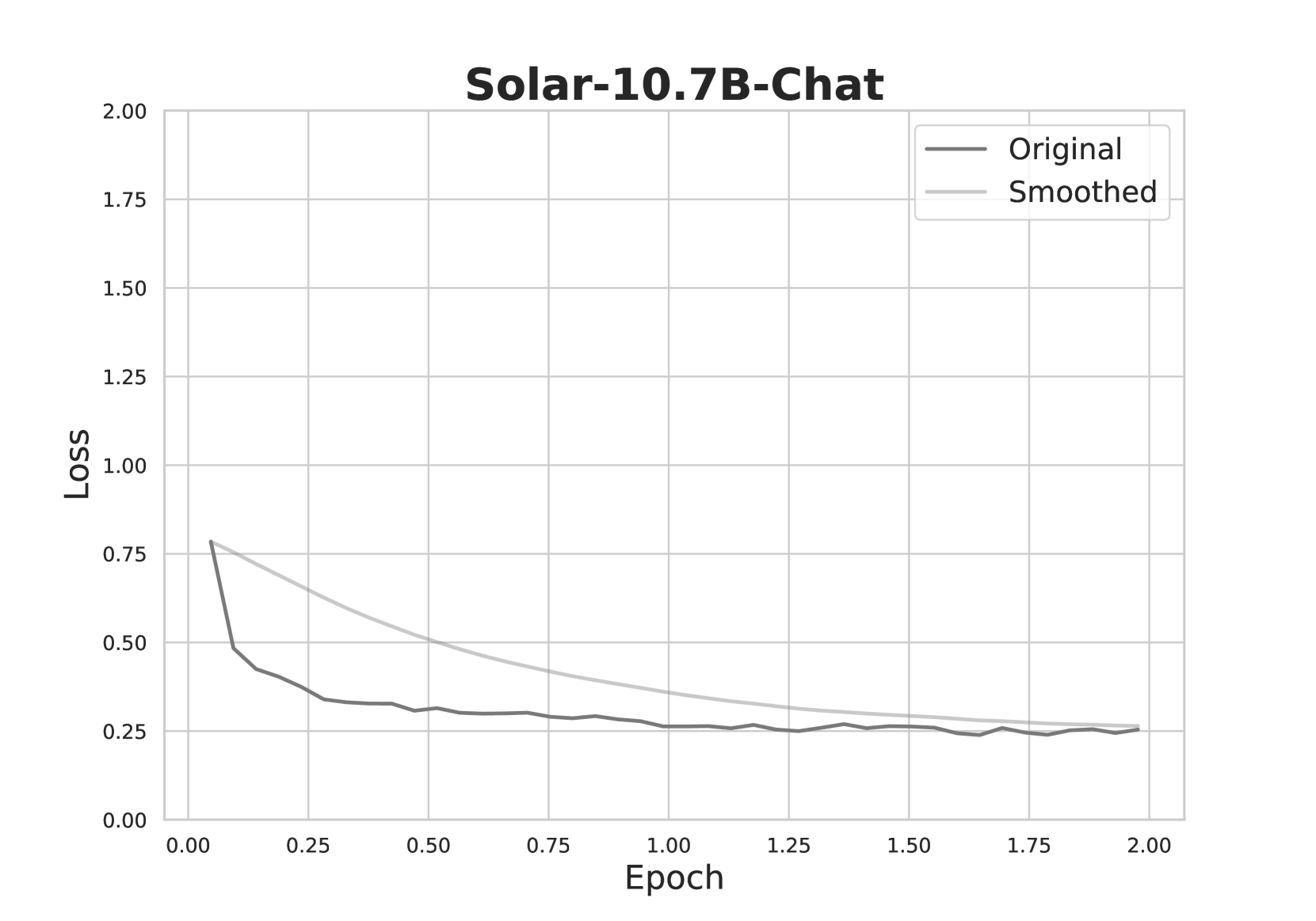
This image presents a line chart illustrating the relationship between 'Loss' and 'Epoch' for a model named "Solar-10.7B-Chat". Two data series are plotted: 'Original' and 'Smoothed', representing different processing methods applied to the loss data. The chart aims to visualize how the loss function changes over training epochs.
### Components/Axes
* **Title:** Solar-10.7B-Chat
* **X-axis:** Epoch (ranging from approximately 0.00 to 2.00)
* **Y-axis:** Loss (ranging from approximately 0.00 to 2.00)
* **Legend:**
* Original (Black line)
* Smoothed (Gray line)
* **Gridlines:** A light gray grid is present, aiding in reading values.
### Detailed Analysis
The chart displays two lines representing the loss function over epochs.
**Original Line (Black):**
The 'Original' line starts at approximately 0.75 loss at Epoch 0.00. It exhibits a steep downward slope initially, decreasing to around 0.30 loss by Epoch 0.25. The slope then gradually decreases, leveling off around 0.25 loss between Epochs 0.75 and 2.00.
Approximate data points:
* Epoch 0.00: Loss ≈ 0.75
* Epoch 0.25: Loss ≈ 0.30
* Epoch 0.50: Loss ≈ 0.27
* Epoch 0.75: Loss ≈ 0.26
* Epoch 1.00: Loss ≈ 0.25
* Epoch 1.25: Loss ≈ 0.25
* Epoch 1.50: Loss ≈ 0.25
* Epoch 1.75: Loss ≈ 0.25
* Epoch 2.00: Loss ≈ 0.25
**Smoothed Line (Gray):**
The 'Smoothed' line begins at approximately 0.65 loss at Epoch 0.00. It also shows a decreasing trend, but it is less steep than the 'Original' line. The smoothed line reaches around 0.20 loss by Epoch 0.25 and continues to decrease, stabilizing around 0.20 loss between Epochs 1.00 and 2.00.
Approximate data points:
* Epoch 0.00: Loss ≈ 0.65
* Epoch 0.25: Loss ≈ 0.20
* Epoch 0.50: Loss ≈ 0.20
* Epoch 0.75: Loss ≈ 0.21
* Epoch 1.00: Loss ≈ 0.20
* Epoch 1.25: Loss ≈ 0.20
* Epoch 1.50: Loss ≈ 0.20
* Epoch 1.75: Loss ≈ 0.20
* Epoch 2.00: Loss ≈ 0.20
### Key Observations
* Both the 'Original' and 'Smoothed' loss curves demonstrate a decreasing trend, indicating that the model is learning and improving over epochs.
* The 'Smoothed' line consistently shows lower loss values than the 'Original' line, suggesting that the smoothing process reduces the variance in the loss function.
* The rate of loss reduction decreases over time for both lines, indicating diminishing returns from further training.
* The 'Original' line appears to fluctuate more than the 'Smoothed' line, which is expected given the smoothing process.
### Interpretation
The chart illustrates the training process of the Solar-10.7B-Chat model. The loss function, representing the error between the model's predictions and the actual values, decreases as the model is trained for more epochs. The 'Smoothed' line suggests that applying a smoothing technique to the loss data can provide a more stable and less noisy representation of the training progress. The convergence of both lines towards a stable loss value indicates that the model is approaching a point of diminishing returns, and further training may not significantly improve performance. The difference between the two lines could be due to the smoothing algorithm used, which likely averages out short-term fluctuations in the loss function. This type of visualization is crucial for monitoring model training, identifying potential issues (e.g., overfitting), and determining when to stop training.