## Bar Chart: Method Preference
### Overview
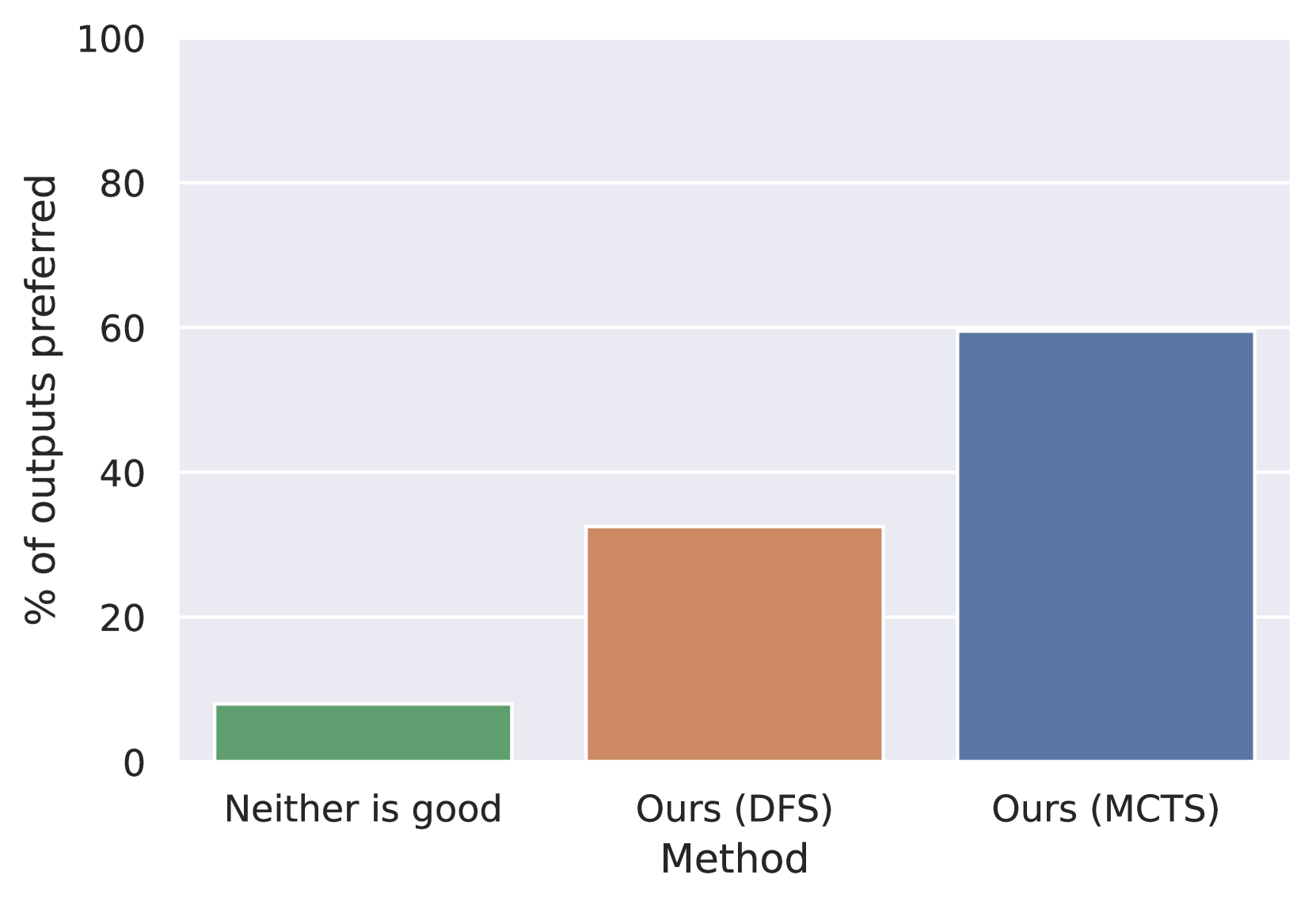
This image is a bar chart that displays the percentage of outputs preferred for different methods. The chart has a vertical axis representing the "% of outputs preferred" and a horizontal axis representing the "Method". There are three bars, each corresponding to a different method.
### Components/Axes
* **Vertical Axis Title:** "% of outputs preferred"
* **Vertical Axis Scale:** Ranges from 0 to 100, with major tick marks at 0, 20, 40, 60, 80, and 100.
* **Horizontal Axis Title:** "Method"
* **Horizontal Axis Categories:**
* "Neither is good"
* "Ours (DFS)"
* "Ours (MCTS)"
### Detailed Analysis
The chart displays the following data points:
* **"Neither is good" Method:**
* **Color:** Green
* **Trend:** This bar is the shortest, indicating the lowest preference.
* **Value:** Approximately 8% of outputs were preferred for this method.
* **"Ours (DFS)" Method:**
* **Color:** Orange/Brown
* **Trend:** This bar is taller than "Neither is good" but shorter than "Ours (MCTS)", indicating a moderate preference.
* **Value:** Approximately 32% of outputs were preferred for this method.
* **"Ours (MCTS)" Method:**
* **Color:** Blue
* **Trend:** This bar is the tallest, indicating the highest preference.
* **Value:** Approximately 59% of outputs were preferred for this method.
### Key Observations
* The "Ours (MCTS)" method is the most preferred, with nearly 60% of outputs being preferred.
* The "Neither is good" category has the lowest preference, suggesting that the methods presented are generally considered better than no good output.
* There is a significant difference in preference between "Ours (DFS)" and "Ours (MCTS)", with MCTS being substantially more preferred.
### Interpretation
This bar chart demonstrates a clear preference for the "Ours (MCTS)" method over the "Ours (DFS)" method and the "Neither is good" baseline. The data suggests that the MCTS approach is significantly more effective or desirable in generating preferred outputs compared to the DFS approach. The fact that "Neither is good" has a low preference further reinforces the idea that the proposed methods, particularly MCTS, offer a valuable improvement. The visual representation clearly highlights the superiority of "Ours (MCTS)" by its dominant bar height.