\n
## Bar Chart: Preference Comparison of Methods
### Overview
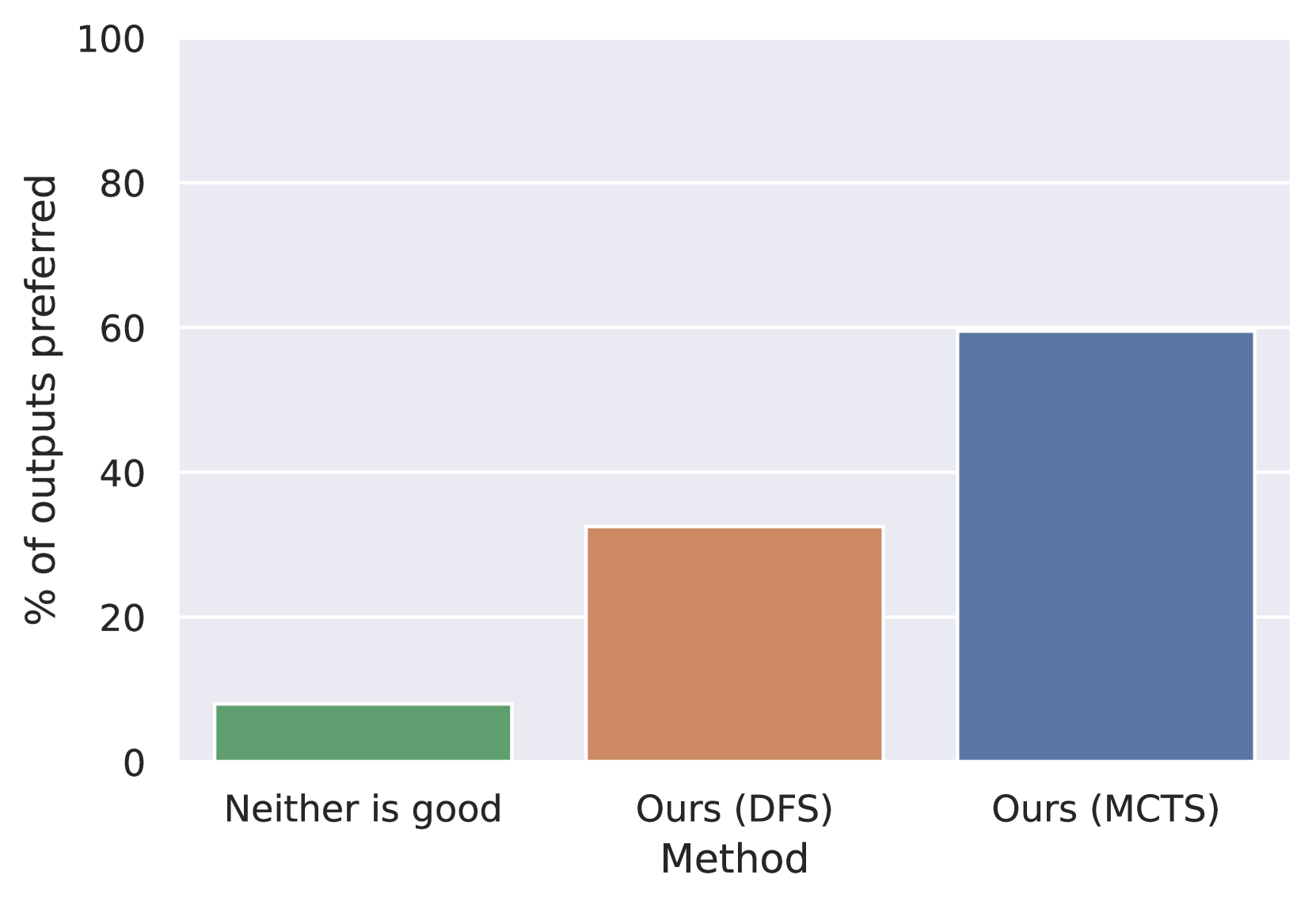
This bar chart compares the percentage of outputs preferred for three different options: "Neither is good", "Ours (DFS) Method", and "Ours (MCTS) Method". The y-axis represents the percentage of outputs preferred, ranging from 0 to 100. The x-axis represents the different methods being compared.
### Components/Axes
* **X-axis Label:** "Method"
* **Y-axis Label:** "% of outputs preferred"
* **X-axis Categories:** "Neither is good", "Ours (DFS) Method", "Ours (MCTS) Method"
* **Y-axis Scale:** 0, 20, 40, 60, 80, 100
* **Bar Colors:**
* "Neither is good": Green
* "Ours (DFS) Method": Brown/Orange
* "Ours (MCTS) Method": Blue
### Detailed Analysis
* **"Neither is good"**: The green bar is short, indicating a low preference. The approximate height of the bar is 8% (± 2%).
* **"Ours (DFS) Method"**: The brown/orange bar is significantly taller than the "Neither is good" bar. The approximate height of the bar is 34% (± 2%).
* **"Ours (MCTS) Method"**: The blue bar is the tallest, indicating the highest preference. The approximate height of the bar is 60% (± 2%).
### Key Observations
The "Ours (MCTS) Method" is clearly preferred over the other two options, with approximately 60% of outputs being favored. The "Ours (DFS) Method" is preferred over "Neither is good", with approximately 34% preference. "Neither is good" receives the lowest preference, at around 8%.
### Interpretation
The data suggests that the "Ours (MCTS)" method performs significantly better than both the "Ours (DFS)" method and the scenario where neither output is considered good. This indicates that the MCTS approach yields more desirable results in whatever task these methods are applied to. The relatively low preference for "Neither is good" suggests that the outputs generated by the methods are generally better than having no output at all. The difference between DFS and MCTS suggests that the MCTS method is more effective at finding optimal or preferred solutions. The chart provides a clear comparative assessment of the three options, highlighting the superiority of the MCTS method.