## System Diagram: Reasoning and Memory Architecture
### Overview
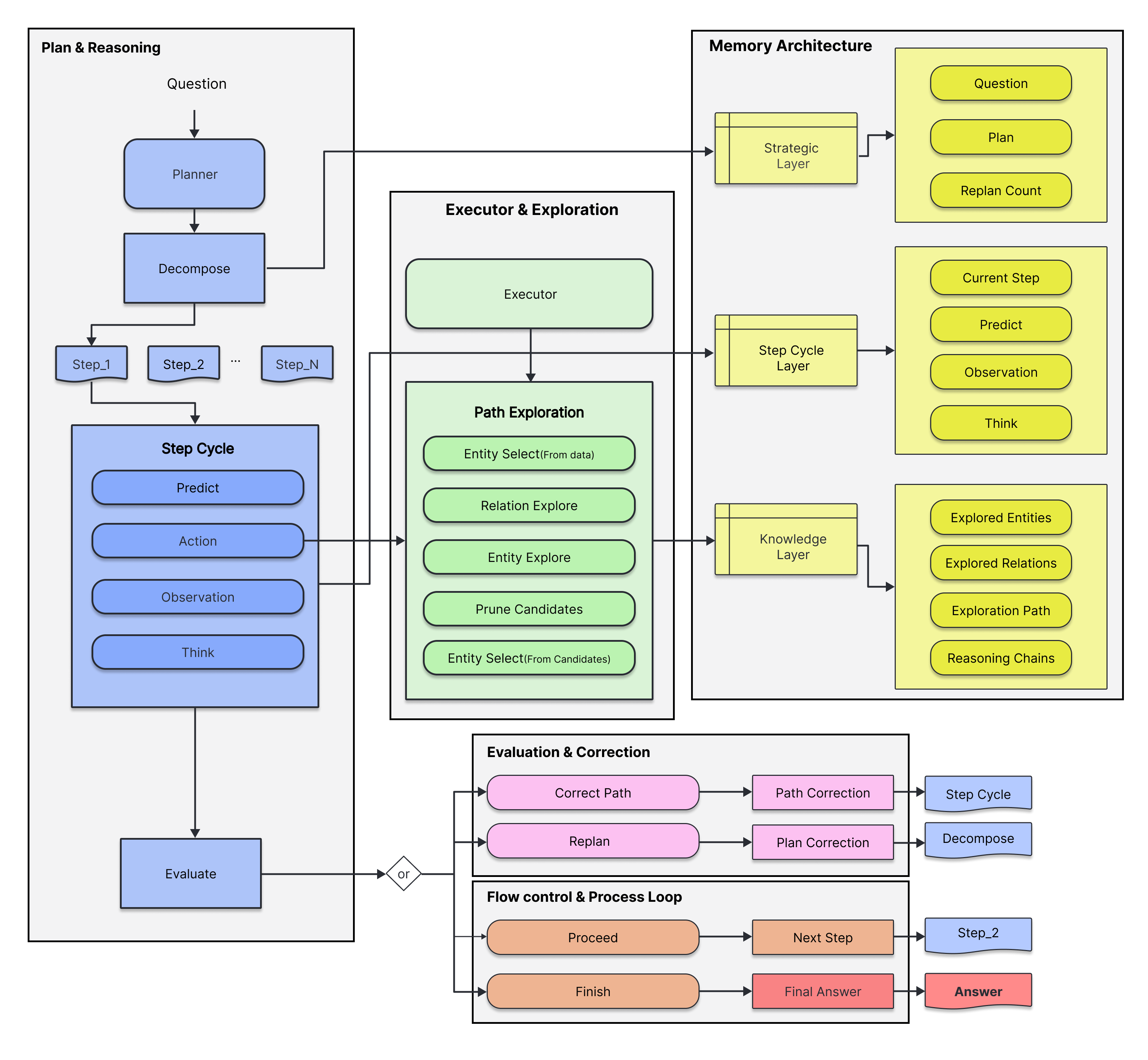
The image is a system diagram illustrating the flow of information and processes within a reasoning and memory architecture. It outlines the steps involved in planning, reasoning, executing, exploring, evaluating, and correcting, as well as the memory architecture that supports these processes. The diagram is divided into several key components: Plan & Reasoning, Executor & Exploration, Memory Architecture, Evaluation & Correction, and Flow Control & Process Loop.
### Components/Axes
* **Plan & Reasoning (Top-Left)**: This section describes the initial stages of the process, starting with a "Question" that leads to a "Planner" and subsequent "Decompose" step. The decomposed steps are represented as "Step_1", "Step_2", ..., "Step_N". A "Step Cycle" follows, consisting of "Predict", "Action", "Observation", and "Think" stages. Finally, the process leads to an "Evaluate" stage. All boxes in this section are blue.
* **Executor & Exploration (Center)**: This section focuses on the execution and exploration of paths. It includes an "Executor" and a "Path Exploration" module. The "Path Exploration" module consists of "Entity Select(From data)", "Relation Explore", "Entity Explore", "Prune Candidates", and "Entity Select(From Candidates)". All boxes in this section are green.
* **Memory Architecture (Top-Right)**: This section describes the memory layers involved, including "Strategic Layer", "Step Cycle Layer", and "Knowledge Layer". The "Strategic Layer" contains "Question", "Plan", and "Replan Count". The "Step Cycle Layer" contains "Current Step", "Predict", "Observation", and "Think". The "Knowledge Layer" contains "Explored Entities", "Explored Relations", "Exploration Path", and "Reasoning Chains". All boxes in this section are yellow.
* **Evaluation & Correction (Bottom-Center)**: This section describes the evaluation and correction mechanisms. It includes "Correct Path" and "Replan", which lead to "Path Correction" and "Plan Correction", respectively. The "Correct Path" leads to "Step Cycle" and the "Replan" leads to "Decompose". All boxes in this section are pink.
* **Flow Control & Process Loop (Bottom-Center)**: This section describes the flow control and process loop. It includes "Proceed" and "Finish", which lead to "Next Step" and "Final Answer", respectively. The "Proceed" leads to "Step_2" and the "Finish" leads to "Answer". All boxes in this section are orange, except for "Final Answer" and "Answer" which are red.
### Detailed Analysis or Content Details
* **Plan & Reasoning**:
* The process starts with a "Question" (blue box).
* The "Planner" (blue box) processes the question.
* The "Decompose" (blue box) breaks down the plan into steps.
* "Step_1", "Step_2", ..., "Step_N" (blue boxes) represent the decomposed steps.
* The "Step Cycle" (blue box) involves "Predict", "Action", "Observation", and "Think".
* The process ends with "Evaluate" (blue box).
* **Executor & Exploration**:
* The "Executor" (green box) executes the plan.
* "Path Exploration" (green box) involves:
* "Entity Select(From data)"
* "Relation Explore"
* "Entity Explore"
* "Prune Candidates"
* "Entity Select(From Candidates)"
* **Memory Architecture**:
* "Strategic Layer" (yellow box) stores "Question", "Plan", and "Replan Count".
* "Step Cycle Layer" (yellow box) stores "Current Step", "Predict", "Observation", and "Think".
* "Knowledge Layer" (yellow box) stores "Explored Entities", "Explored Relations", "Exploration Path", and "Reasoning Chains".
* **Evaluation & Correction**:
* "Correct Path" (pink box) leads to "Path Correction" (pink box) and "Step Cycle" (blue box).
* "Replan" (pink box) leads to "Plan Correction" (pink box) and "Decompose" (blue box).
* **Flow Control & Process Loop**:
* "Proceed" (orange box) leads to "Next Step" (orange box) and "Step_2" (blue box).
* "Finish" (orange box) leads to "Final Answer" (red box) and "Answer" (red box).
### Key Observations
* The diagram illustrates a cyclical process with feedback loops.
* The "Memory Architecture" section highlights the different layers of memory used in the process.
* The "Evaluation & Correction" section shows how the system corrects itself based on the evaluation of the results.
* The color-coding helps to distinguish between different types of processes and data.
### Interpretation
The diagram represents a sophisticated system for automated reasoning and problem-solving. The "Plan & Reasoning" section outlines the initial planning and decomposition stages, while the "Executor & Exploration" section focuses on the execution and exploration of potential solutions. The "Memory Architecture" provides the necessary context and knowledge for the system to operate effectively. The "Evaluation & Correction" section ensures that the system can learn from its mistakes and improve its performance over time. The "Flow Control & Process Loop" manages the overall flow of the process, ensuring that it reaches a final answer. The system is designed to handle complex problems by breaking them down into smaller, more manageable steps, and by using a combination of planning, execution, and learning.