## Diagram Type: Multi-Component Process Flowchart (AI/Reasoning System Architecture)
### Overview
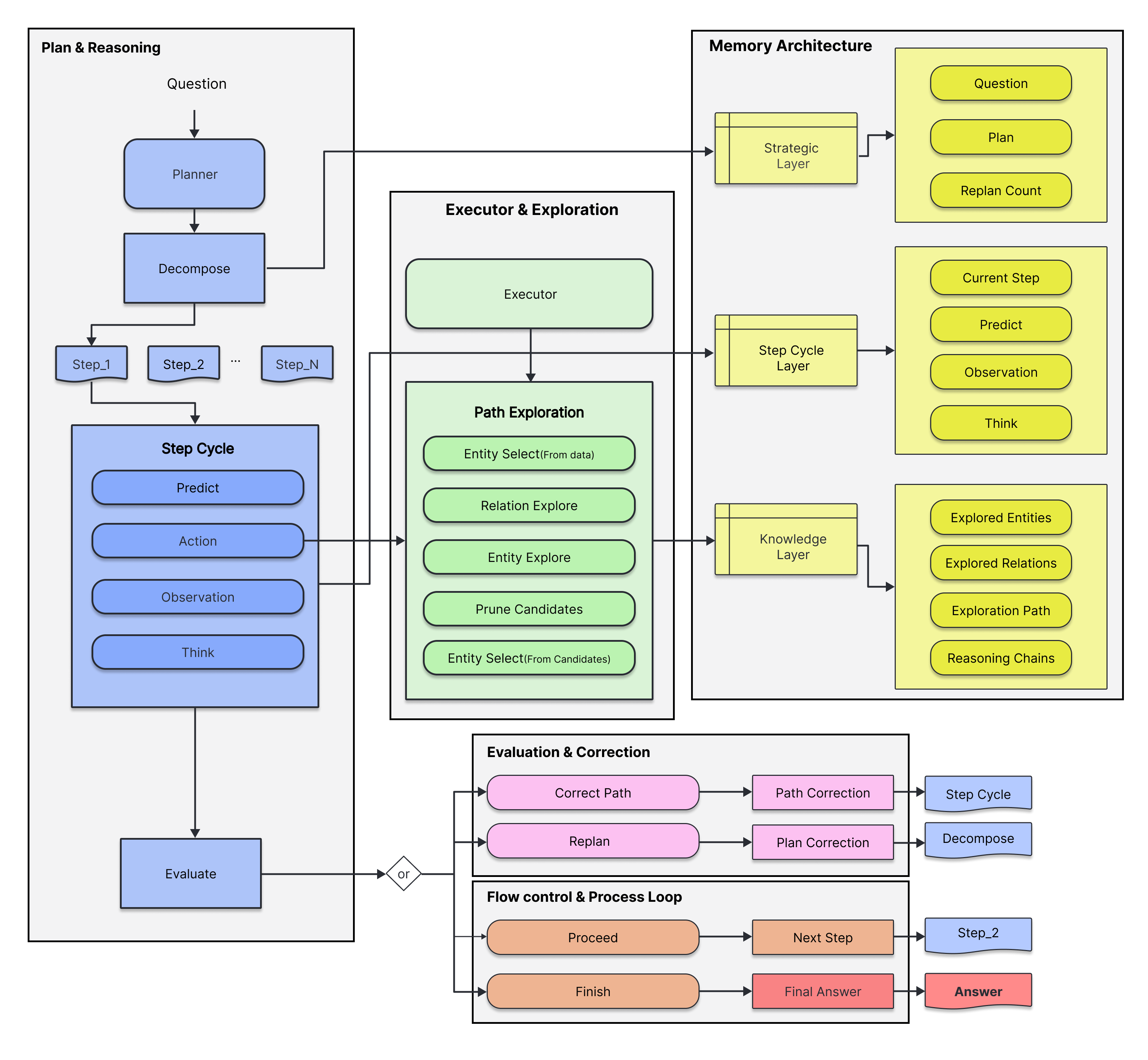
The image is a detailed flowchart illustrating a **reasoning system** (likely for AI problem-solving) with five interconnected components: *Plan & Reasoning*, *Executor & Exploration*, *Memory Architecture*, *Evaluation & Correction*, and *Flow control & Process Loop*. Each component contains nested sub-elements (rectangles/rounded rectangles) with text labels, connected by arrows to show process flow and feedback loops.
### Components/Axes (Sub-Components and Labels)
The diagram is divided into five main light-gray boxes, each with distinct color-coded sub-components:
#### 1. **Plan & Reasoning (Left Box, Blue Sub-Components)**
- Top: *“Question”* (text) → *“Planner”* (blue rounded rectangle) → *“Decompose”* (blue rectangle) → *“Step_1”*, *“Step_2”*, ..., *“Step_N”* (blue rectangles; “...” indicates multiple steps).
- Below: *“Step Cycle”* (blue rectangle) with sub-components: *“Predict”*, *“Action”*, *“Observation”*, *“Think”* (blue rounded rectangles).
- Bottom: *“Evaluate”* (blue rectangle).
#### 2. **Executor & Exploration (Middle Box, Green Sub-Components)**
- Top: *“Executor”* (green rounded rectangle).
- Below: *“Path Exploration”* (green rectangle) with sub-components: *“Entity Select(From data)”*, *“Relation Explore”*, *“Entity Explore”*, *“Prune Candidates”*, *“Entity Select(From Candidates)”* (green rounded rectangles).
#### 3. **Memory Architecture (Right Box, Yellow Sub-Components)**
Three layers (yellow rectangles) store data:
- *“Strategic Layer”*: *“Question”*, *“Plan”*, *“Replan Count”* (yellow rounded rectangles).
- *“Step Cycle Layer”*: *“Current Step”*, *“Predict”*, *“Observation”*, *“Think”* (yellow rounded rectangles).
- *“Knowledge Layer”*: *“Explored Entities”*, *“Explored Relations”*, *“Exploration Path”*, *“Reasoning Chains”* (yellow rounded rectangles).
#### 4. **Evaluation & Correction (Bottom Middle Box, Pink Sub-Components)**
Two feedback paths:
- *“Correct Path”* (pink rounded rectangle) → *“Path Correction”* (pink rectangle) → *“Step Cycle”* (blue rectangle).
- *“Replan”* (pink rounded rectangle) → *“Plan Correction”* (pink rectangle) → *“Decompose”* (blue rectangle).
#### 5. **Flow control & Process Loop (Bottom Right Box, Orange/Red Sub-Components)**
Two progression paths:
- *“Proceed”* (orange rounded rectangle) → *“Next Step”* (orange rectangle) → *“Step_2”* (blue rectangle).
- *“Finish”* (orange rounded rectangle) → *“Final Answer”* (red rectangle) → *“Answer”* (red rectangle).
### Detailed Analysis (Component Relationships and Flow)
- **Plan & Reasoning** initiates with a *“Question”*, processed by *“Planner”* and *“Decompose”* into steps (Step_1 to Step_N). Each step enters *“Step Cycle”* (Predict → Action → Observation → Think), then *“Evaluate”*.
- **Executor & Exploration** handles execution: *“Executor”* oversees *“Path Exploration”* (entity/relation exploration, pruning, selection).
- **Memory Architecture** stores data across layers: *Strategic* (question, plan, replan count), *Step Cycle* (current step, predict, observation, think), *Knowledge* (explored entities/relations, path, reasoning chains).
- **Evaluation & Correction** corrects paths or replans: *“Correct Path”* fixes the path, *“Replan”* adjusts the plan, feeding back to *“Step Cycle”* or *“Decompose”*.
- **Flow control & Process Loop** manages progression: *“Proceed”* moves to the next step, *“Finish”* outputs the final answer.
### Key Observations
- **Color Coding:** Blue (Plan & Reasoning), Green (Executor & Exploration), Yellow (Memory Architecture), Pink (Evaluation & Correction), Orange (Flow control), Red (Final Answer).
- **Flow Direction:** Arrows show sequential and feedback loops (e.g., *Evaluate* feeds back to *Step Cycle* or *Decompose*).
- **Sub-Component Hierarchy:** Each main box contains nested sub-components (e.g., *Step Cycle* has *Predict*, *Action*, etc.).
### Interpretation
This diagram models a **cognitive/AI agent’s decision-making process** for complex tasks. It emphasizes:
- **Iterative Learning:** Feedback loops (replan, path correction) refine plans and paths.
- **Structured Memory:** Layers (strategic, step, knowledge) support planning, execution, and knowledge retention.
- **Modular Design:** Components (plan, execute, evaluate, control) work in tandem to break down tasks, explore solutions, and correct errors.
The architecture suggests a system designed to handle ambiguity, learn from experience, and produce reasoned answers—similar to how humans or advanced AI agents solve problems.
*(No numerical data or charts; this is a process diagram with text labels and flow relationships.)*