## Flowchart: Multi-Stage Problem-Solving Process
### Overview
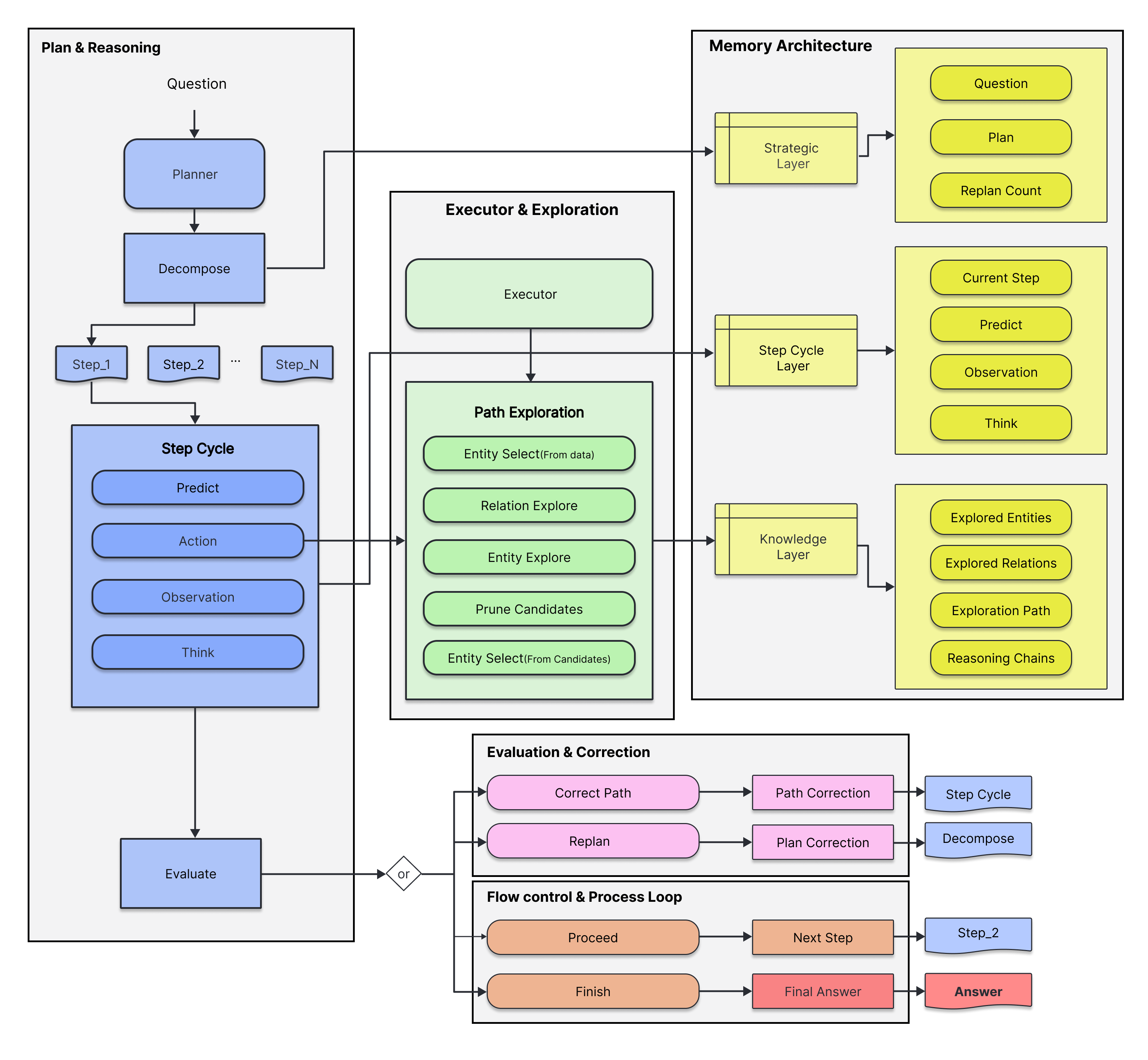
The diagram illustrates a structured problem-solving workflow with interconnected components across four primary sections: **Plan & Reasoning**, **Memory Architecture**, **Executor & Exploration**, and **Evaluation & Correction**. Arrows indicate directional flow between components, with decision points and feedback loops.
---
### Components/Axes
#### Plan & Reasoning Section
- **Planner**: Initiates the process by receiving a **Question**.
- **Decompose**: Breaks the question into sequential steps (**Step_1**, **Step_2**, ..., **Step_N**).
- **Step Cycle**: Contains four sub-components:
- **Predict**
- **Action**
- **Observation**
- **Think**
- **Evaluate**: Final step in this section, outputting to **Flow control & Process Loop**.
#### Memory Architecture Section
- **Strategic Layer**:
- **Question**
- **Plan**
- **Replan Count**
- **Step Cycle Layer**:
- **Current Step**
- **Predict**
- **Observation**
- **Think**
- **Knowledge Layer**:
- **Explored Entities**
- **Explored Relations**
- **Exploration Path**
- **Reasoning Chains**
#### Executor & Exploration Section
- **Executor**: Central component connected to **Path Exploration**.
- **Path Exploration**:
- **Entity Select (From data)**
- **Relation Explore**
- **Entity Explore**
- **Prune Candidates**
- **Entity Select (From Candidates)**
#### Evaluation & Correction Section
- **Correct Path**: Feeds back to **Step Cycle**.
- **Replan**: Triggers **Plan Correction** and loops to **Decompose**.
- **Flow control & Process Loop**:
- **Proceed** → **Next Step** (connects to **Step_2**).
- **Finish** → **Final Answer** (outputs to **Answer**).
---
### Detailed Analysis
1. **Plan & Reasoning**:
- The process begins with a **Question** input to the **Planner**, which decomposes it into discrete steps.
- Each **Step Cycle** iterates through **Predict**, **Action**, **Observation**, and **Think** phases.
- **Evaluate** determines whether to proceed or trigger corrections.
2. **Memory Architecture**:
- **Strategic Layer** stores high-level metadata (e.g., **Replan Count**).
- **Step Cycle Layer** tracks real-time execution states (**Current Step**, **Observation**).
- **Knowledge Layer** archives exploration outcomes (e.g., **Explored Entities**).
3. **Executor & Exploration**:
- The **Executor** drives exploration via **Path Exploration**, which dynamically selects entities/relations from data or candidate pools.
4. **Evaluation & Correction**:
- A decision diamond splits outcomes: **Correct Path** (resumes execution) or **Replan** (triggers plan correction and re-decomposition).
---
### Key Observations
- **Feedback Loops**: The **Replan** component creates a closed-loop system, allowing iterative refinement of the plan.
- **Modular Design**: Components like **Path Exploration** and **Step Cycle** operate semi-independently but are tightly coupled through shared inputs/outputs.
- **Color Coding**:
- **Yellow** (Strategic Layer) for high-level planning.
- **Light Green** (Step Cycle Layer) for execution states.
- **Light Blue** (Knowledge Layer) for stored exploration data.
---
### Interpretation
This flowchart represents a **cognitive architecture** for autonomous problem-solving, blending planning, execution, and adaptive correction. Key insights:
1. **Iterative Refinement**: The **Replan Count** in the Strategic Layer suggests bounded retries before finalizing a solution.
2. **Dynamic Exploration**: The **Path Exploration** module enables context-aware entity/relation selection, critical for complex reasoning tasks.
3. **State Management**: The **Step Cycle Layer** acts as a working memory, tracking real-time progress (e.g., **Current Step**, **Observation**).
The system prioritizes **modularity** (isolated components) and **adaptability** (feedback loops), making it suitable for tasks requiring both structured reasoning and flexibility.