## Line Chart: 1-NN Accuracy vs. Representation Size
### Overview
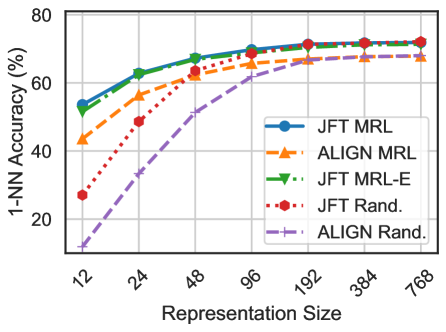
This line chart displays the 1-Nearest Neighbor (1-NN) accuracy for different representation sizes, comparing several models: JFT MRL, ALIGN MRL, JFT MRL-E, JFT Rand., and ALIGN Rand. The x-axis represents the representation size, and the y-axis represents the 1-NN accuracy in percentage.
### Components/Axes
* **X-axis:** Representation Size (with markers at 12, 24, 48, 96, 192, 384, 768)
* **Y-axis:** 1-NN Accuracy (%) (scale from 0 to 80, increments of 10)
* **Legend:** Located in the top-right corner, containing the following labels and corresponding colors:
* JFT MRL (Blue)
* ALIGN MRL (Orange)
* JFT MRL-E (Green)
* JFT Rand. (Red)
* ALIGN Rand. (Purple)
### Detailed Analysis
* **JFT MRL (Blue Line):** The line slopes upward sharply from 12 to 48, then plateaus, reaching approximately 72% accuracy at a representation size of 48, and remaining relatively stable around 72-74% for larger representation sizes.
* At Representation Size 12: ~54%
* At Representation Size 24: ~64%
* At Representation Size 48: ~72%
* At Representation Size 96: ~73%
* At Representation Size 192: ~73%
* At Representation Size 384: ~73%
* At Representation Size 768: ~73%
* **ALIGN MRL (Orange Line):** The line shows a similar upward trend to JFT MRL, but starts at a lower accuracy. It reaches approximately 68% accuracy at a representation size of 48 and plateaus around 70-72% for larger sizes.
* At Representation Size 12: ~42%
* At Representation Size 24: ~55%
* At Representation Size 48: ~68%
* At Representation Size 96: ~70%
* At Representation Size 192: ~71%
* At Representation Size 384: ~71%
* At Representation Size 768: ~71%
* **JFT MRL-E (Green Line):** This line starts with a similar accuracy to ALIGN MRL at a representation size of 12, and increases steadily, reaching approximately 70% accuracy at a representation size of 48. It plateaus around 71-72% for larger sizes.
* At Representation Size 12: ~50%
* At Representation Size 24: ~60%
* At Representation Size 48: ~70%
* At Representation Size 96: ~71%
* At Representation Size 192: ~71%
* At Representation Size 384: ~71%
* At Representation Size 768: ~71%
* **JFT Rand. (Red Line):** This line exhibits a steep upward trend, starting from approximately 24% at a representation size of 12 and reaching approximately 70% accuracy at a representation size of 384. It plateaus around 71-72% for larger sizes.
* At Representation Size 12: ~24%
* At Representation Size 24: ~34%
* At Representation Size 48: ~48%
* At Representation Size 96: ~60%
* At Representation Size 192: ~67%
* At Representation Size 384: ~71%
* At Representation Size 768: ~71%
* **ALIGN Rand. (Purple Line):** This line shows the most significant upward trend, starting from a very low accuracy at a representation size of 12 and increasing rapidly to approximately 65% at a representation size of 192. It plateaus around 70-72% for larger sizes.
* At Representation Size 12: ~10%
* At Representation Size 24: ~20%
* At Representation Size 48: ~32%
* At Representation Size 96: ~46%
* At Representation Size 192: ~65%
* At Representation Size 384: ~71%
* At Representation Size 768: ~71%
### Key Observations
* All models exhibit diminishing returns in accuracy as the representation size increases beyond 48.
* JFT MRL consistently achieves the highest accuracy across all representation sizes.
* ALIGN Rand. shows the most significant improvement in accuracy with increasing representation size, starting from the lowest accuracy.
* The "Rand." models (JFT Rand. and ALIGN Rand.) initially perform worse than their corresponding "MRL" counterparts but converge towards similar accuracy levels at larger representation sizes.
### Interpretation
The chart demonstrates the relationship between representation size and 1-NN accuracy for different models. The plateauing of accuracy at larger representation sizes suggests that the models have reached a point of diminishing returns, where increasing the representation size does not significantly improve performance. The differences in accuracy between the models indicate varying levels of effectiveness in capturing relevant information from the data. The convergence of the "Rand." models towards the "MRL" models at larger representation sizes suggests that random representations can become effective with sufficient dimensionality. This data could be used to optimize model selection and representation size for a given task, balancing accuracy with computational cost. The fact that all lines converge suggests that the underlying data has a limited amount of information that can be extracted, and beyond a certain point, increasing the representation size does not reveal new patterns.