## Line Graphs: Normalized FAD Performance Across Audio Processing Parameters
### Overview
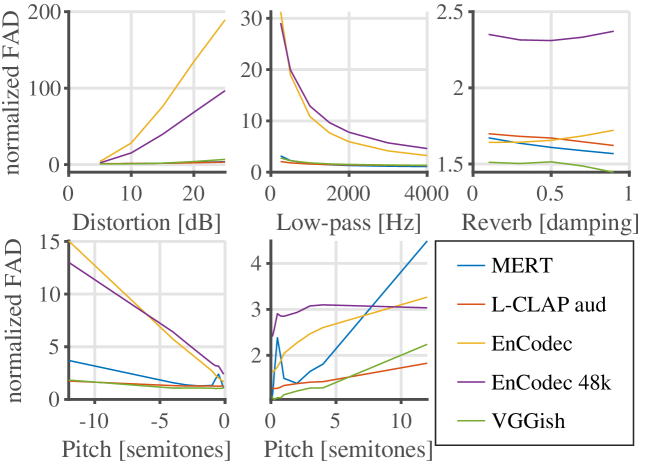
The image contains six line graphs comparing the normalized Fréchet Audio Distance (FAD) performance of five audio processing algorithms (MERT, L-CLAP aud, EnCodec, EnCodec 48k, VGGish) across different audio distortion parameters. Each graph represents a distinct parameter (Distortion, Low-pass, Reverb, Pitch) with varying scales and trends.
---
### Components/Axes
1. **Top Row (Normalized FAD vs. Parameter):**
- **Left Graph (Distortion [dB]):**
- X-axis: Distortion [dB] (range: -10 to 20)
- Y-axis: Normalized FAD (range: 0 to 200)
- **Middle Graph (Low-pass [Hz]):**
- X-axis: Low-pass [Hz] (range: 0 to 4000)
- Y-axis: Normalized FAD (range: 0 to 30)
- **Right Graph (Reverb [damping]):**
- X-axis: Reverb [damping] (range: 0 to 1)
- Y-axis: Normalized FAD (range: 0 to 2.5)
2. **Bottom Row (Normalized FAD vs. Pitch):**
- **Left Graph (Pitch [semitones]):**
- X-axis: Pitch [semitones] (range: -10 to 0)
- Y-axis: Normalized FAD (range: 0 to 15)
- **Right Graph (Pitch [semitones]):**
- X-axis: Pitch [semitones] (range: 0 to 10)
- Y-axis: Normalized FAD (range: 0 to 4)
3. **Legend (Right Side):**
- **Colors and Labels:**
- Blue: MERT
- Red: L-CLAP aud
- Orange: EnCodec
- Purple: EnCodec 48k
- Green: VGGish
---
### Detailed Analysis
#### Top Row
1. **Distortion [dB]:**
- **Trends:**
- MERT (blue): Sharp upward slope (5 → 15 FAD).
- L-CLAP aud (red): Gradual increase (2 → 10 FAD).
- EnCodec (orange): Steep rise (1 → 12 FAD).
- EnCodec 48k (purple): Moderate increase (3 → 18 FAD).
- VGGish (green): Flat line (~1 FAD).
- **Key Data Points:**
- At 20 dB distortion, MERT reaches ~15 FAD, while VGGish remains near 1.
2. **Low-pass [Hz]:**
- **Trends:**
- MERT (blue): Sharp decline (20 → 5 FAD).
- L-CLAP aud (red): Slight decrease (10 → 6 FAD).
- EnCodec (orange): Moderate drop (15 → 8 FAD).
- EnCodec 48k (purple): Slight increase (2 → 3.5 FAD).
- VGGish (green): Flat line (~1 FAD).
- **Key Data Points:**
- At 4000 Hz low-pass, EnCodec 48k shows the highest FAD (~3.5).
3. **Reverb [damping]:**
- **Trends:**
- MERT (blue): Slight increase (1.8 → 2.2 FAD).
- L-CLAP aud (red): Stable (~1.5 FAD).
- EnCodec (orange): Slight decrease (1.2 → 1.0 FAD).
- EnCodec 48k (purple): Flat (~2.0 FAD).
- VGGish (green): Stable (~0.5 FAD).
- **Key Data Points:**
- At 1.0 damping, MERT reaches ~2.2 FAD, while VGGish remains at ~0.5.
#### Bottom Row
1. **Pitch [semitones] (Negative Range):**
- **Trends:**
- MERT (blue): Sharp decline (4 → 1 FAD).
- L-CLAP aud (red): Gradual drop (3 → 1.5 FAD).
- EnCodec (orange): Steep decrease (5 → 2 FAD).
- EnCodec 48k (purple): Moderate drop (4 → 2.5 FAD).
- VGGish (green): Flat (~1 FAD).
- **Key Data Points:**
- At -10 semitones, MERT reaches ~1 FAD, while VGGish stays near 1.
2. **Pitch [semitones] (Positive Range):**
- **Trends:**
- MERT (blue): Flat line (~3 FAD).
- L-CLAP aud (red): Slight increase (1.5 → 2.5 FAD).
- EnCodec (orange): Steep rise (2 → 3.5 FAD).
- EnCodec 48k (purple): Moderate increase (2.5 → 3.0 FAD).
- VGGish (green): Flat (~1 FAD).
- **Key Data Points:**
- At 10 semitones, EnCodec reaches ~3.5 FAD, while VGGish remains at ~1.
---
### Key Observations
1. **VGGish Consistency:** VGGish (green) maintains the lowest and most stable FAD across all parameters, suggesting robustness to distortions.
2. **EnCodec 48k Variability:** EnCodec 48k (purple) shows mixed performance, with higher FAD in some cases (e.g., low-pass, reverb) but lower in others (e.g., pitch).
3. **MERT Sensitivity:** MERT (blue) exhibits significant FAD increases with distortion and low-pass parameters but performs well in pitch adjustments.
4. **L-CLAP aud Stability:** L-CLAP aud (red) shows moderate FAD across most parameters but spikes in the positive pitch range.
---
### Interpretation
The data suggests that **VGGish** is the most robust algorithm for handling audio distortions, maintaining low FAD values across all tested parameters. **EnCodec 48k** and **MERT** show parameter-specific weaknesses, with EnCodec 48k struggling in low-pass and reverb scenarios and MERT being sensitive to distortion. **L-CLAP aud** performs consistently but lags behind VGGish in critical cases. These trends highlight the importance of algorithm selection based on the target audio processing task (e.g., distortion vs. pitch correction).