## Diagram: Comparison of AnalogNAS T500 and ResNet32 Architectures
### Overview
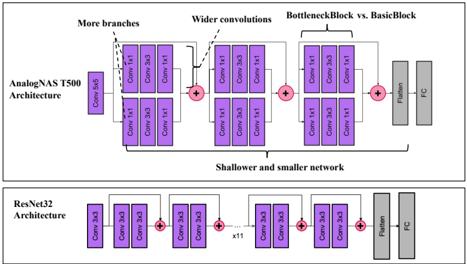
The image displays two distinct neural network architectural diagrams stacked vertically. The top diagram represents the "AnalogNAS T500 Architecture," characterized by parallel branches and 1x1 convolutions. The bottom diagram represents the "ResNet32 Architecture," characterized by a sequential series of 3x3 convolutional residual blocks. The diagram is designed to contrast the structural complexity and depth of the two models.
### Components/Axes
* **Purple Rectangles:** Represent Convolutional (Conv) layers. They are labeled with their kernel sizes (e.g., "Conv 5x5", "Conv 3x3", "Conv 1x1").
* **Pink Circles with '+':** Represent summation nodes, typical in residual network architectures where input is added to the output of a block.
* **Grey Rectangles:** Represent the final stages of the network: "Flatten" and "FC" (Fully Connected) layers.
* **Arrows:** Indicate the direction of data flow (left to right).
* **Annotations:** Text labels and brackets providing qualitative descriptions of the architectural features.
### Detailed Analysis
#### 1. AnalogNAS T500 Architecture (Top Panel)
* **Input Stage:** Begins with a single "Conv 5x5" block.
* **Processing Stages:** The network consists of three sequential stages. Each stage is composed of two parallel branches.
* **Branch Structure:** Each of the two branches contains three "Conv 1x1" blocks arranged in series.
* **Merging:** At the end of each stage, the two branches are merged via a summation node (pink circle).
* **Annotations:**
* **"More branches":** A dashed line points to the parallel structure of the blocks, indicating increased branching.
* **"Wider convolutions":** A dashed line points to the parallel structure, suggesting the network is "wider" due to these branches.
* **"BottleneckBlock vs. BasicBlock":** A bracket spans the third stage, implying this specific stage functions as a bottleneck block.
* **"Shallow and smaller network":** A large bracket spans the entire sequence of the three stages, indicating the overall network is less deep and has fewer parameters than the comparison model.
* **Output:** The final summation node feeds into a "Flatten" layer, followed by an "FC" layer.
#### 2. ResNet32 Architecture (Bottom Panel)
* **Input Stage:** Begins with a single "Conv 3x3" block.
* **Processing Stages:** The network consists of a repeating sequence of residual blocks.
* **Block Structure:** Each block consists of two "Conv 3x3" layers, with a residual connection bypassing them to a summation node.
* **Repetition:** An ellipsis ("...") is placed between the first and second block, with the label "x11" below it. This indicates that the residual block pattern is repeated 11 times.
* **Output:** The final summation node feeds into a "Flatten" layer, followed by an "FC" layer.
### Key Observations
* **Structural Contrast:** The AnalogNAS T500 utilizes a "wider" approach with parallel branches of 1x1 convolutions, whereas the ResNet32 utilizes a "deeper" approach with sequential 3x3 convolutions.
* **Depth vs. Width:** The explicit label "Shallow and smaller network" for the AnalogNAS T500 suggests it is an optimized architecture designed to achieve performance comparable to ResNet32 but with reduced computational cost or memory footprint.
* **Repetition:** The ResNet32 architecture relies on deep repetition (implied by "x11"), while the AnalogNAS T500 relies on complex internal block structures (parallel branches).
### Interpretation
This diagram is a comparative architectural analysis likely intended to demonstrate the efficiency of the AnalogNAS T500.
* **Design Philosophy:** The AnalogNAS T500 appears to be a Neural Architecture Search (NAS) result designed to optimize for hardware constraints. By using 1x1 convolutions in parallel branches, it likely reduces the number of parameters and operations compared to the standard 3x3 convolutions used in ResNet32.
* **Bottleneck Efficiency:** The "BottleneckBlock vs. BasicBlock" annotation suggests that the AnalogNAS T500 uses a bottleneck design (common in ResNet-50 and above) to compress and then expand feature maps, which is more parameter-efficient than the "BasicBlock" (two 3x3 convolutions) used in standard ResNet architectures.
* **Conclusion:** The visual evidence suggests that AnalogNAS T500 is an attempt to achieve the representational power of a deep network (ResNet32) using a shallower, wider, and more computationally efficient structure.