## Diagram: Comparison of AnalogNAS T500 and ResNet32 Architectures
### Overview
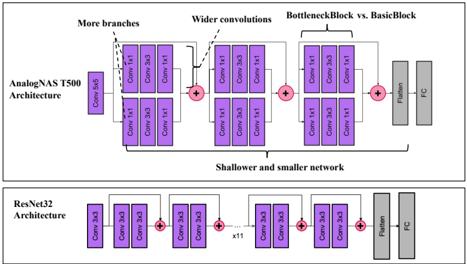
The image compares two neural network architectures: **AnalogNAS T500** (top) and **ResNet32** (bottom). Both diagrams illustrate block structures, convolutional layers, and network flow. Key differences include branching strategies, convolutional widths, and block types (BottleneckBlock vs. BasicBlock).
### Components/Axes
- **Top Section (AnalogNAS T500 Architecture)**:
- **Labels**:
- "AnalogNAS T500 Architecture" (title).
- "More branches" (dashed arrow pointing to multiple Conv 1x1 blocks).
- "Wider convolutions" (dashed arrow pointing to Conv 3x3 blocks).
- "BottleneckBlock vs. BasicBlock" (comparison of block types).
- "Shallower and smaller network" (note at the bottom).
- **Elements**:
- Purple rectangles labeled "Conv 1x1" and "Conv 3x3" (convolutional layers).
- Pink "+" symbols (concatenation operations).
- Gray rectangles labeled "Flatten" and "FC" (fully connected layer).
- Arrows indicating data flow.
- **Bottom Section (ResNet32 Architecture)**:
- **Labels**:
- "ResNet32 Architecture" (title).
- "x11" (multiplier for repeated blocks).
- **Elements**:
- Purple rectangles labeled "Conv 3x3" (convolutional layers).
- Pink "+" symbols (concatenation operations).
- Gray rectangles labeled "Flatten" and "FC" (fully connected layer).
- Arrows indicating data flow.
### Detailed Analysis
- **AnalogNAS T500**:
- Features **more branches** (dashed arrow) and **wider convolutions** (dashed arrow), suggesting a focus on increasing model capacity and complexity.
- Uses **BottleneckBlock** (narrower intermediate layers) and **BasicBlock** (standard convolutional blocks) for modularity.
- Ends with a **Flatten** layer followed by a **Fully Connected (FC)** layer.
- **ResNet32**:
- Simpler structure with **repeated Conv 3x3 blocks** (x11 multiplier), indicating a shallower and smaller network.
- Also ends with a **Flatten** layer and **FC** layer.
### Key Observations
1. **Architectural Complexity**: AnalogNAS T500 is designed with more branches and wider convolutions, likely for advanced tasks requiring higher capacity.
2. **Block Types**: The comparison of BottleneckBlock vs. BasicBlock highlights trade-offs between efficiency (Bottleneck) and simplicity (BasicBlock).
3. **ResNet32 Simplicity**: The "x11" multiplier and repeated Conv 3x3 blocks suggest a focus on depth without excessive complexity.
### Interpretation
- The **AnalogNAS T500** architecture prioritizes **scalability and adaptability** through modular blocks and wider convolutions, potentially improving performance on complex tasks.
- The **ResNet32** architecture emphasizes **simplicity and efficiency**, using repeated blocks to achieve depth without excessive computational overhead.
- The absence of numerical data (e.g., accuracy, FLOPs) limits quantitative analysis, but the structural differences suggest AnalogNAS T500 is optimized for advanced applications, while ResNet32 is a baseline for standard tasks.
## Notes
- No numerical data or charts are present; the image focuses on architectural design.
- The legend (if any) is not explicitly visible, but block types (BottleneckBlock vs. BasicBlock) are labeled directly.
- Spatial grounding: All elements are arranged in a top-to-bottom flow, with labels positioned near their respective components.