## Line Chart: Δf vs. n
### Overview
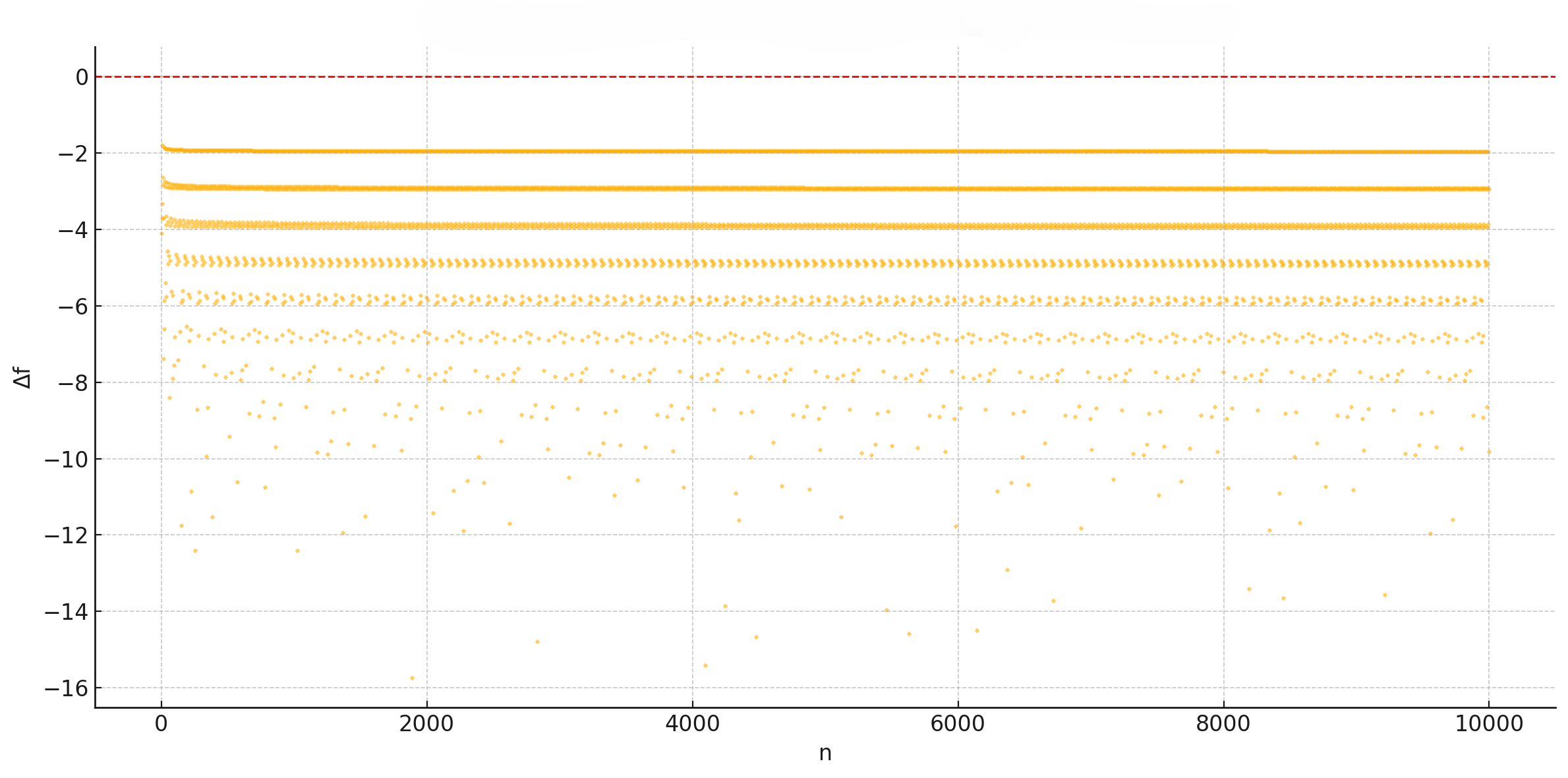
The chart displays a multi-series line plot with horizontal reference lines and scattered data points. The x-axis represents a sequential index "n" (0–10,000), while the y-axis shows "Δf" values ranging from -16 to 0. Multiple horizontal lines at fixed Δf values (-2, -4, -6, -8, -10, -12, -14) are overlaid with varying marker styles and colors. A red dashed line at Δf=0 serves as a baseline. Scattered yellow points populate the lower half of the chart, with density decreasing as Δf decreases.
### Components/Axes
- **X-axis (n)**: Sequential index from 0 to 10,000 (discrete steps).
- **Y-axis (Δf)**: Values from -16 to 0, with gridlines at integer intervals.
- **Legend**: Located on the right, mapping colors/markers to Δf values:
- Red dashed line: Δf=0 (baseline).
- Solid orange lines: Δf=-2, -4, -6, -8, -10, -12, -14.
- Yellow markers: Scattered data points (no explicit legend label).
### Detailed Analysis
1. **Horizontal Reference Lines**:
- **Δf=-2**: Solid orange line with small square markers. Stable across all n.
- **Δf=-4**: Solid orange line with small triangle markers. Stable across all n.
- **Δf=-6**: Solid orange line with small circle markers. Stable across all n.
- **Δf=-8**: Solid orange line with small diamond markers. Stable across all n.
- **Δf=-10**: Solid orange line with small pentagon markers. Stable across all n.
- **Δf=-12**: Solid orange line with small hexagon markers. Stable across all n.
- **Δf=-14**: Solid orange line with small octagon markers. Stable across all n.
2. **Scattered Data Points**:
- Yellow points cluster densely around Δf=-4 and Δf=-6, with moderate density at Δf=-8.
- Points become sparser below Δf=-10, with only a few isolated points at Δf=-12 and Δf=-14.
- No points appear above Δf=-2 or at Δf=0.
3. **Red Baseline (Δf=0)**:
- A horizontal red dashed line at y=0 spans the entire x-axis. No data points intersect this line.
### Key Observations
- **Stability of Reference Lines**: All horizontal lines remain perfectly flat across the entire n range (0–10,000), suggesting fixed thresholds or targets.
- **Data Point Distribution**:
- **Clustered Regions**: High density of points between Δf=-4 and Δf=-8, indicating frequent deviations in this range.
- **Sparse Regions**: Minimal points below Δf=-10, suggesting rare or extreme deviations.
- **Baseline Significance**: The red dashed line at Δf=0 acts as a clear reference for positive/negative deviations.
### Interpretation
The chart likely represents a system's performance or deviation metric (Δf) over sequential iterations (n). The stable horizontal lines may represent predefined tolerance levels or operational targets. The scattered points suggest variability in Δf measurements, with most data concentrated around moderate deviations (-4 to -8). The absence of points above Δf=-2 implies the system rarely exceeds this threshold. The red baseline at Δf=0 could indicate a nominal or equilibrium state, with all observed deviations being negative. The decreasing density of points at lower Δf values might reflect diminishing frequency of extreme deviations as the system stabilizes or operates within constrained bounds.