## Bar Chart: TPS_sys Performance Across Concurrency Levels
### Overview
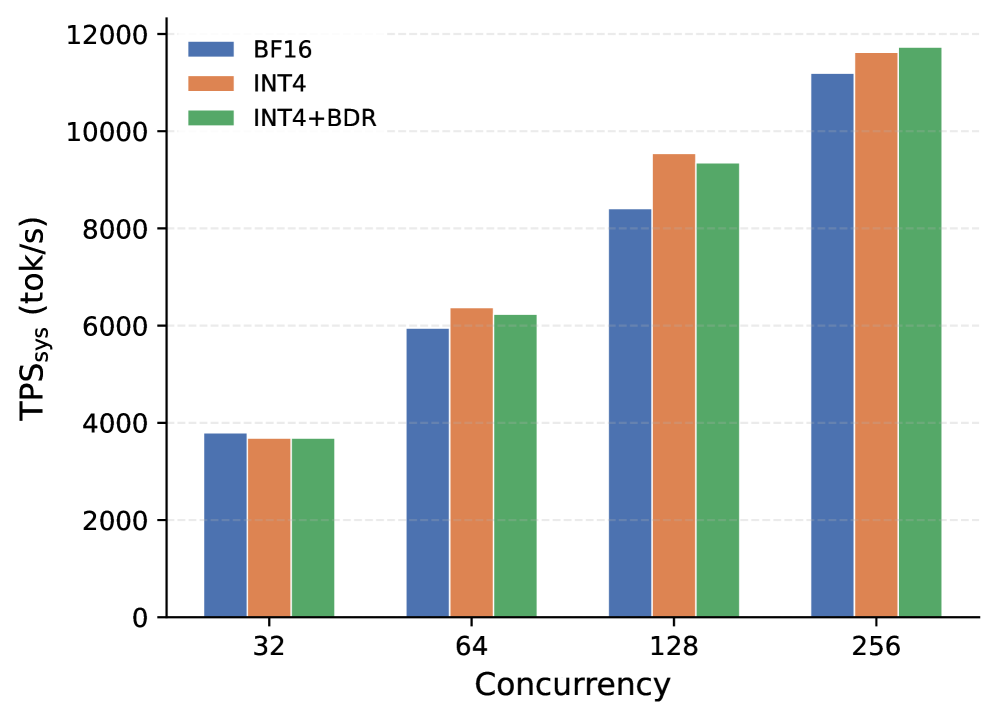
The chart compares the transaction processing speed (TPS_sys) of three algorithms (BF16, INT4, INT4+BDR) across four concurrency levels (32, 64, 128, 256). TPS_sys is measured in tokens per second (tok/s), with values ranging from 0 to 12,000 on the y-axis.
### Components/Axes
- **X-axis (Concurrency)**: Labeled "Concurrency" with discrete values: 32, 64, 128, 256.
- **Y-axis (TPS_sys)**: Labeled "TPS_sys (tok/s)" with a linear scale from 0 to 12,000.
- **Legend**: Positioned in the top-left corner, mapping colors to algorithms:
- Blue: BF16
- Orange: INT4
- Green: INT4+BDR
- **Bars**: Grouped by concurrency level, with three bars per group (one per algorithm).
### Detailed Analysis
#### Concurrency = 32
- **BF16 (Blue)**: ~3,800 tok/s
- **INT4 (Orange)**: ~3,700 tok/s
- **INT4+BDR (Green)**: ~3,700 tok/s
#### Concurrency = 64
- **BF16 (Blue)**: ~6,000 tok/s
- **INT4 (Orange)**: ~6,300 tok/s
- **INT4+BDR (Green)**: ~6,200 tok/s
#### Concurrency = 128
- **BF16 (Blue)**: ~8,300 tok/s
- **INT4 (Orange)**: ~9,600 tok/s
- **INT4+BDR (Green)**: ~9,400 tok/s
#### Concurrency = 256
- **BF16 (Blue)**: ~11,300 tok/s
- **INT4 (Orange)**: ~11,700 tok/s
- **INT4+BDR (Green)**: ~11,800 tok/s
### Key Observations
1. **Scalability Trends**:
- All algorithms show increasing TPS_sys with higher concurrency.
- INT4+BDR consistently outperforms INT4 and BF16 across all concurrency levels.
- BF16 exhibits the slowest growth, particularly at higher concurrency (e.g., 256: ~11,300 vs. INT4+BDR’s ~11,800).
2. **Performance Gaps**:
- At 256 concurrency, INT4+BDR achieves ~5% higher TPS than INT4 and ~4% higher than BF16.
- The gap between BF16 and the other two algorithms widens as concurrency increases.
3. **Efficiency**:
- INT4+BDR demonstrates the most efficient scaling, maintaining a near-linear relationship between concurrency and TPS_sys.
### Interpretation
The data suggests that **INT4+BDR** is the most scalable algorithm for high-concurrency workloads, outperforming both INT4 and BF16. BF16’s performance lags significantly at higher concurrency, indicating potential limitations in parallel processing efficiency. The results imply that INT4+BDR’s architecture (possibly incorporating batch data reduction or optimized memory management) is better suited for distributed or multi-threaded environments. These findings could guide algorithm selection for systems prioritizing throughput under heavy load.