## Chart/Diagram Type: Real-World Spatial Reasoning
### Overview
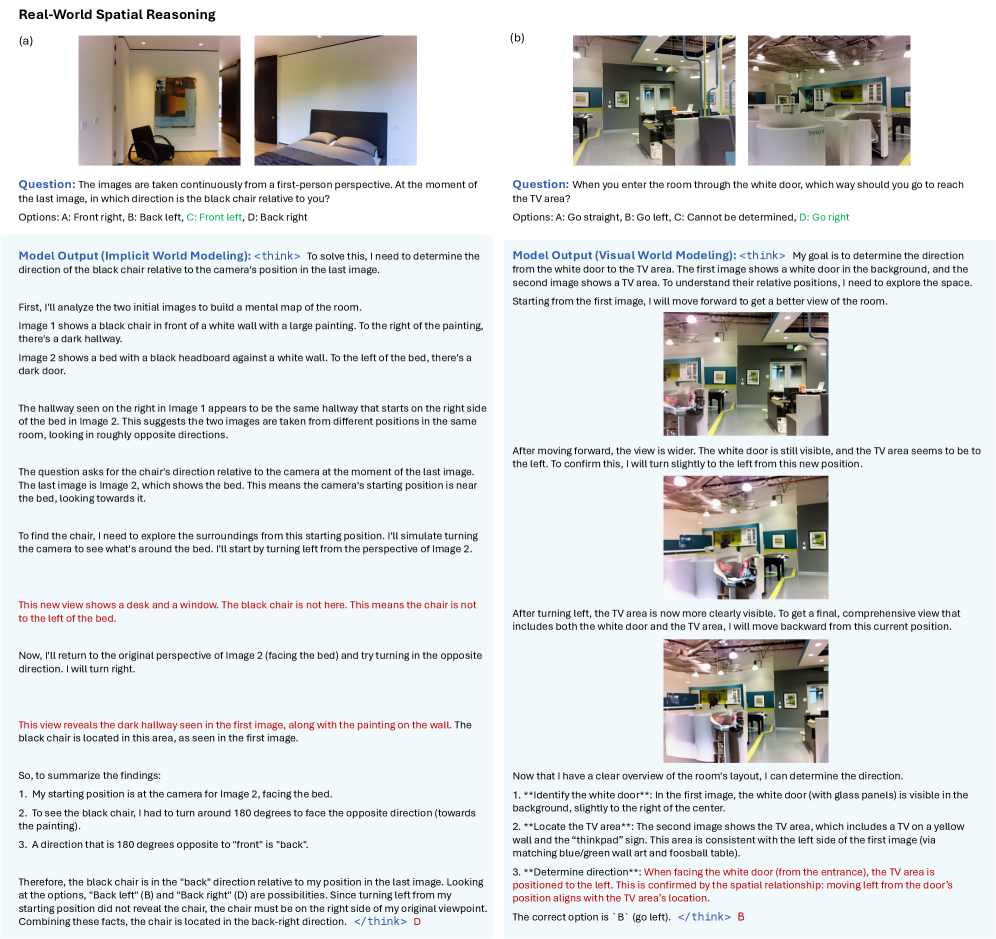
The image presents two spatial reasoning problems, each with a question, a series of images, and a model's reasoning process to arrive at an answer. Part (a) involves determining the location of a black chair relative to the viewer, while part (b) involves determining the direction to the TV area from the entrance.
### Components/Axes
**Part (a):**
* **Title:** Real-World Spatial Reasoning (a)
* **Question:** The images are taken continuously from a first-person perspective. At the moment of the last image, in which direction is the black chair relative to you?
* **Options:** A: Front right, B: Back left, C: Front left, D: Back right
* **Images:** Two images showing different views of a room. Image 1 shows a black chair in front of a white wall with a large painting and a dark hallway to the right of the painting. Image 2 shows a bed with a black headboard against a white wall and a dark door to the left of the bed.
* **Model Output (Implicit World Modeling):** A textual explanation of the reasoning process.
**Part (b):**
* **Title:** Real-World Spatial Reasoning (b)
* **Question:** When you enter the room through the white door, which way should you go to reach the TV area?
* **Options:** A: Go straight, B: Go left, C: Cannot be determined, D: Go right
* **Images:** Three images showing different views of a room. The first image shows a white door in the background. The second image shows a TV area. The third image shows both the white door and the TV area.
* **Model Output (Visual World Modeling):** A textual explanation of the reasoning process.
### Detailed Analysis or ### Content Details
**Part (a):**
* The model analyzes the two images to build a mental map of the room.
* It identifies the hallway in Image 1 as the same hallway on the right side of the bed in Image 2.
* The model determines that the camera's starting position is near the bed, looking towards it.
* It simulates turning the camera to see what's around the bed, starting by turning left from the perspective of Image 2.
* The model concludes that the black chair is in the "back-right" direction relative to the camera's position.
* The correct answer is D: Back right.
**Part (b):**
* The model identifies the white door in the first image and the TV area in the second image.
* It determines that the TV area is positioned to the left of the white door.
* The model confirms this by noting that moving left from the door's position aligns with the TV area's location.
* The correct answer is B: Go left.
### Key Observations
* Both parts involve spatial reasoning from a first-person perspective.
* The model uses visual information from the images to build a mental map of the room.
* The model uses logical reasoning to determine the correct answer.
### Interpretation
The image demonstrates how a model can use visual information and logical reasoning to solve spatial reasoning problems. The model's ability to build a mental map of the room and simulate movement within the environment is crucial to its success. The problems highlight the importance of understanding spatial relationships and perspective in real-world scenarios.