## Diagram: Real-World Spatial Reasoning Problem Set
### Overview
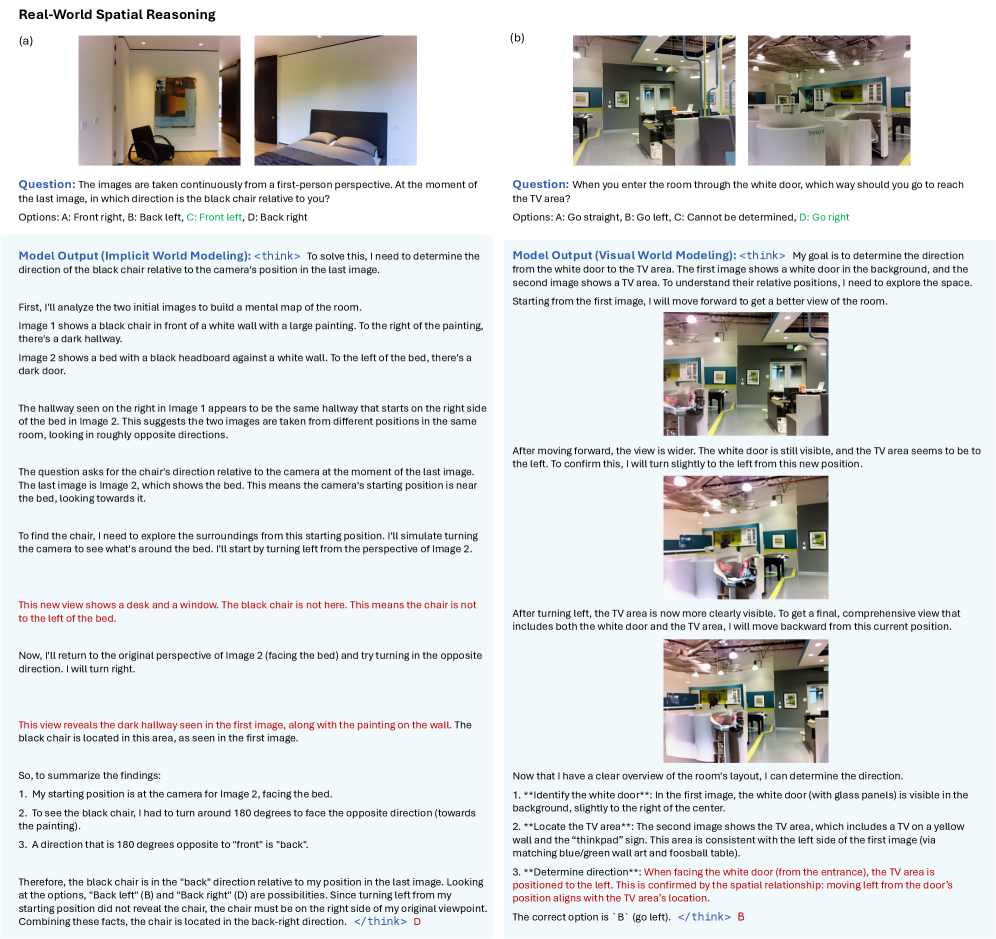
The image displays two distinct spatial reasoning problems, labeled (a) and (b), presented side-by-side. Each problem consists of a question, multiple-choice options, and a detailed "Model Output" showing a step-by-step reasoning process to arrive at the correct answer. The content appears to be from a technical paper or report evaluating an AI model's ability to perform spatial reasoning from visual inputs.
### Components/Axes
The image is divided into two primary vertical columns:
**Column (a) - Left Side:**
* **Header:** "Real-World Spatial Reasoning" (top-left of entire image).
* **Sub-header:** "(a)".
* **Image Sequence:** Two photographs placed side-by-side.
* **Left Photo:** Shows a room interior with a black chair in the foreground, a large abstract painting on a white wall, and a dark hallway to the right.
* **Right Photo:** Shows a bedroom with a bed (black headboard) against a white wall. A dark doorway is visible to the left of the bed.
* **Question Text:** "Question: The images are taken continuously from a first-person perspective. At the moment of the last image, in which direction is the black chair relative to you?"
* **Options:** "Options: A: Front right, B: Back left, C: Front left, D: Back right".
* **Model Output Section:** Titled "Model Output (Implicit World Modeling):". Contains a `D` (indicating option D: Back right).
**Problem (b) Analysis:**
* **Task:** Determine the direction to go from the entrance (white door) to reach the TV area.
* **Model's Reasoning Process (Transcribed):**
1. The model's goal is to determine the direction from the white door to the TV area using the provided images.
2. It starts by analyzing the first image, noting the white door in the background and a TV area to the left.
3. It simulates moving forward to get a better view (corresponding to the second image). From this new position, the TV area is more clearly to the left.
4. To confirm, it simulates turning slightly left from this new position (corresponding to the third image). The TV area is now clearly visible.
5. **Spatial Relationship Summary:**
* **Identify the white door:** In the first image, the white door (with glass panels) is visible in the background, slightly to the right of the center.
* **Locate the TV area:** The second image shows the TV area, which includes a TV on a yellow wall and the "thinkpad" sign. This area is consistent with the left side of the first image (via matching blue/green wall art and foosball table).
* **Determine direction:** When facing the white door (from the entrance), the TV area is positioned to the left. This is confirmed by the spatial relationship: moving left from the door's position aligns with the TV area's location.
* **Model's Answer:** `<think> B` (indicating option B: Go left).
### Key Observations
1. **Two Modeling Approaches:** The problems explicitly label two different reasoning approaches: "Implicit World Modeling" for (a) and "Visual World Modeling" for (b). Problem (a) requires building a mental map from two static images, while (b) uses a sequence of images that simulate movement through a space.
2. **Reasoning Transparency:** The model's internal reasoning (`<think>` block) is fully exposed, showing a logical, step-by-step process of spatial deduction, hypothesis testing, and confirmation.
3. **Image as Evidence:** In both problems, the provided photographs are not just illustrations but are the primary data sources for the reasoning task. The model references specific visual elements (chair, painting, hallway, door, TV, sign) from the images to build its argument.
4. **Consistent Structure:** Both problems follow an identical layout: Question -> Options -> Model Output with embedded thinking process -> Final Answer tag.
5. **Correct Answers:** The model correctly solves both spatial puzzles, arriving at "D: Back right" for (a) and "B: Go left" for (b).
### Interpretation
This image demonstrates a framework for evaluating and explaining an AI's spatial reasoning capabilities. The core insight is that the model is not just pattern-matching answers but is engaging in a form of **simulated embodied cognition**.
* **What the data suggests:** The model performs "mental simulations" of movement and rotation within a represented 3D space. For (a), it mentally rotates its viewpoint 180 degrees. For (b), it mentally translates and rotates its viewpoint forward and then left. This suggests an internal capability for maintaining object permanence and spatial relationships across different viewpoints.
* **How elements relate:** The questions test different aspects of spatial intelligence. Problem (a) tests **allocentric spatial reasoning** (understanding the layout of a room from disconnected views) and **perspective-taking** (determining "left/right/front/back" from a specific ego-centric position). Problem (b) tests **path integration** and **landmark-based navigation** (using the door as a start point and the TV as a goal).
* **Notable patterns:** The reasoning is methodical and self-correcting. The model explicitly states its assumptions (e.g., "the hallway... appears to be the same"), tests them (e.g., "I'll simulate turning left"), and uses negative evidence (e.g., "The black chair is not here") to refine its conclusion. This mirrors human problem-solving heuristics.
* **Why it matters:** This type of transparent, step-by-step reasoning is crucial for building trustworthy and debuggable AI systems. It moves beyond treating the model as a black box and instead provides a window into its "thought process," allowing researchers to verify that the correct answer is derived from sound logic rather than statistical coincidence. The successful solutions indicate a promising level of grounded spatial understanding.