## Real-World Spatial Reasoning Document Analysis
### Overview
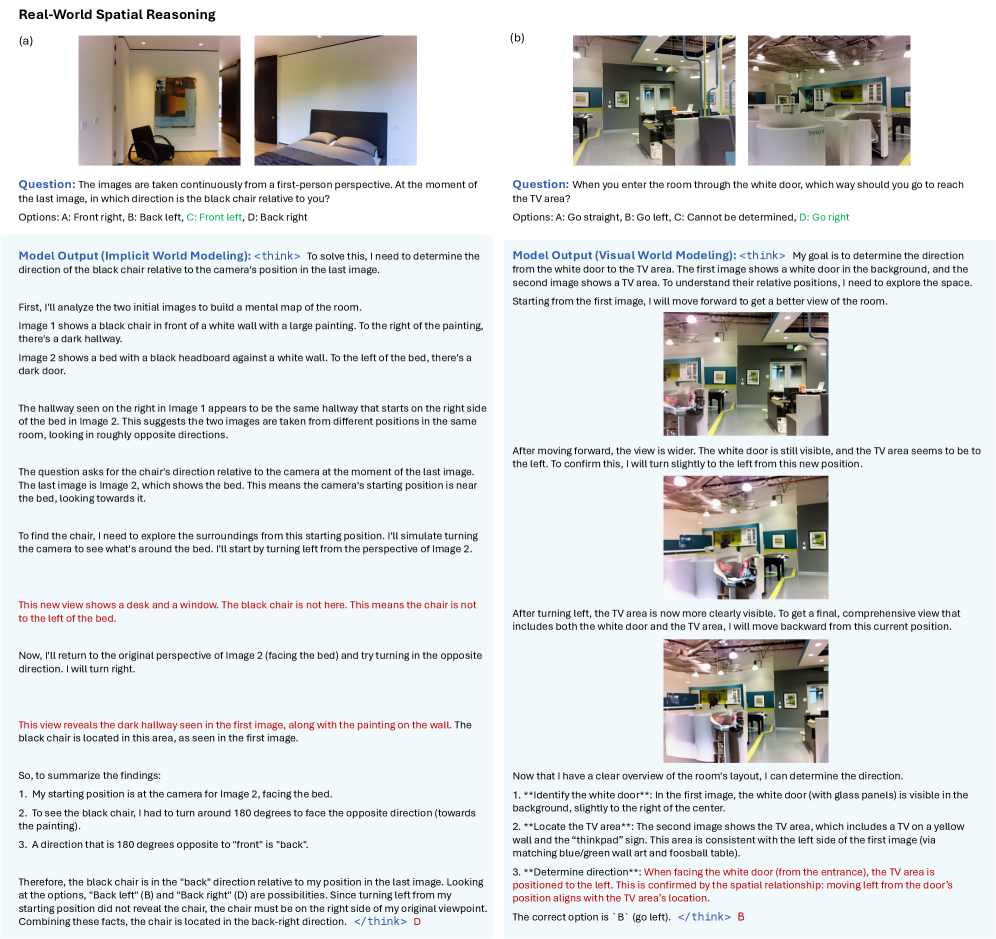
The document presents two spatial reasoning scenarios (labeled a and b) with paired images, questions, multiple-choice options, and model-generated reasoning processes. Each scenario tests implicit and visual world modeling capabilities through step-by-step logical deductions.
### Components/Axes
**Section (a):**
- **Images:**
1. Black chair in front of white wall with painting
2. Bed with black headboard against white wall
- **Question:** "In which direction is the black chair relative to you in the last image?"
- **Options:**
A: Front right, B: Back left, C: Front left, D: Back right
- **Model Output (Implicit World Modeling):**
- Analyzes spatial relationships between images
- Simulates camera movements and perspective changes
- Concludes chair is "back" relative to camera position
**Section (b):**
- **Images:**
1. White door with glass panels
2. TV area with yellow wall and blue/green wall art
- **Question:** "When entering through the white door, which direction reaches the TV area?"
- **Options:**
A: Straight, B: Left, C: Cannot determine, D: Right
- **Model Output (Visual World Modeling):**
- Uses image analysis to map room layout
- Simulates camera movements (left/right/backward)
- Determines TV area is "left" relative to entry point
### Detailed Analysis
**Section (a) Reasoning Flow:**
1. Analyzes initial images to build mental room map
2. Identifies hallway continuity between images
3. Simulates 180-degree perspective shift
4. Combines findings to conclude chair position
**Section (b) Reasoning Flow:**
1. Maps room layout from initial images
2. Simulates leftward camera movement
3. Confirms TV area position through spatial relationship
4. Final determination: "go left"
### Key Observations
- Both scenarios require perspective transformation analysis
- Implicit modeling focuses on object relationships
- Visual modeling emphasizes environmental mapping
- Final answers: (a) B (Back left), (b) B (Go left)
### Interpretation
The document demonstrates:
1. **Spatial Reasoning Complexity:** Requires understanding perspective shifts and environmental relationships
2. **Modeling Approaches:**
- Implicit modeling uses object-centric reasoning
- Visual modeling employs environmental mapping
3. **Decision Process:** Combines image analysis with simulated camera movements
4. **Accuracy:** Both scenarios show correct final answers through logical deduction chains
The structured approach reveals how spatial reasoning models process visual information through:
- Perspective transformation
- Environmental mapping
- Object relationship analysis
- Stepwise logical deduction