## Text List: Thematic Categories
### Overview
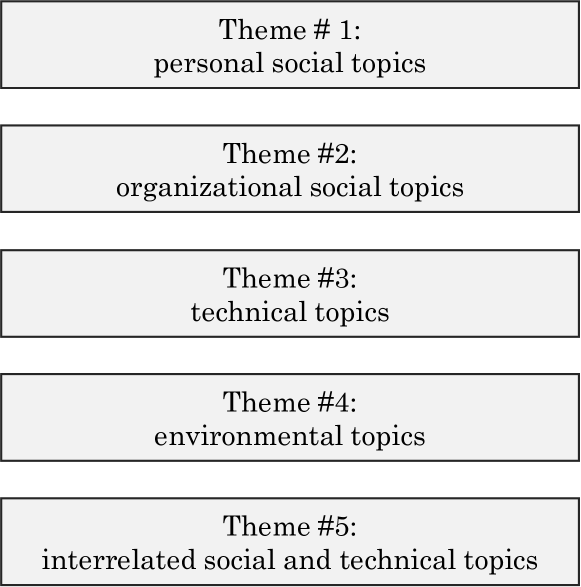
The image displays a vertically aligned list of five numbered themes, each presented as a heading followed by a descriptive phrase. The text is rendered in a serif font against a plain, light background. There are no charts, diagrams, or complex graphical elements; the content is purely textual.
### Components/Axes
* **Format:** A simple, numbered list.
* **Font:** Serif typeface.
* **Layout:** Text is centered horizontally. Each theme is separated by vertical space.
* **Language:** English.
### Content Details
The image contains the following five thematic entries, transcribed exactly as they appear:
1. **Theme # 1:**
personal social topics
2. **Theme #2:**
organizational social topics
3. **Theme #3:**
technical topics
4. **Theme #4:**
environmental topics
5. **Theme #5:**
interrelated social and technical topics
### Key Observations
* The list follows a clear numerical sequence from 1 to 5.
* The themes progress from individual/personal scope (#1) to organizational (#2), then to non-social domains like technical (#3) and environmental (#4), culminating in a theme that explicitly combines social and technical aspects (#5).
* The phrasing is concise and categorical, suggesting a framework for classification or analysis.
### Interpretation
This list appears to define a taxonomy or coding scheme for categorizing topics, likely within a research, analytical, or organizational context. The structure suggests a deliberate progression:
* **Themes #1 & #2** focus on the social dimension at different scales (personal vs. organizational).
* **Themes #3 & #4** introduce distinct, non-social domains (technical and environmental).
* **Theme #5** serves as a synthesis category, acknowledging the complexity of real-world issues that span both social and technical realms.
The framework implies that understanding a subject may require examining it through these multiple, sometimes overlapping, lenses. The absence of numerical data indicates this is a conceptual model rather than a presentation of empirical results. Its primary function is to provide a structured vocabulary for discussion or analysis.