## Diagram: Protocol Negotiation
### Overview
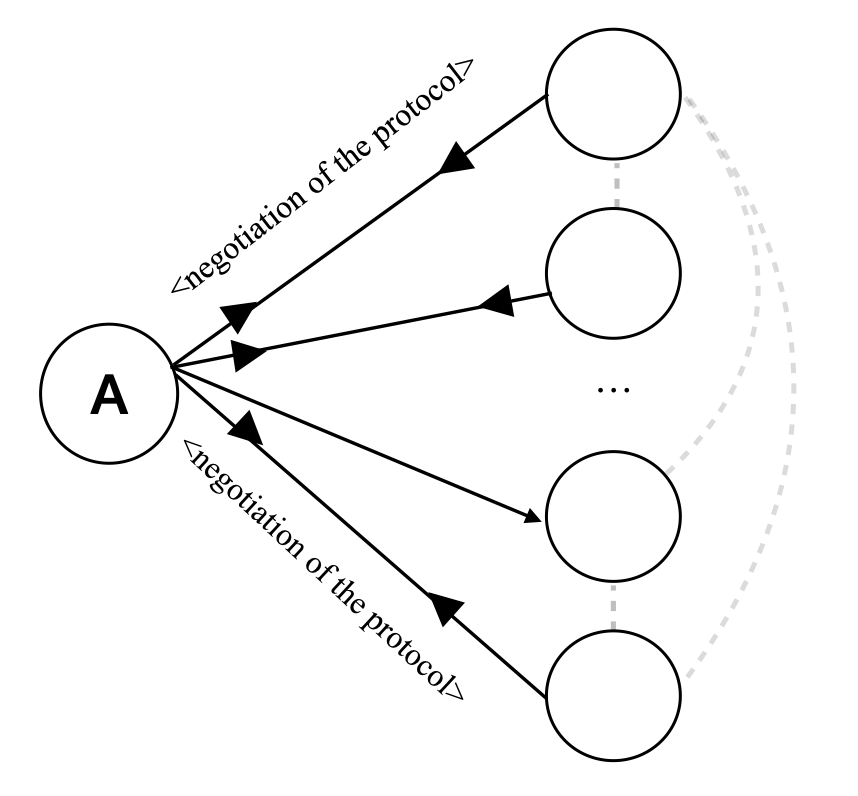
The image is a diagram illustrating a protocol negotiation process. It shows a central node labeled "A" connected to multiple other nodes via directed edges, representing the negotiation flow. A dashed line connects the last node back to the first, suggesting a cyclical or iterative process.
### Components/Axes
* **Nodes:** Represented by circles. One central node labeled "A" and multiple other unlabeled nodes.
* **Edges:** Directed arrows indicating the direction of negotiation.
* **Labels:**
* Central Node: "A"
* Edges: "<negotiation of the protocol>" (appears twice)
* Ellipsis: "..." indicating continuation of nodes.
* **Connections:** Solid black lines with arrowheads indicate the negotiation flow from node A to other nodes. Dashed gray lines indicate a connection between the last and first of the other nodes.
### Detailed Analysis
* **Central Node:** The central node, labeled "A", acts as the starting point for the negotiation process.
* **Negotiation Flow:** The solid black arrows indicate that the negotiation flows from node "A" to each of the other nodes. The text "<negotiation of the protocol>" is associated with these arrows.
* **Other Nodes:** There are four other nodes depicted, with an ellipsis ("...") suggesting that there may be more.
* **Cyclical Connection:** The dashed gray line connects the last node back to the first node, suggesting a loop or cycle in the negotiation process.
### Key Observations
* The diagram illustrates a star-like network topology with node "A" at the center.
* The negotiation process appears to be initiated by node "A" and directed towards other nodes.
* The dashed line suggests a feedback loop or a cyclical process.
### Interpretation
The diagram represents a protocol negotiation process where a central entity "A" initiates negotiations with multiple other entities. The "<negotiation of the protocol>" label suggests that the arrows represent the exchange of information or proposals related to the protocol. The dashed line indicates that the process is iterative, potentially involving adjustments or refinements based on the outcomes of previous negotiations. The ellipsis suggests that the number of entities involved in the negotiation may be variable or unspecified.