\n
## Diagram: Protocol Negotiation Flow
### Overview
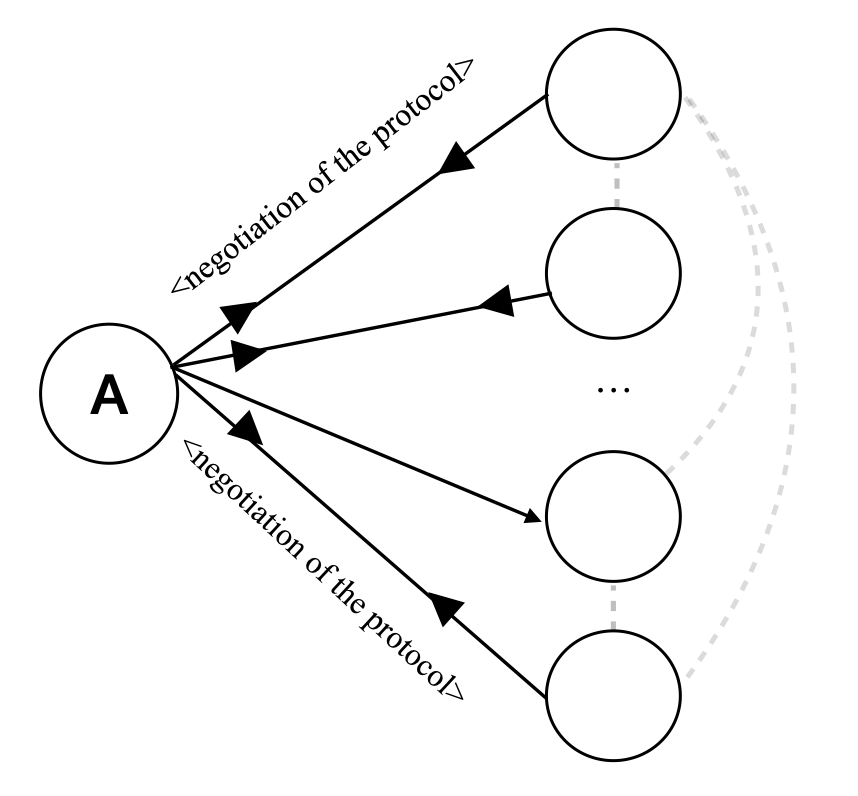
The image depicts a diagram illustrating a protocol negotiation flow originating from a central node labeled "A". The diagram shows "A" initiating negotiations with multiple other nodes, represented by circles. The connections between "A" and the other nodes are labeled with "<negotiation of the protocol>". A dashed gray line connects the bottom-most node to a placeholder indicated by "...".
### Components/Axes
* **Node A:** The central initiating node, labeled "A". Located on the left side of the diagram.
* **Negotiation Nodes:** Multiple circular nodes representing entities involved in protocol negotiation. Positioned to the right of Node A.
* **Negotiation Arrows:** Solid black arrows indicating the direction of protocol negotiation from Node A to the negotiation nodes. Each arrow is labeled "<negotiation of the protocol>".
* **Placeholder:** Three dots ("...") indicating that the negotiation flow continues with more nodes.
* **Dashed Line:** A dashed gray line connecting the last explicitly drawn negotiation node to the placeholder.
### Detailed Analysis or Content Details
The diagram shows a one-to-many relationship where Node A initiates a protocol negotiation with several other nodes. The label "<negotiation of the protocol>" appears on each arrow, suggesting a consistent negotiation process. The dashed line and "..." indicate that the diagram represents a partial view of a potentially larger system with more negotiation nodes. There are four fully drawn negotiation nodes. The arrows all originate from Node A and point towards the negotiation nodes.
### Key Observations
* The diagram illustrates a fan-out pattern, where a single entity (A) interacts with multiple others.
* The consistent labeling of the arrows suggests a standardized negotiation process.
* The placeholder indicates that the diagram is not exhaustive and represents a subset of the overall system.
* The dashed line suggests a continuation of the negotiation flow, but without specific details.
### Interpretation
The diagram likely represents a communication or control system where a central authority (A) establishes a protocol with multiple clients or devices. The negotiation process ensures that all parties agree on the communication rules before data exchange or operation begins. The use of a placeholder suggests that the system is scalable and can accommodate an arbitrary number of negotiation nodes. The diagram is abstract and does not provide specific details about the protocol itself or the nature of the negotiation. It focuses on the flow of the negotiation process rather than the content of the negotiation. The diagram could represent a network protocol setup, a security handshake, or any other scenario where a standardized agreement is required before interaction.