## Time Series Chart: 3-Axis Motion Data
### Overview
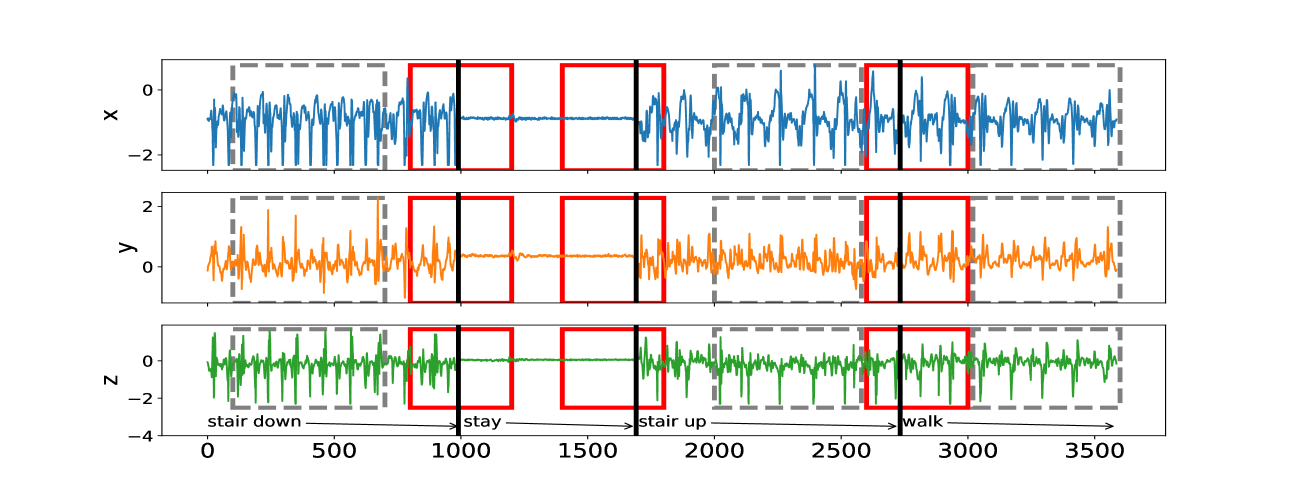
The image presents three time series charts stacked vertically, representing motion data along the X, Y, and Z axes. Each chart displays signal intensity (approximately ranging from -4 to 2) over time (from 0 to 3500 time units). Red boxes highlight specific time intervals labeled with activity types: "stair down", "stay", "stair up", and "walk". Grey dashed vertical lines demarcate the boundaries of these activity segments.
### Components/Axes
* **X-axis:** Time (units from 0 to 3500).
* **Y-axis (for each chart):** Signal Intensity (approximately -4 to 2). Each chart has a different label: "X", "Y", and "Z".
* **Labels:** "stair down", "stay", "stair up", "walk".
* **Highlighting:** Red rectangular boxes around specific time intervals.
* **Vertical Lines:** Grey dashed lines marking segment boundaries.
### Detailed Analysis or Content Details
**Chart 1: X-Axis Data**
* The X-axis data (blue line) exhibits a generally oscillating pattern throughout the entire time series.
* **"stair down" (0-500):** High-frequency oscillations with an approximate amplitude of 1.5.
* **"stay" (500-1000):** The signal stabilizes around 0, with minimal oscillation.
* **"stair up" (1000-1500):** Similar to "stair down", high-frequency oscillations with an approximate amplitude of 1.5.
* **"walk" (1500-3500):** Oscillations continue, but with a slightly lower average amplitude (around 1.2) and a more irregular pattern.
**Chart 2: Y-Axis Data**
* The Y-axis data (orange line) also shows oscillations, but with a different character than the X-axis.
* **"stair down" (0-500):** Oscillations with an approximate amplitude of 1.
* **"stay" (500-1000):** Signal stabilizes around 0, with minimal oscillation.
* **"stair up" (1000-1500):** Oscillations with an approximate amplitude of 1.
* **"walk" (1500-3500):** Oscillations continue, with a slightly lower average amplitude (around 0.8) and a more irregular pattern.
**Chart 3: Z-Axis Data**
* The Z-axis data (green line) displays a more complex pattern, with a noticeable negative offset.
* **"stair down" (0-500):** Oscillations around -2, with an approximate amplitude of 1.
* **"stay" (500-1000):** Signal stabilizes around -2, with minimal oscillation.
* **"stair up" (1000-1500):** Oscillations around -2, with an approximate amplitude of 1.
* **"walk" (1500-3500):** Oscillations continue, with a slightly lower average amplitude (around 0.7) and a more irregular pattern.
### Key Observations
* The "stay" periods consistently show minimal signal variation across all three axes, indicating a stationary state.
* "Stair down" and "stair up" exhibit similar oscillatory patterns, suggesting a consistent motion profile during these activities.
* The "walk" period shows more irregular oscillations, likely due to the more complex and variable nature of walking.
* The Z-axis data is consistently offset to negative values, suggesting a predominant downward force or orientation.
### Interpretation
The data likely represents accelerometer readings from a sensor attached to a person or object. The three axes (X, Y, and Z) capture motion in three dimensions. The labeled segments ("stair down", "stay", "stair up", "walk") represent different activities, and the corresponding signal patterns allow for activity recognition.
The consistent patterns during "stair down" and "stair up" suggest a relatively regular motion profile, while the more irregular pattern during "walk" reflects the more complex dynamics of walking. The stabilization of signals during "stay" confirms a lack of movement. The negative offset in the Z-axis could indicate the sensor is oriented downwards, or that the subject is generally leaning or applying force in a downward direction.
This type of data is commonly used in activity recognition systems, wearable sensors, and human-computer interaction applications. The data suggests a clear correlation between the observed motion patterns and the labeled activities, which could be used to train a machine learning model for automated activity classification.