## Flowchart: Solution Verification and Finetuning Process
### Overview
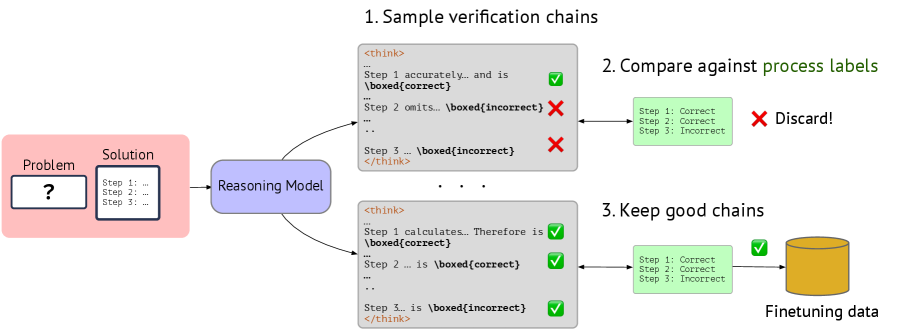
The image depicts a technical workflow for evaluating and refining solution chains generated by a reasoning model. It illustrates a multi-step verification process, comparison against process labels, and data selection for model finetuning. The diagram uses color-coded boxes, checkmarks, and X marks to represent correctness and decision points.
### Components/Axes
1. **Problem & Solution Section** (Pink Rectangle):
- Contains a question mark (Problem) and a solution box with three steps (Step 1, Step 2, Step 3).
2. **Reasoning Model** (Blue Oval):
- Central component connecting problem/solution to verification chains.
3. **Sample Verification Chains** (Two Gray Boxes):
- **Chain 1**:
- Step 1: Correct (✓)
- Step 2: Incorrect (✗)
- Step 3: Incorrect (✗)
- **Chain 2**:
- Step 1: Correct (✓)
- Step 2: Correct (✓)
- Step 3: Incorrect (✗)
4. **Process Labels** (Green Box):
- Textual comparison of verification chain steps.
5. **Finetuning Data** (Orange Cylinder):
- Final output for model improvement.
### Detailed Analysis
- **Verification Chain 1**:
- Step 1: "accurately..." (✓)
- Step 2: "omits..." (✗)
- Step 3: "..." (✗)
- Outcome: Discarded (✗ "Discard!").
- **Verification Chain 2**:
- Step 1: "calculates..." (✓)
- Step 2: "is..." (✓)
- Step 3: "is..." (✗)
- Outcome: Kept (✓ "Keep good chains").
- **Process Labels**:
- Explicitly lists steps with correctness annotations:
- Step 1: Correct
- Step 2: Correct
- Step 3: Incorrect
- **Finetuning Data**:
- Receives input from kept chains (Chain 2).
### Key Observations
1. **Partial Correctness Retention**: Chain 2 is retained despite Step 3 being incorrect, suggesting the system prioritizes majority correctness.
2. **Step-by-Step Evaluation**: Each verification chain is assessed individually, with explicit correctness labels for each step.
3. **Color-Coded Feedback**: Green (✓) and red (✗) symbols provide immediate visual feedback on step validity.
4. **Data Flow**: Only chains passing the "Compare against process labels" stage contribute to finetuning data.
### Interpretation
This workflow demonstrates a quality control mechanism for AI-generated solutions. By retaining chains with partial correctness (e.g., Chain 2), the system likely aims to:
- Capture near-correct reasoning patterns for iterative improvement.
- Balance between discarding entirely flawed solutions and preserving valuable partial insights.
- Use explicit process labels to ground evaluations in predefined criteria, reducing ambiguity in verification.
The orange finetuning data cylinder acts as a feedback loop, implying the model will be retrained on these curated chains to reduce future errors. The red "Discard!" label on Chain 1 highlights a strict threshold for solution validity, while the green checkmark on Chain 2 suggests a more lenient approach for chains with mixed results.