\n
## Photographs: Object Recognition Examples
### Overview
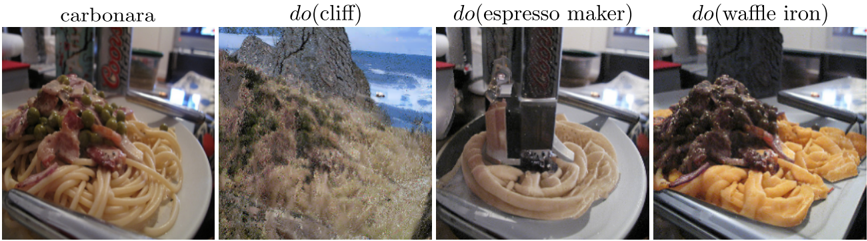
The image presents four photographs arranged horizontally. Each photograph depicts a different object, and each is labeled with a descriptive string above it. The labels appear to be related to object recognition or image classification tasks.
### Components/Axes
There are no axes or scales present in this image. The components are simply the four photographs and their corresponding labels. The labels are positioned directly above their respective images.
### Detailed Analysis or Content Details
1. **carbonara:** The first image shows a plate of spaghetti carbonara. The dish includes pasta, bacon, egg yolk, and what appears to be peas. A can of soda is visible in the background.
2. **do(cliff):** The second image depicts a rocky cliff face overlooking a body of water (likely the ocean). Vegetation is growing on the cliff. The sky is overcast.
3. **do(espresso maker):** The third image shows an espresso maker in operation, pressing down on a portion of what appears to be a pastry or cake. The machine is metallic and industrial-looking.
4. **do(waffle iron):** The fourth image displays a waffle iron with cooked waffles inside. There is also a pile of dark-colored food (possibly meat) on top of the waffles.
### Key Observations
The images are diverse in content, ranging from food to natural landscapes to machinery. The labels "do(cliff)", "do(espresso maker)", and "do(waffle iron)" suggest these images are being used as examples for a computer vision or machine learning task, potentially related to object detection or image classification. The "do()" prefix might indicate a function call or a specific context within a program.
### Interpretation
The image serves as a visual demonstration of objects that a system might be trained to recognize. The variety of objects suggests the system is intended to handle a broad range of visual inputs. The labels indicate a focus on identifying specific objects within images. The "do()" notation suggests these images are part of a larger process, possibly a test set or training data for a machine learning model. The image does not provide any quantitative data or trends; it is purely illustrative. The image is a collection of photographs used to demonstrate object recognition capabilities.