## Photographs with Labels: Four-Panel Image Set
### Overview
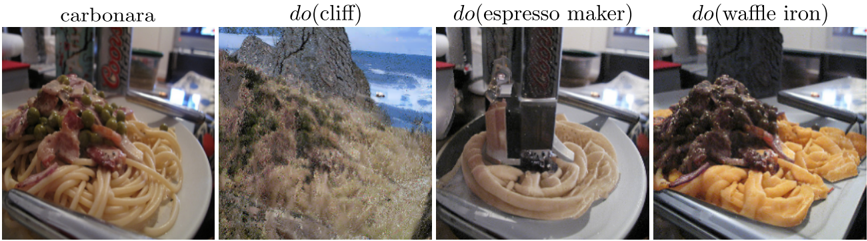
The image consists of four distinct photographs arranged horizontally in a single row. Each photograph is accompanied by a text label positioned directly above it. The set appears to be a composite image, likely from a dataset or research paper, showcasing different subjects or actions. The overall composition is a simple, non-interactive grid of four images.
### Components/Axes
The image is segmented into four vertical panels of equal width. Each panel contains:
1. **A Photograph:** A rectangular image depicting a specific scene or object.
2. **A Text Label:** A single line of text in a sans-serif font, centered above its corresponding photograph.
**Labels (from left to right):**
1. `carbonara`
2. `do(cliff)`
3. `do(espresso maker)`
4. `do(waffle iron)`
### Detailed Analysis
**Panel 1 (Leftmost):**
* **Label:** `carbonara`
* **Image Content:** A close-up photograph of a plate of pasta. The dish appears to be spaghetti carbonara, featuring long pasta strands coated in a creamy sauce, mixed with pieces of cured meat (likely guanciale or pancetta) and possibly green peas or herbs. The pasta is served on a white plate. In the background, out of focus, is a metallic object that resembles part of a kitchen appliance or utensil holder.
**Panel 2 (Second from left):**
* **Label:** `do(cliff)`
* **Image Content:** A landscape photograph of a coastal cliff. The foreground shows dry, grassy vegetation and rocky terrain. The mid-ground features a steep, rugged cliff face descending towards the sea. The background shows the ocean with visible white waves crashing against the base of the cliffs under a partly cloudy sky.
**Panel 3 (Third from left):**
* **Label:** `do(espresso maker)`
* **Image Content:** A close-up action shot of an espresso machine in operation. The focus is on the portafilter (the handled component that holds the coffee grounds) from which a stream of espresso is being extracted into a cup below. The coffee is forming a circular, layered pattern in the cup. The machine's metallic group head and handle are prominently visible.
**Panel 4 (Rightmost):**
* **Label:** `do(waffle iron)`
* **Image Content:** A close-up photograph of a waffle iron containing freshly cooked waffles. The waffles have a deep, grid-like pattern and a golden-brown color. They are topped with a generous amount of a dark, chunky substance, possibly a fruit compote, chocolate spread, or savory topping. The open waffle iron's cooking plates are visible around the edges of the waffles.
### Key Observations
1. **Subject Diversity:** The four panels depict highly diverse subjects: a prepared food dish (carbonara), a natural landscape (cliff), a kitchen appliance in use (espresso maker), and another kitchen appliance with food (waffle iron).
2. **Label Syntax:** The labels use two distinct formats. "carbonara" is a simple noun. The other three labels use a `do(object)` format, which strongly suggests an action or interaction with the named object (e.g., the action of making coffee with an espresso maker, or cooking with a waffle iron).
3. **Photography Style:** All images are realistic, color photographs with a shallow depth of field in the food/appliance shots, focusing attention on the main subject. The cliff image has a deeper focus to capture the landscape.
4. **Potential Context:** The combination of a static object label (`carbonara`) with three action-oriented labels (`do(...)`) is notable. This could indicate a dataset for training AI models to recognize both objects and the actions performed with them.
### Interpretation
This composite image is most likely a figure from a technical document, such as a computer vision or machine learning research paper. The `do(...)` notation is a common way in such fields to denote an action class (e.g., from datasets like Something-Something or Charades). The figure likely serves to illustrate example samples from a dataset or the outputs of a model capable of classifying both objects and actions.
The inclusion of "carbonara" without the `do()` prefix might represent a control, a different class of label (pure object recognition), or an error/inconsistency in the figure's labeling scheme. The primary informational content is not numerical data but categorical: it defines four distinct visual concepts. The relationship between the panels is categorical rather than sequential or comparative; they are presented as separate, equally important examples. The key takeaway is the demonstration of a labeling system that distinguishes between a static object ("carbonara") and actions performed with specific tools or in specific environments ("do(cliff)", "do(espresso maker)", "do(waffle iron)").