## Diagram: Key Caching System Architecture
### Overview
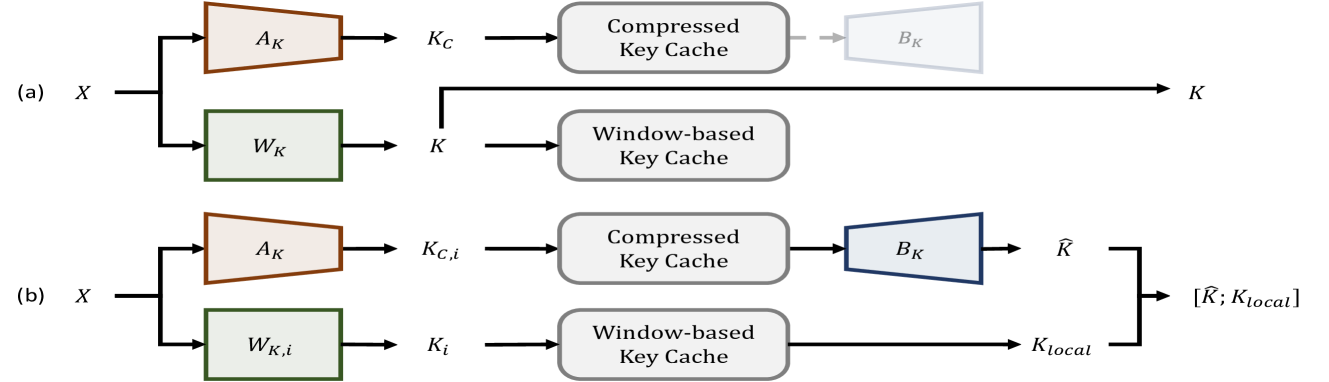
The image depicts two key caching architectures (labeled **a** and **b**) for processing input data **X**. Both architectures involve splitting **X** into components, processing through key caches, and producing outputs. The diagrams use color-coded blocks and arrows to represent data flow, transformations, and caching mechanisms.
### Components/Axes
1. **Input**:
- **X**: Primary input data source (positioned at the top-left of both sections).
2. **Processing Paths**:
- **Section (a)**:
- **A_K** (orange block): Transforms **X** into **K_c**.
- **W_K** (green block): Processes **X** directly into **K**.
- **Compressed Key Cache** (gray block): Stores **K_c** and outputs **B_K**.
- **Window-based Key Cache** (gray block): Stores **K** and outputs **K**.
- **Section (b)**:
- **A_K** (orange block): Transforms **X** into **K_c,i**.
- **W_K,i** (green block): Processes **X** into **K_i**.
- **Compressed Key Cache** (gray block): Stores **K_c,i** and outputs **B_K**.
- **Window-based Key Cache** (gray block): Stores **K_i** and outputs **K_local**.
3. **Outputs**:
- **K**: Final output in section (a).
- **K̂**: Refined output in section (b), derived from **B_K**.
- **[K̂; K_local]**: Combined output in section (b), merging **K̂** and **K_local**.
4. **Arrows**:
- Black arrows indicate data flow direction.
- Dashed arrows (e.g., from **Compressed Key Cache** to **B_K**) suggest optional or indirect pathways.
5. **Color Coding**:
- **Orange**: Key transformation blocks (**A_K**).
- **Green**: Window-based processing blocks (**W_K**, **W_K,i**).
- **Gray**: Key cache blocks (**Compressed Key Cache**, **Window-based Key Cache**).
- **Blue**: Refined output block (**B_K**).
### Detailed Analysis
- **Section (a)**:
- **A_K** and **W_K** process **X** independently.
- **K_c** (from **A_K**) is compressed and cached, then partially output as **B_K**.
- **K** (from **W_K**) bypasses compression and is directly cached and output.
- **Section (b)**:
- Introduces **W_K,i** and **K_i**, suggesting iterative or localized processing.
- **K_c,i** (from **A_K**) is compressed and cached, then refined into **B_K**.
- **K_i** (from **W_K,i**) is cached locally and combined with **K̂** for final output.
### Key Observations
1. **Evolution from (a) to (b)**:
- Section (b) adds granularity with **W_K,i** and **K_i**, implying localized or windowed processing.
- **K_local** in (b) suggests a focus on proximity-aware caching.
2. **Caching Strategies**:
- **Compressed Key Cache** reduces storage overhead for transformed keys (**K_c**, **K_c,i**).
- **Window-based Key Cache** retains raw keys (**K**, **K_i**) for direct use.
3. **Output Refinement**:
- **B_K** (blue block) acts as an intermediary for refining **K_c,i** into **K̂**.
- Final output **[K̂; K_local]** combines refined and localized keys, indicating a hybrid approach.
### Interpretation
The diagram illustrates a progression from a simple key caching system (section **a**) to a more sophisticated, multi-stage architecture (section **b**). Key insights include:
- **Efficiency vs. Accuracy**: Compressed caching reduces storage but may lose fidelity, while window-based caching preserves raw data for critical use cases.
- **Localization**: The introduction of **K_local** in (b) suggests optimization for proximity-sensitive applications (e.g., edge computing).
- **Hybrid Output**: Combining **K̂** (refined) and **K_local** (localized) implies a balance between global efficiency and local responsiveness.
This architecture could be applied to systems requiring adaptive caching, such as distributed databases, real-time analytics, or edge AI deployments. The use of color and block differentiation aids in visualizing the trade-offs between compression, caching, and output refinement.