## Diagram: Problem Solving Process
### Overview
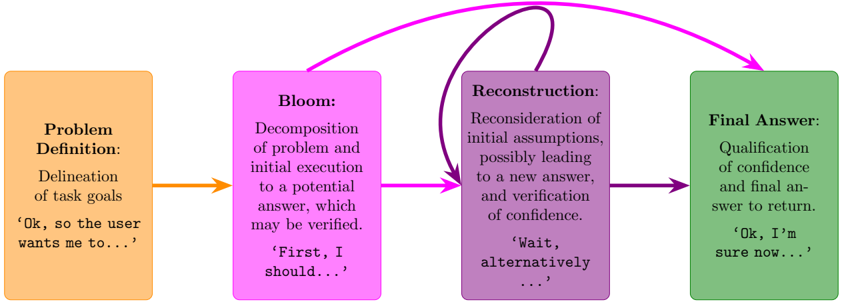
The image is a diagram illustrating a problem-solving process. It consists of four stages represented by colored rectangles, with arrows indicating the flow of the process. The process starts with "Problem Definition," moves to "Bloom," then "Reconstruction," and finally "Final Answer." There is a feedback loop from "Reconstruction" back to "Bloom" and from "Reconstruction" back to "Final Answer".
### Components/Axes
* **Rectangles (Stages):**
* **Problem Definition:** (Orange)
* Description: Delineation of task goals.
* Example: 'Ok, so the user wants me to...'
* **Bloom:** (Pink)
* Description: Decomposition of problem and initial execution to a potential answer, which may be verified.
* Example: 'First, I should...'
* **Reconstruction:** (Purple)
* Description: Reconsideration of initial assumptions, possibly leading to a new answer, and verification of confidence.
* Example: 'Wait, alternatively...'
* **Final Answer:** (Green)
* Description: Qualification of confidence and final answer to return.
* Example: 'Ok, I'm sure now...'
* **Arrows:**
* Orange arrow: From "Problem Definition" to "Bloom."
* Pink arrow: From "Bloom" to "Reconstruction."
* Purple arrow: From "Reconstruction" to "Final Answer."
* Magenta curved arrow: From "Reconstruction" back to "Bloom."
* Magenta curved arrow: From "Reconstruction" to "Final Answer."
### Detailed Analysis or Content Details
The diagram presents a sequential process with feedback loops.
1. **Problem Definition:** The process begins with defining the problem and setting task goals.
2. **Bloom:** The problem is then decomposed, and an initial attempt is made to find a potential answer.
3. **Reconstruction:** The initial assumptions are reconsidered, potentially leading to a new answer. Confidence is verified.
4. **Final Answer:** The final answer is qualified with a level of confidence and returned.
The feedback loops from "Reconstruction" to "Bloom" and "Reconstruction" to "Final Answer" indicate that the process can iterate and refine the solution based on the reconsideration of assumptions.
### Key Observations
* The process is iterative, as indicated by the feedback loops.
* Each stage includes a brief description and an example phrase.
* The color-coding helps to visually distinguish the stages.
### Interpretation
The diagram illustrates a problem-solving approach that emphasizes iterative refinement and verification of confidence. The "Bloom" stage represents an initial attempt to solve the problem, while the "Reconstruction" stage allows for revisiting assumptions and improving the solution. The feedback loops highlight the importance of continuous evaluation and adjustment in the problem-solving process. The process is not strictly linear; the feedback loops allow for revisiting earlier stages based on insights gained during reconstruction.