\n
## Diagram: Problem Solving Process
### Overview
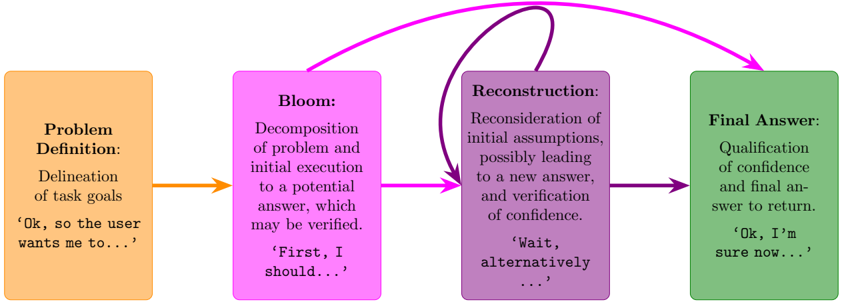
The image depicts a four-stage process for problem-solving, presented as a flow diagram with four colored rectangular blocks connected by curved arrows. The diagram illustrates a cyclical process, starting with problem definition and culminating in a final answer, with potential for reconstruction and refinement.
### Components/Axes
The diagram consists of four blocks, each representing a stage in the process:
1. **Problem Definition:** (Orange block) - "Delineation of task goals" and example phrase: "Ok, so the user wants to..."
2. **Bloom:** (Magenta block) - "Decomposition of problem and initial execution to a potential answer, which may be verified." and example phrase: "First, I should..."
3. **Reconstruction:** (Dark Red block) - "Reconsideration of initial assumptions, possibly leading to a new answer; and verification of confidence." and example phrase: "Wait, alternatively..."
4. **Final Answer:** (Green block) - "Qualification of confidence and final answer to return." and example phrase: "Ok, I'm sure now..."
The blocks are connected by curved arrows:
- Orange (Problem Definition) to Magenta (Bloom) - Orange arrow
- Magenta (Bloom) to Dark Red (Reconstruction) - Magenta arrow
- Dark Red (Reconstruction) to Green (Final Answer) - Grey arrow
- Green (Final Answer) to Orange (Problem Definition) - Grey arrow, completing the cycle.
### Detailed Analysis or Content Details
The diagram is structured linearly from left to right, but the final arrow returns to the beginning, indicating a cyclical process. Each block contains a descriptive title and a short example phrase.
* **Problem Definition:** The initial stage focuses on clearly defining the task or problem. The example phrase suggests a user-centric approach.
* **Bloom:** This stage involves breaking down the problem and attempting an initial solution. The phrase "may be verified" indicates a need for testing or validation.
* **Reconstruction:** This stage emphasizes critical thinking and re-evaluation of assumptions. The phrase "Wait, alternatively..." suggests exploring different approaches.
* **Final Answer:** The final stage involves confirming the solution and expressing confidence in its accuracy.
### Key Observations
The diagram highlights the iterative nature of problem-solving. The cycle suggests that the process may require multiple rounds of refinement before arriving at a satisfactory solution. The inclusion of example phrases provides context and makes the process more relatable. The use of different colors for each stage helps to visually distinguish them.
### Interpretation
This diagram illustrates a robust problem-solving methodology that goes beyond simply finding an answer. It emphasizes the importance of clear problem definition, initial exploration, critical evaluation, and confidence building. The cyclical nature of the process suggests that problem-solving is rarely a linear path and often requires revisiting earlier stages. The diagram is likely intended for use in fields such as software development, design thinking, or any domain where complex problems require careful analysis and iterative refinement. The phrases within each block suggest a conversational or thought-process style, potentially representing internal dialogue during problem-solving. The diagram is a conceptual model rather than a data-driven representation; it does not present numerical data or measurable values. It is a qualitative illustration of a process.