\n
## Diagram: Iterative Problem-Solving Flowchart
### Overview
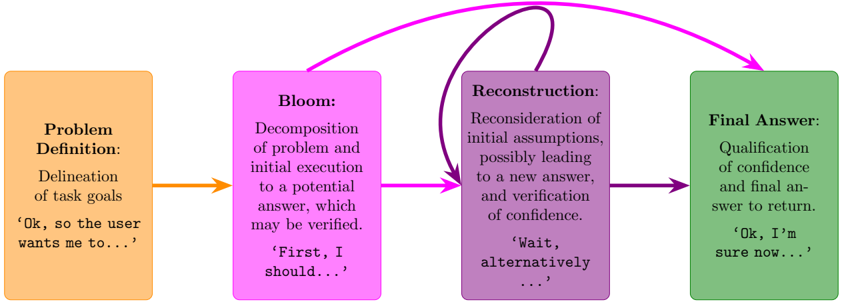
The image displays a four-stage, iterative flowchart illustrating a problem-solving or reasoning process. The flowchart uses colored rectangular boxes connected by directional arrows, indicating a primary linear progression with two significant feedback loops that allow for re-evaluation and refinement.
### Components/Axes
The diagram consists of four main components arranged horizontally from left to right:
1. **Problem Definition (Orange Box, Leftmost)**
* **Title:** Problem Definition:
* **Description:** Delineation of task goals
* **Example Phrase:** 'Ok, so the user wants me to...'
* **Connection:** An orange arrow points from this box to the "Bloom" box.
2. **Bloom (Magenta Box, Center-Left)**
* **Title:** Bloom:
* **Description:** Decomposition of problem and initial execution to a potential answer, which may be verified.
* **Example Phrase:** 'First, I should...'
* **Connections:** Receives an orange arrow from "Problem Definition." A magenta arrow points from this box to the "Reconstruction" box. It also receives two feedback arrows (see below).
3. **Reconstruction (Purple Box, Center-Right)**
* **Title:** Reconstruction:
* **Description:** Reconsideration of initial assumptions, possibly leading to a new answer, and verification of confidence.
* **Example Phrase:** 'Wait, alternatively...'
* **Connections:** Receives a magenta arrow from "Bloom." A purple arrow points from this box to the "Final Answer" box. A **purple curved feedback arrow** originates from the top of this box and points back to the top of the "Bloom" box.
4. **Final Answer (Green Box, Rightmost)**
* **Title:** Final Answer:
* **Description:** Qualification of confidence and final answer to return.
* **Example Phrase:** 'Ok, I'm sure now...'
* **Connections:** Receives a purple arrow from "Reconstruction." A **magenta curved feedback arrow** originates from the top of this box and points back to the top of the "Bloom" box.
### Detailed Analysis
The process flow is as follows:
1. **Primary Linear Path:** Problem Definition → Bloom → Reconstruction → Final Answer. This represents the standard forward progression from understanding the task to generating and verifying an answer.
2. **Feedback Loop 1 (Reconstruction → Bloom):** A purple curved arrow indicates that during the "Reconstruction" phase, the process can loop back to the "Bloom" phase. This suggests that reconsidering assumptions may require re-decomposing the problem or re-executing initial steps.
3. **Feedback Loop 2 (Final Answer → Bloom):** A magenta curved arrow indicates that even at the "Final Answer" stage, the process can loop back to "Bloom." This implies that final confidence qualification might reveal a need to revisit the problem decomposition or initial execution.
### Key Observations
* **Iterative Nature:** The two feedback loops are the most critical feature, transforming a simple linear process into an iterative one. This emphasizes that problem-solving is not always a straight line and may require backtracking.
* **Stage-Specific Language:** The example phrases ('Ok, so...', 'First, I should...', 'Wait, alternatively...', 'Ok, I'm sure now...') provide concrete, conversational markers for each cognitive stage.
* **Color Coding:** Each stage has a distinct color (orange, magenta, purple, green), and the connecting arrows match the color of their source box, except for the feedback arrows which use the color of their origin stage.
### Interpretation
This flowchart models a metacognitive or AI reasoning process that values verification and self-correction. It doesn't just generate an answer; it builds in mandatory checkpoints ("verification of confidence," "qualification of confidence") that can trigger a return to earlier stages.
The "Bloom" stage acts as the central execution hub, as both feedback loops return to it. This suggests that the core act of problem decomposition and initial execution is where adjustments are most fundamentally made. The process is designed to be robust, allowing for the discovery of flawed assumptions ("Reconstruction") or last-minute doubts ("Final Answer") to prompt a re-evaluation rather than forcing a potentially incorrect output. It visually represents a system that prioritizes accuracy and confidence over speed or linear efficiency.