## Flowchart: Problem-Solving Process with Feedback Loop
### Overview
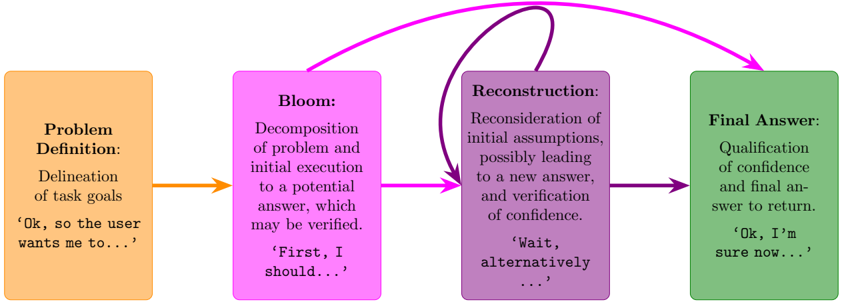
The image depicts a four-stage problem-solving process represented as a flowchart. The stages are connected sequentially with directional arrows, including a feedback loop from the "Reconstruction" stage back to the "Bloom" stage. Each stage is color-coded and contains descriptive text and example dialogue snippets.
### Components/Axes
1. **Stages (Boxes)**:
- **Problem Definition** (Orange): Contains the text "Problem Definition: Delineation of task goals" and example dialogue: "‘Ok, so the user wants me to...’"
- **Bloom** (Pink): Contains "Bloom: Decomposition of problem and initial execution to a potential answer, which may be verified" and example: "‘First, I should...’"
- **Reconstruction** (Purple): Contains "Reconstruction: Reconsideration of initial assumptions, possibly leading to a new answer, and verification of confidence" and example: "‘Wait, alternatively...’"
- **Final Answer** (Green): Contains "Final Answer: Qualification of confidence and final answer to return" and example: "‘Ok, I’m sure now...’"
2. **Arrows**:
- **Orange Arrow**: From "Problem Definition" to "Bloom"
- **Pink Arrow**: From "Bloom" to "Reconstruction"
- **Purple Arrow**: From "Reconstruction" to "Final Answer"
- **Purple Feedback Loop**: From "Reconstruction" back to "Bloom"
### Detailed Analysis
- **Problem Definition**: Establishes the task goals, with an example prompt indicating user intent ("Ok, so the user wants me to...").
- **Bloom**: Focuses on decomposing the problem and executing initial steps to form a potential answer, illustrated by the phrase "First, I should...".
- **Reconstruction**: Involves re-evaluating assumptions, potentially revising the answer, and verifying confidence. The example "Wait, alternatively..." suggests exploring alternatives.
- **Final Answer**: Concludes with a confidence-verified response, exemplified by "Ok, I’m sure now...".
- **Feedback Loop**: The purple arrow from "Reconstruction" to "Bloom" indicates iterative refinement of assumptions and answers.
### Key Observations
- The process is linear but allows for iteration via the feedback loop, emphasizing adaptability in problem-solving.
- Each stage includes both a descriptive label and a concrete example, bridging abstract concepts with practical application.
- The color-coding (orange → pink → purple → green) visually reinforces the progression and feedback mechanism.
### Interpretation
This flowchart models a structured yet flexible approach to problem-solving, where initial assumptions (Bloom) are subject to revision (Reconstruction) before finalizing an answer. The feedback loop highlights the importance of revisiting and refining hypotheses, aligning with iterative methodologies like agile or scientific inquiry. The example dialogues ground the stages in conversational AI contexts, suggesting applications in natural language processing or human-AI collaboration. The absence of numerical data implies the focus is on process logic rather than quantitative analysis.