## Line Graph: Gradient Norms During Training
### Overview
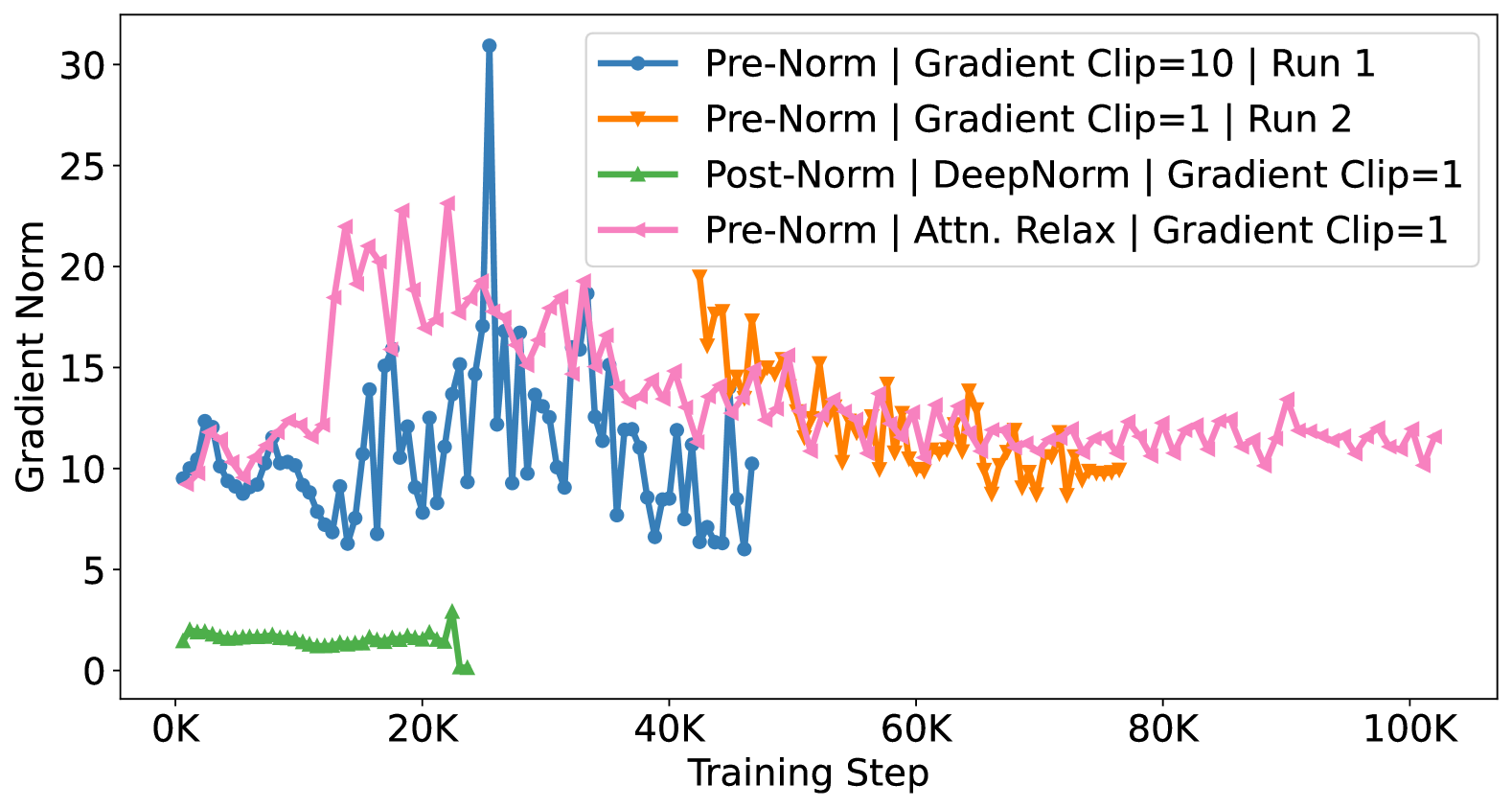
The line graph displays the gradient norms over training steps for four different normalization techniques: Pre-Norm, Post-Norm, DeepNorm, and Attn. Relax. The gradients are clipped at a maximum value of 10 for Pre-Norm and 1 for the other techniques.
### Components/Axes
- **X-axis (Training Step)**: Represents the number of training steps, ranging from 0 to 100,000.
- **Y-axis (Gradient Norm)**: Represents the gradient norm values, ranging from 0 to 30.
- **Legend**: Contains four lines, each representing a different normalization technique.
- **Pre-Norm | Gradient Clip=10 | Run 1**: Blue line with circular markers.
- **Pre-Norm | Gradient Clip=1 | Run 2**: Orange line with circular markers.
- **Post-Norm | DeepNorm | Gradient Clip=1**: Green line with square markers.
- **Pre-Norm | Attn. Relax | Gradient Clip=1**: Pink line with square markers.
### Detailed Analysis
- **Pre-Norm Techniques**: Both Pre-Norm techniques with Gradient Clip=10 and Gradient Clip=1 show a similar trend, with a sharp increase in gradient norm around the 20,000 training step mark, followed by a gradual decrease.
- **Post-Norm Technique**: The Post-Norm technique with DeepNorm and Gradient Clip=1 shows a more stable gradient norm, with a slight increase around the 20,000 training step mark and a gradual decrease thereafter.
- **Attn. Relax Technique**: The Attn. Relax technique with Gradient Clip=1 shows a similar trend to Pre-Norm techniques, with a sharp increase around the 20,000 training step mark, followed by a gradual decrease.
### Interpretation
The data suggests that the normalization techniques have different effects on the gradient norms during training. The Pre-Norm techniques with Gradient Clip=10 and Gradient Clip=1 show a similar trend, with a sharp increase in gradient norm around the 20,000 training step mark, followed by a gradual decrease. This could indicate that the normalization techniques are not significantly affecting the gradient norms during the later stages of training. The Post-Norm technique with DeepNorm and Gradient Clip=1 shows a more stable gradient norm, with a slight increase around the 20,000 training step mark and a gradual decrease thereafter. This could indicate that the normalization techniques are having a more significant effect on the gradient norms during the later stages of training. The Attn. Relax technique with Gradient Clip=1 shows a similar trend to Pre-Norm techniques, with a sharp increase around the 20,000 training step mark, followed by a gradual decrease. This could indicate that the normalization techniques are not significantly affecting the gradient norms during the later stages of training. Overall, the data suggests that the normalization techniques have different effects on the gradient norms during training, with the Post-Norm technique with DeepNorm and Gradient Clip=1 showing a more stable gradient norm.