## Scatter Plot: Accuracy vs. Consistency
### Overview
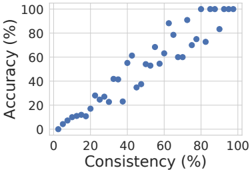
This image is a standard 2D scatter plot visualizing the relationship between two variables: "Consistency (%)" on the horizontal axis and "Accuracy (%)" on the vertical axis. The plot contains approximately 35-40 individual data points represented by blue circles. The data exhibits a clear, positive linear correlation, suggesting that as consistency increases, accuracy also tends to increase.
### Components/Axes
* **X-Axis:** Labeled "Consistency (%)". The scale ranges from 0 to 100, with major tick marks at intervals of 20 (0, 20, 40, 60, 80, 100).
* **Y-Axis:** Labeled "Accuracy (%)". The scale ranges from 0 to 100, with major tick marks at intervals of 20 (0, 20, 40, 60, 80, 100).
* **Data Series:** Represented by solid blue circular markers distributed across the plot area.
* **Grid:** A light grey grid is overlaid on the white background, aligned with the major tick marks of both axes.
### Detailed Analysis
The data points are distributed along a diagonal trajectory from the bottom-left origin (0,0) toward the top-right corner (100,100).
**Trend Verification:**
The visual trend is strongly positive. There is a distinct "ceiling effect" visible at the top right of the chart, where a cluster of data points aligns perfectly at 100% accuracy.
**Data Distribution (Approximate Values):**
* **Low Range (0-20% Consistency):** Points are tightly clustered near the diagonal, showing low accuracy (0-15%).
* **Mid-Low Range (20-40% Consistency):** Accuracy begins to spread. For example, at ~33% consistency, accuracy is ~42%. There is an outlier at ~38% consistency with only ~23% accuracy.
* **Mid-High Range (40-70% Consistency):** This region shows the highest variance.
* At ~45% consistency, accuracy is ~62%.
* At ~48% consistency, accuracy drops to ~35%.
* At ~65% consistency, accuracy reaches ~88%.
* At ~70% consistency, accuracy drops to ~60%.
* **High Range (80-100% Consistency):** The data points saturate at the top of the chart. Multiple points are positioned at 100% accuracy, starting from approximately 82% consistency through 100% consistency.
### Key Observations
* **Positive Correlation:** There is a strong, observable positive correlation between consistency and accuracy.
* **Saturation Point:** Once consistency exceeds approximately 80%, the accuracy consistently hits the maximum value of 100%.
* **Mid-Range Volatility:** The most significant variance occurs between 40% and 70% consistency. In this range, the same level of consistency does not guarantee the same level of accuracy, suggesting that other variables may influence the outcome in this specific performance band.
* **Outliers:** There are a few points that deviate from the tightest linear path, specifically the point at ~48% consistency / ~35% accuracy, which sits well below the general trend line of its neighbors.
### Interpretation
This chart likely represents a performance metric for a system (such as a machine learning model, a human annotator, or a manufacturing process) where "Consistency" is a prerequisite for "Accuracy."
The data suggests that consistency is a strong predictor of accuracy, but it is not a perfect linear function. The "ceiling effect" at 100% accuracy indicates that once a system achieves a high enough level of consistency (above 80%), it effectively achieves perfect accuracy. The volatility in the mid-range (40-70%) suggests that in this phase of operation, the system is unstable; small changes in consistency can lead to disproportionately large swings in accuracy, or perhaps there is an external factor causing performance instability in this specific range.