## Line Chart: Mstencil/s vs Input Length
### Overview
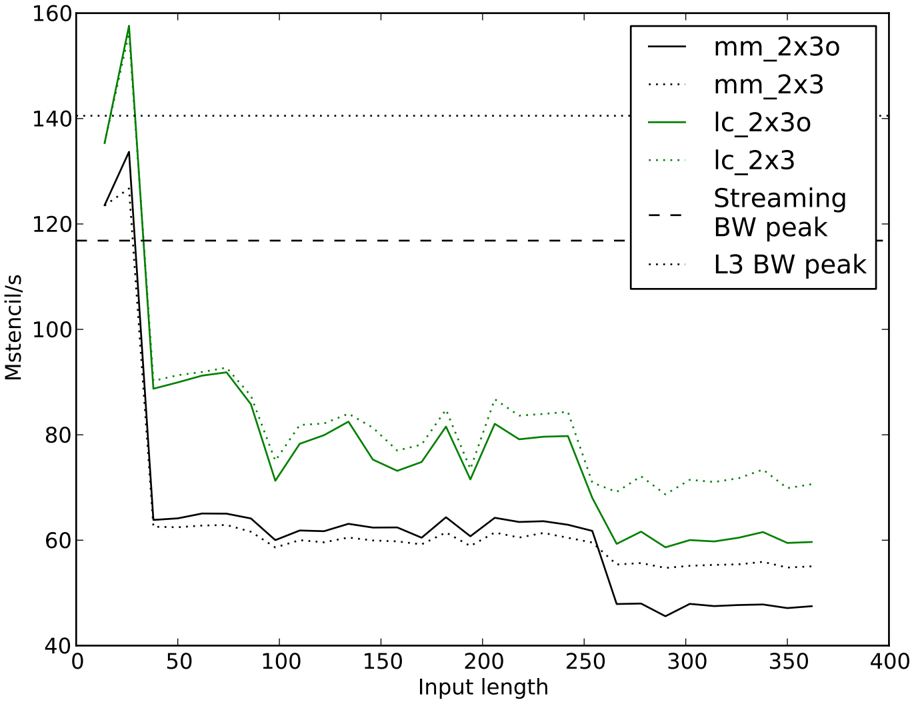
The image is a line chart comparing the performance (Mstencil/s) of different stencil calculation methods (mm_2x3o, mm_2x3, lc_2x3o, lc_2x3) against varying input lengths. It also includes horizontal lines indicating the Streaming BW peak and L3 BW peak.
### Components/Axes
* **X-axis:** Input length, ranging from 0 to 400 in increments of 50.
* **Y-axis:** Mstencil/s, ranging from 40 to 160 in increments of 20.
* **Legend (top-right):**
* `mm_2x3o` (solid black line)
* `mm_2x3` (dotted black line)
* `lc_2x3o` (solid green line)
* `lc_2x3` (dotted green line)
* `Streaming BW peak` (dashed black line)
* `L3 BW peak` (dotted black line)
### Detailed Analysis
* **`mm_2x3o` (solid black line):**
* Trend: Starts at approximately 133 Mstencil/s, drops sharply to around 64 Mstencil/s by an input length of 50. Remains relatively stable between 60 and 65 Mstencil/s until an input length of approximately 250, then drops to around 47 Mstencil/s and remains stable.
* Data Points:
* Input Length 0: ~133 Mstencil/s
* Input Length 50: ~64 Mstencil/s
* Input Length 250: ~60 Mstencil/s
* Input Length 300: ~47 Mstencil/s
* Input Length 350: ~47 Mstencil/s
* **`mm_2x3` (dotted black line):**
* Trend: Starts at approximately 125 Mstencil/s, drops sharply to around 63 Mstencil/s by an input length of 50. Remains relatively stable between 60 and 65 Mstencil/s until an input length of approximately 250, then drops to around 55 Mstencil/s and remains stable.
* Data Points:
* Input Length 0: ~125 Mstencil/s
* Input Length 50: ~63 Mstencil/s
* Input Length 100: ~60 Mstencil/s
* Input Length 250: ~60 Mstencil/s
* Input Length 300: ~55 Mstencil/s
* Input Length 350: ~55 Mstencil/s
* **`lc_2x3o` (solid green line):**
* Trend: Starts at approximately 138 Mstencil/s, peaks at approximately 158 Mstencil/s around an input length of 30, drops sharply to around 90 Mstencil/s by an input length of 50. Fluctuates between 70 and 90 Mstencil/s until an input length of approximately 250, then drops to around 60 Mstencil/s and remains stable.
* Data Points:
* Input Length 0: ~138 Mstencil/s
* Input Length 30: ~158 Mstencil/s
* Input Length 50: ~90 Mstencil/s
* Input Length 100: ~72 Mstencil/s
* Input Length 200: ~82 Mstencil/s
* Input Length 250: ~65 Mstencil/s
* Input Length 300: ~60 Mstencil/s
* Input Length 350: ~60 Mstencil/s
* **`lc_2x3` (dotted green line):**
* Trend: Starts at approximately 128 Mstencil/s, drops sharply to around 90 Mstencil/s by an input length of 50. Fluctuates between 70 and 90 Mstencil/s until an input length of approximately 250, then drops to around 58 Mstencil/s and remains stable.
* Data Points:
* Input Length 0: ~128 Mstencil/s
* Input Length 50: ~90 Mstencil/s
* Input Length 100: ~80 Mstencil/s
* Input Length 200: ~80 Mstencil/s
* Input Length 250: ~70 Mstencil/s
* Input Length 300: ~58 Mstencil/s
* Input Length 350: ~58 Mstencil/s
* **`Streaming BW peak` (dashed black line):**
* Constant value at approximately 117 Mstencil/s.
* **`L3 BW peak` (dotted black line):**
* Constant value at approximately 140 Mstencil/s.
### Key Observations
* All four stencil calculation methods (`mm_2x3o`, `mm_2x3`, `lc_2x3o`, `lc_2x3`) exhibit a significant performance drop between input lengths of 0 and 50.
* The `lc_2x3o` method initially performs the best, peaking at 158 Mstencil/s, but its performance degrades more than the `mm_2x3o` and `mm_2x3` methods as the input length increases.
* The `mm_2x3o` and `mm_2x3` methods have similar performance profiles, with `mm_2x3o` being slightly better.
* The `Streaming BW peak` and `L3 BW peak` represent upper performance bounds. The stencil calculation methods approach these bounds at smaller input lengths but fall below them as the input length increases.
### Interpretation
The chart illustrates the performance characteristics of different stencil calculation methods as the input length varies. The initial performance drop suggests that the methods are more efficient for smaller input sizes. The `lc_2x3o` method shows the highest initial performance, but its performance degrades more significantly with increasing input length compared to the `mm_2x3o` and `mm_2x3` methods. This suggests that `lc_2x3o` might be more sensitive to input size or have a higher overhead for larger inputs. The horizontal lines representing the `Streaming BW peak` and `L3 BW peak` provide a benchmark for the maximum achievable performance. The fact that the stencil calculation methods fall below these peaks indicates that they are not fully utilizing the available bandwidth, especially at larger input lengths. The drop in performance around an input length of 250 for `mm_2x3o` and `mm_2x3` could indicate a cache-related issue or a change in the algorithm's behavior.