## Diagram: Stages of Reinforcement Learning for Model Training
### Overview
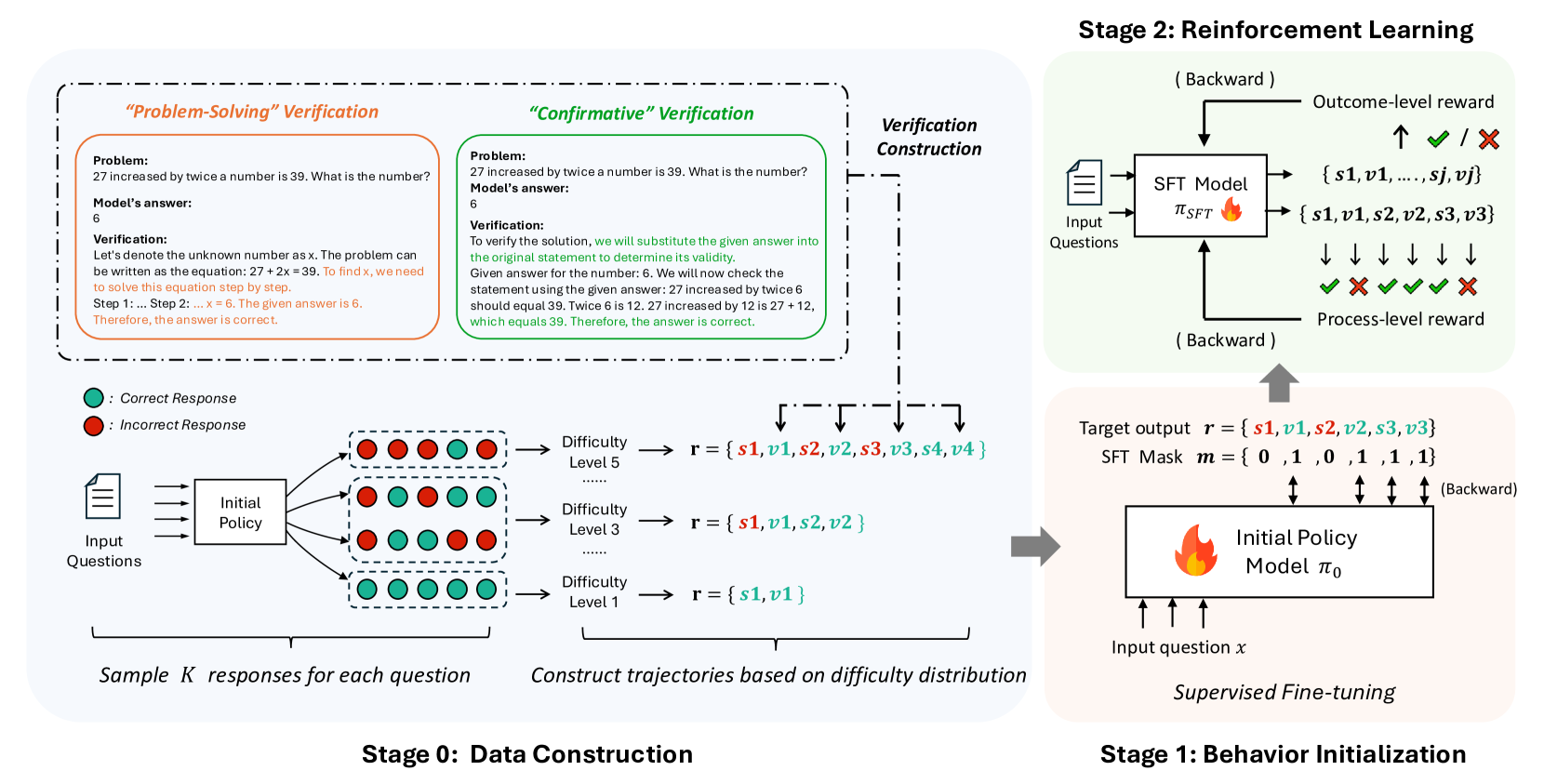
This diagram illustrates a three-stage process for training a model, likely a language model or a similar AI system, using reinforcement learning. The stages are: Stage 0: Data Construction, Stage 1: Behavior Initialization, and Stage 2: Reinforcement Learning. The diagram details how data is generated, how an initial policy is established, and how reinforcement learning is applied to refine the model's performance.
### Components/Axes
**Stage 0: Data Construction**
* **Input:** "Input Questions" (represented by a document icon).
* **Process:** An "Initial Policy" box receives input questions.
* **Output:** The "Initial Policy" generates "Sample K responses for each question." These responses are visually represented as a grid of colored circles, indicating "Correct Response" (green) and "Incorrect Response" (red).
* **Legend:**
* Green circle: Correct Response
* Red circle: Incorrect Response
* **Further Processing:** These samples are used to "Construct trajectories based on difficulty distribution." This is shown by arrows leading to different difficulty levels:
* Difficulty Level 5
* Difficulty Level 3
* Difficulty Level 1
* **Trajectory Representation:** Each difficulty level is associated with a set of tokens represented as `r = {s1, v1, s2, v2, s3, v3, s4, v4}` for Level 5, `r = {s1, v1, s2, v2}` for Level 3, and `r = {s1, v1}` for Level 1. The colors of the tokens in the example trajectories are:
* Level 5: `s1` (red), `v1` (green), `s2` (red), `v2` (green), `s3` (red), `v3` (green), `s4` (red), `v4` (green)
* Level 3: `s1` (red), `v1` (green), `s2` (red), `v2` (green)
* Level 1: `s1` (red), `v1` (green)
**Verification Construction (Within Stage 0)**
* This section provides two methods of verification for a given problem and model answer.
* **"Problem-Solving" Verification:**
* **Problem:** "27 increased by twice a number is 39. What is the number?"
* **Model's answer:** 6
* **Verification:** A step-by-step explanation of how to solve the equation `27 + 2x = 39` to arrive at `x = 6`.
* **"Confirmative" Verification:**
* **Problem:** "27 increased by twice a number is 39. What is the number?"
* **Model's answer:** 6
* **Verification:** Substituting the answer `6` back into the original statement to confirm its validity. It shows that `27 increased by twice 6` (which is `27 + 12`) equals `39`.
**Stage 1: Behavior Initialization**
* **Process:** "Supervised Fine-tuning" is applied to an "Initial Policy Model π₀".
* **Input:** "Input question x".
* **Output:** The model outputs a "Target output r = {s1, v1, s2, s3, v3}" and an "SFT Mask m = {0, 1, 0, 1, 1, 1, 1}". Arrows indicate a "Backward" pass.
**Stage 2: Reinforcement Learning**
* **Process:** A "SFT Model π_SFT" (presumably the model after Stage 1) is trained using reinforcement learning.
* **Input:** "Input Questions".
* **Outputs:**
* **Outcome-level reward:** Indicated by an upward arrow with checkmarks (✓) and crosses (✗), representing success or failure. The possible outcomes are listed as `{s1, v1, ..., sj, vj}`.
* **Process-level reward:** Indicated by downward arrows with checkmarks (✓) and crosses (✗), representing success or failure at intermediate steps.
* **Feedback Loop:** Both outcome-level and process-level rewards are fed back to the SFT Model via a "Backward" pass.
* **Relationship to Stage 1:** The SFT Model in Stage 2 appears to be an evolution of the Initial Policy Model from Stage 1. The "Target output r" and "SFT Mask m" from Stage 1 are shown feeding into the SFT Model in Stage 2, along with "Input question x".
### Detailed Analysis or Content Details
**Stage 0: Data Construction**
The diagram shows that input questions are processed by an initial policy to generate multiple responses. These responses are categorized as correct (green) or incorrect (red). The distribution of these responses is then used to construct trajectories based on difficulty levels (Level 5, Level 3, Level 1). The token sets associated with each difficulty level suggest a hierarchical structure or varying complexity of generated sequences. For example, Level 5 has the longest sequence of tokens (`s1` through `v4`), while Level 1 has the shortest (`s1`, `v1`). The coloring of these tokens (red for `s` tokens, green for `v` tokens) might indicate specific types of actions or states within the trajectory.
The verification sections provide a concrete example of a mathematical problem and demonstrate two distinct methods for verifying the model's answer:
1. **Problem-Solving:** This method involves solving the problem from scratch to derive the correct answer and comparing it to the model's answer.
2. **Confirmative:** This method involves plugging the model's answer back into the problem statement to check for consistency. Both methods confirm that the model's answer of `6` for the problem "27 increased by twice a number is 39" is correct.
**Stage 1: Behavior Initialization**
This stage focuses on supervised fine-tuning (SFT) of an initial policy model (π₀). The model takes an input question `x` and is trained to produce a target output `r = {s1, v1, s2, s3, v3}`. A corresponding "SFT Mask" `m = {0, 1, 0, 1, 1, 1, 1}` is also generated. The mask likely indicates which parts of the target output are relevant or should be attended to during fine-tuning. The "Backward" arrow suggests that gradients are propagated during this supervised learning process.
**Stage 2: Reinforcement Learning**
This stage applies reinforcement learning to a "SFT Model π_SFT". The model receives input questions and generates outputs that are evaluated by both "Outcome-level reward" and "Process-level reward".
* **Outcome-level reward:** This reward is a global evaluation of the final output. The symbols `✓` and `✗` indicate successful or unsuccessful outcomes, respectively. The set `{s1, v1, ..., sj, vj}` likely represents the possible final states or actions.
* **Process-level reward:** This reward provides feedback on intermediate steps of the model's generation process. The visual representation of multiple downward arrows with `✓` and `✗` suggests that each step in the generated sequence is evaluated.
Both reward signals are fed back to the SFT Model via a "Backward" pass, allowing the model to learn and improve its policy to maximize cumulative rewards. The diagram shows that the "Target output r" and "SFT Mask m" from Stage 1 are inputs to the SFT Model in Stage 2, implying that the supervised fine-tuning in Stage 1 initializes the model for the subsequent reinforcement learning phase.
### Key Observations
* The diagram outlines a structured approach to training a model, moving from data generation and initial policy learning to sophisticated reinforcement learning.
* The use of both "Problem-Solving" and "Confirmative" verification methods in Stage 0 highlights a robust approach to ensuring the correctness of generated data or model outputs.
* The concept of "difficulty distribution" in Stage 0 suggests that the training data is curated to cover a range of problem complexities.
* Stage 1 (Supervised Fine-tuning) serves as a crucial initialization step, preparing the model with a baseline behavior before it undergoes reinforcement learning.
* Stage 2 (Reinforcement Learning) utilizes both global (outcome-level) and granular (process-level) rewards, indicating a comprehensive feedback mechanism for model improvement.
* The "Backward" arrows consistently denote the flow of gradients or error signals in supervised fine-tuning and reinforcement learning.
### Interpretation
This diagram depicts a common pipeline in modern AI development, particularly for tasks involving sequential generation or decision-making, such as natural language processing or game playing.
**Stage 0: Data Construction** lays the groundwork by generating a diverse and verified dataset. The inclusion of verification methods suggests a focus on data quality and correctness, which is paramount for effective model training. The segmentation by difficulty level implies a strategy to gradually expose the model to increasingly complex tasks, a common technique in curriculum learning. The token sets `r = {s1, v1, ...}` likely represent sequences of actions or states, where `s` and `v` might denote different types of tokens or decisions. The coloring of these tokens (red/green) could represent specific attributes or classes within the sequence, potentially related to the correctness or type of action taken.
**Stage 1: Behavior Initialization** is critical for providing the reinforcement learning agent with a reasonable starting point. Supervised fine-tuning on a dataset of input-output pairs (questions and target outputs) allows the model to learn basic patterns and generate plausible responses. The "SFT Mask" might be used to guide the fine-tuning process, focusing the model's attention on specific parts of the input or output that are deemed most important. This stage prevents the reinforcement learning agent from starting with a completely random policy, which would be highly inefficient.
**Stage 2: Reinforcement Learning** is where the model truly learns to optimize its behavior. By receiving rewards based on both the final outcome and the intermediate steps, the model can learn to make better decisions throughout its generation process. The distinction between outcome-level and process-level rewards is significant:
* **Outcome-level reward** is essential for achieving the overall goal.
* **Process-level reward** is crucial for learning efficient and correct intermediate steps, which can lead to better outcomes and prevent common errors. This is particularly important in complex tasks where a single error early on can derail the entire process.
The overall flow suggests a progression from supervised learning to reinforcement learning, a paradigm often referred to as "pre-training and fine-tuning" or "behavior cloning followed by reinforcement learning." The diagram effectively visualizes how an initial, supervised policy is refined through trial and error guided by rewards, leading to a more robust and optimized model. The "Backward" arrows are a consistent visual cue for the backpropagation of errors or gradients, a fundamental mechanism in training deep learning models. The entire process aims to build a model that not only generates correct answers but does so through a sound and efficient reasoning process.