TECHNICAL ASSET FINGERPRINT
e72d40f130aafee49a549fee
Click to view fullscreen
Press ESC or click to close
FOUND IN PAPERS
EXPERT: healer-alpha-free VERSION 1
RUNTIME: free/openrouter/healer-alpha
INTEL_VERIFIED
## Line Charts: Mistral-7B-v0.1 and Mistral-7B-v0.3 "I-Don't-Know Rate" by Layer
### Overview
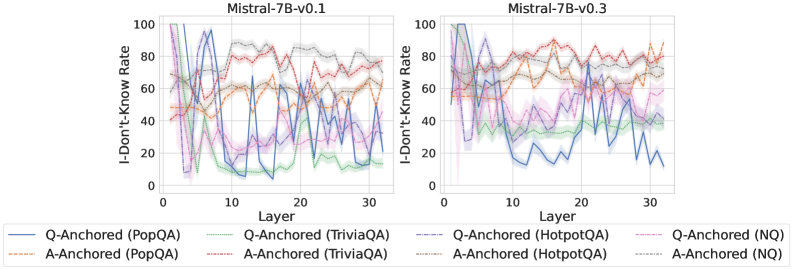
The image displays two side-by-side line charts comparing the "I-Don't-Know Rate" across the 32 layers (0-31) of two versions of the Mistral-7B language model: v0.1 (left) and v0.3 (right). Each chart plots eight data series, representing combinations of two anchoring methods (Q-Anchored and A-Anchored) applied to four different question-answering datasets (PopQA, TriviaQA, HotpotQA, NQ). The charts visualize how the model's expressed uncertainty (the rate of producing an "I don't know" response) varies by layer and model version.
### Components/Axes
* **Titles:**
* Left Chart: `Mistral-7B-v0.1`
* Right Chart: `Mistral-7B-v0.3`
* **Y-Axis (Both Charts):** Label is `I-Don't-Know Rate`. Scale runs from 0 to 100 in increments of 20.
* **X-Axis (Both Charts):** Label is `Layer`. Scale runs from 0 to 30, with major ticks at 0, 10, 20, and 30. The data appears to cover layers 0 through 31.
* **Legend (Bottom, spanning both charts):** Contains eight entries, each with a unique line style and color.
* **Q-Anchored Series (Solid Lines):**
* `Q-Anchored (PopQA)`: Solid blue line.
* `Q-Anchored (TriviaQA)`: Solid green line.
* `Q-Anchored (HotpotQA)`: Solid purple line.
* `Q-Anchored (NQ)`: Solid pink line.
* **A-Anchored Series (Dashed Lines):**
* `A-Anchored (PopQA)`: Dashed orange line.
* `A-Anchored (TriviaQA)`: Dashed red line.
* `A-Anchored (HotpotQA)`: Dashed gray line.
* `A-Anchored (NQ)`: Dashed brown line.
### Detailed Analysis
**Mistral-7B-v0.1 (Left Chart):**
* **General Trend:** All series show high volatility across layers, with sharp peaks and troughs. There is no single monotonic trend for any series.
* **Q-Anchored Series (Solid Lines):** These generally exhibit lower "I-Don't-Know Rates" compared to their A-Anchored counterparts for the same dataset, particularly in the middle layers (approx. 5-25). The solid blue (PopQA) and solid green (TriviaQA) lines show the most dramatic dips, reaching near 0% around layers 10-15 and 20-25.
* **A-Anchored Series (Dashed Lines):** These maintain higher rates, often fluctuating between 40% and 90%. The dashed red (TriviaQA) and dashed gray (HotpotQA) lines are frequently among the highest.
* **Notable Points:**
* A significant convergence of multiple lines occurs around layer 0, starting at high rates (60-100%).
* A pronounced dip for several Q-Anchored series is visible between layers 10 and 15.
* The dashed orange line (A-Anchored PopQA) shows a distinctive peak near layer 25.
**Mistral-7B-v0.3 (Right Chart):**
* **General Trend:** The volatility appears somewhat reduced compared to v0.1, with lines showing slightly smoother transitions between layers. The overall spread between the highest and lowest lines seems narrower.
* **Q-Anchored Series (Solid Lines):** The solid blue (PopQA) line shows a very distinct pattern: it starts high, drops sharply to a low plateau (approx. 10-20%) between layers 10-20, then rises again. The solid green (TriviaQA) line also shows a notable dip in the middle layers.
* **A-Anchored Series (Dashed Lines):** These continue to generally sit higher than the Q-Anchored lines. The dashed red (TriviaQA) and dashed gray (HotpotQA) lines remain prominent at the top of the chart.
* **Notable Points:**
* The separation between the solid blue line (Q-Anchored PopQA) and the others is more sustained and defined in the middle layers compared to v0.1.
* The dashed brown line (A-Anchored NQ) appears to have a lower profile in v0.3 compared to v0.1.
* The overall "floor" of the rates (the lowest points reached) seems slightly higher in v0.3 for most series.
### Key Observations
1. **Anchoring Effect:** Across both model versions and all datasets, the **A-Anchored** (dashed lines) method consistently results in a higher "I-Don't-Know Rate" than the **Q-Anchored** (solid lines) method. This is the most salient pattern.
2. **Dataset Variation:** The choice of dataset significantly impacts the rate. For example, the PopQA dataset (blue/orange lines) often shows more extreme swings, especially in the Q-Anchored configuration.
3. **Model Version Difference:** Mistral-7B-v0.3 exhibits different layer-wise uncertainty profiles than v0.1. The most striking difference is the behavior of the Q-Anchored PopQA series (solid blue), which in v0.3 shows a deep, sustained valley in the middle layers, a pattern less clearly defined in v0.1.
4. **Layer Sensitivity:** The "I-Don't-Know Rate" is highly sensitive to the specific layer within the model, indicating that different layers process or express uncertainty in fundamentally different ways.
### Interpretation
These charts provide a technical diagnostic of how two versions of the Mistral-7B model express calibrated uncertainty ("I don't know") internally across their processing layers. The data suggests several key insights:
* **Anchoring Controls Uncertainty Expression:** The consistent gap between A-Anchored and Q-Anchored lines indicates that the prompting or anchoring strategy is a primary lever for controlling a model's propensity to abstain from answering. A-Anchoring appears to make the model more cautious or more likely to express uncertainty.
* **Model Evolution Changes Internal Dynamics:** The differences between v0.1 and v0.3 show that updates to the model architecture or training data alter not just final output quality, but also the internal, layer-by-layer pathway to generating an answer. The more defined pattern in v0.3 might suggest a more structured or specialized processing of uncertainty.
* **Layers Have Functional Specialization:** The high volatility and lack of a smooth trend imply that layers are not simply becoming "more certain" or "less certain" sequentially. Instead, specific layers or ranges of layers may be critically involved in evidence integration, confidence estimation, or decision gating, and this function varies by the type of question (dataset) and prompting method.
* **Practical Implication:** For developers using these models, this analysis underscores that the model's reliability and calibration are not uniform. To elicit a well-calibrated "I don't know," one must consider both the **prompting strategy** (Q vs. A-Anchored) and potentially the **internal layer** from which a final answer is derived, if such control is available. The model version is also a critical factor.
DECODING INTELLIGENCE...