## Flowchart: Multi-Label Classification and Segmentation Workflow
### Overview
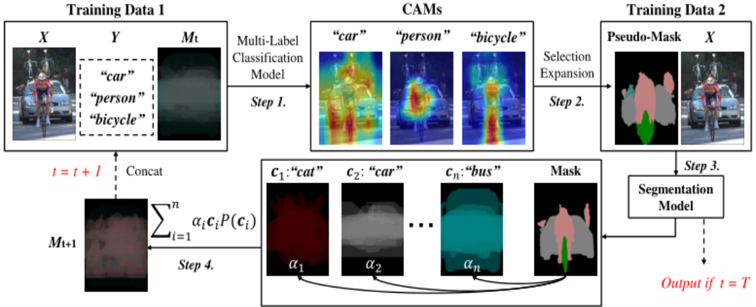
The image depicts a technical workflow for a multi-label classification and segmentation model. It illustrates the process of generating pseudo-masks from training data, using Class Activation Maps (CAMs), and iteratively refining segmentation outputs. The workflow includes steps for data preparation, model inference, feature concatenation, and final segmentation output.
### Components/Axes
1. **Training Data 1**
- **X**: Input image (e.g., a cyclist with a car and bicycle).
- **Y**: Ground-truth labels: `"car"`, `"person"`, `"bicycle"`.
- **M<sub>t</sub>**: Initial pseudo-mask (black-and-white segmentation).
2. **Multi-Label Classification Model**
- Processes **X** and **Y** to generate **CAMs** (Class Activation Maps) for each label.
3. **CAMs**
- Visual heatmaps highlighting regions associated with each label:
- `"car"` (red), `"person"` (blue), `"bicycle"` (green).
4. **Training Data 2**
- **Pseudo-Mask**: Color-coded mask derived from CAMs (e.g., pink, green, gray).
- **X**: Same input image as Training Data 1.
5. **Segmentation Model**
- Takes concatenated features (**M<sub>t+1</sub>**) and outputs a refined mask.
- Final output is labeled as `"Output if t = T"`.
### Detailed Analysis
- **Step 1**: Multi-Label Classification Model infers labels from **X** and **Y**, producing CAMs that visualize object regions.
- **Step 2**: CAMs are expanded to create a pseudo-mask for **Training Data 2**.
- **Step 3**: The pseudo-mask is combined with **X** to refine segmentation.
- **Step 4**: Features from CAMs (`c₁: "car"`, `c₂: "car"`, `cₙ: "bus"`) are concatenated with weights (`α₁`, `α₂`, ..., `αₙ`) to form **M<sub>t+1</sub>**.
- **Step 5**: The segmentation model processes **M<sub>t+1</sub>** to generate the final mask.
### Key Observations
- **Iterative Refinement**: The workflow uses an iterative process (`t = t + 1`) to improve segmentation accuracy.
- **Color Coding**:
- CAMs use distinct colors (red, blue, green) to differentiate labels.
- Pseudo-masks use pink, green, and gray for class-specific regions.
- **Feature Concatenation**: Weights (`α_i`) are applied to CAM features before concatenation, suggesting a weighted fusion of multi-label information.
### Interpretation
This workflow demonstrates a hybrid approach combining multi-label classification and segmentation. The use of CAMs allows the model to focus on relevant regions for each label, while iterative refinement (via pseudo-masks) improves segmentation precision. The weighted concatenation of features (`M<sub>t+1</sub>`) implies a mechanism to prioritize certain labels over others during segmentation. The final output (`t = T`) represents the culmination of this process, likely achieving higher accuracy than initial pseudo-masks.
**Note**: No numerical data or explicit trends are present; the diagram focuses on architectural components and process flow.