## Train Diagram: Model Evolution
### Overview
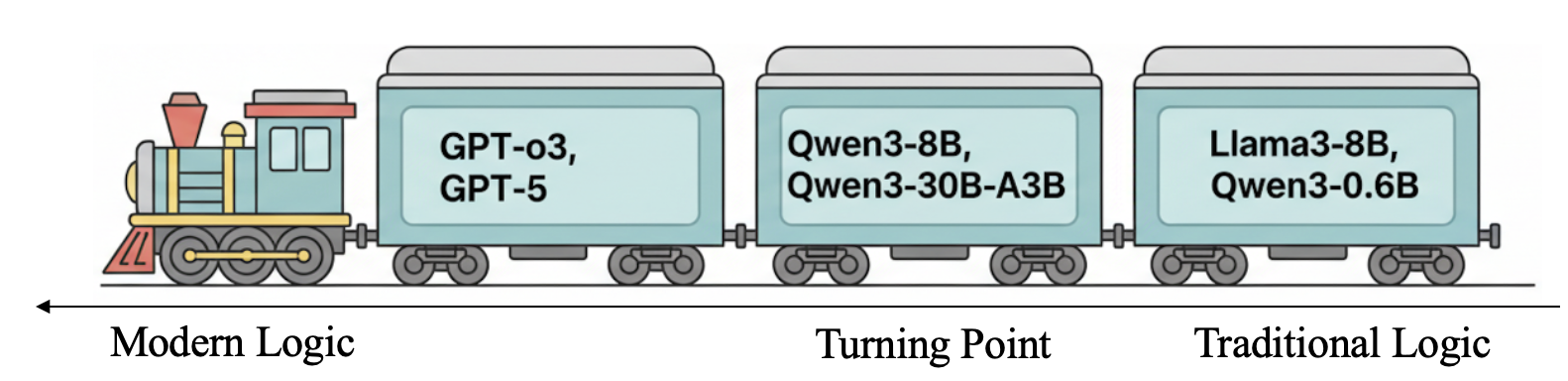
The image is a diagram depicting a train with three cars, each representing a different category of language models. The train is oriented from left to right, with an arrow indicating the direction of "Modern Logic" towards "Traditional Logic." Each car is labeled with specific model names.
### Components/Axes
* **Horizontal Axis:** Represents a spectrum from "Modern Logic" to "Traditional Logic."
* **Locomotive:** Represents "Modern Logic" and is pulling the train.
* **Car 1:** Labeled "GPT-o3, GPT-5"
* **Car 2:** Labeled "Qwen3-8B, Qwen3-30B-A3B" and positioned at the "Turning Point."
* **Car 3:** Labeled "Llama3-8B, Qwen3-0.6B" and represents "Traditional Logic."
### Detailed Analysis
* **Locomotive:** The locomotive is positioned at the left end of the diagram, indicating the start of the progression towards "Modern Logic."
* **Car 1 (GPT-o3, GPT-5):** This car is directly behind the locomotive, suggesting these models are associated with "Modern Logic."
* **Car 2 (Qwen3-8B, Qwen3-30B-A3B):** This car is positioned at the "Turning Point," implying these models represent a transition between "Modern Logic" and "Traditional Logic."
* **Car 3 (Llama3-8B, Qwen3-0.6B):** This car is at the right end of the diagram, indicating these models are associated with "Traditional Logic."
### Key Observations
* The diagram uses a train metaphor to illustrate the evolution or categorization of language models.
* The positioning of the cars along the "Modern Logic" to "Traditional Logic" spectrum suggests a classification based on their underlying principles or architectures.
* The "Turning Point" highlights a shift or change in the type of models being represented.
### Interpretation
The diagram suggests a categorization of language models based on their alignment with "Modern Logic" versus "Traditional Logic." The train metaphor implies a progression or evolution of these models, with GPT-o3 and GPT-5 representing more modern approaches, Llama3-8B and Qwen3-0.6B representing more traditional approaches, and Qwen3-8B and Qwen3-30B-A3B representing a transition between the two. The specific criteria for defining "Modern Logic" and "Traditional Logic" are not explicitly stated in the image, but it can be inferred that they relate to the underlying architecture, training methods, or performance characteristics of the models. The diagram could be used to illustrate the evolution of language models or to compare and contrast different approaches to natural language processing.