## Diagram: AI Model Progression Train
### Overview
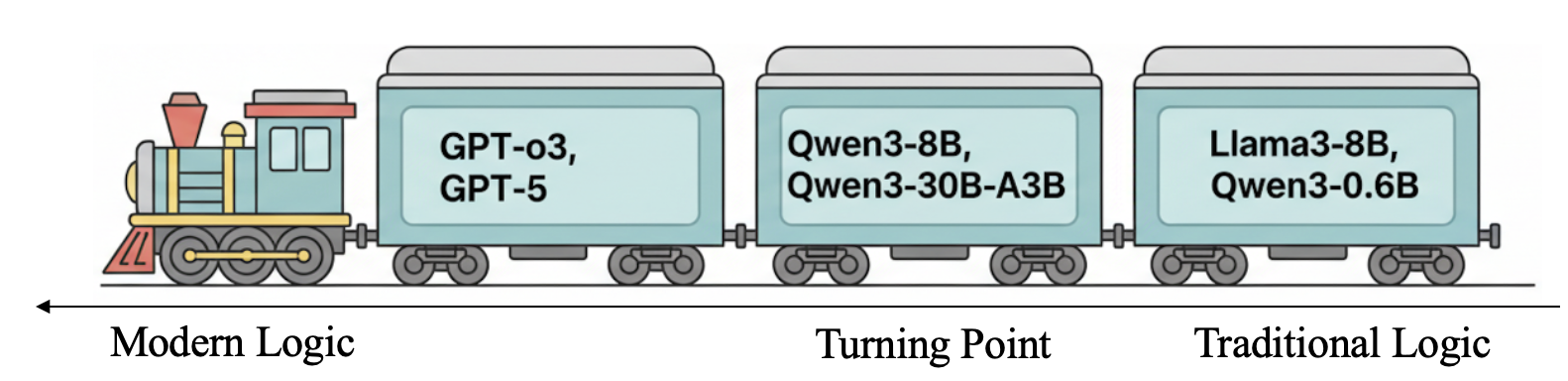
The image is a conceptual diagram using a train metaphor to illustrate a progression or spectrum of AI models. A train, consisting of a locomotive and three freight cars, moves from right to left along a track. Below the track is a labeled timeline arrow indicating a directional flow from "Traditional Logic" to "Modern Logic." Each train car contains the names of specific AI models, grouping them conceptually.
### Components/Axes
1. **Train:**
* **Locomotive:** Positioned on the far left. It is a stylized, cartoonish steam engine in light blue with red and yellow accents. It has no text label.
* **Freight Car 1 (Leftmost):** A light blue boxcar directly behind the locomotive. Text: "GPT-o3, GPT-5".
* **Freight Car 2 (Center):** A light blue boxcar. Text: "Qwen3-8B, Qwen3-30B-A3B".
* **Freight Car 3 (Rightmost):** A light blue boxcar. Text: "Llama3-8B, Qwen3-0.6B".
2. **Timeline/Axis:**
* A black horizontal arrow runs beneath the train track, pointing to the left.
* **Left Label (Arrow Tip):** "Modern Logic"
* **Center Label:** "Turning Point"
* **Right Label (Arrow Tail):** "Traditional Logic"
### Detailed Analysis
* **Spatial Grounding & Flow:** The diagram establishes a clear leftward directional flow. The locomotive leads the train towards "Modern Logic." The cars are ordered sequentially from right (Traditional Logic) to left (Modern Logic).
* **Model Grouping:**
* The car closest to the "Traditional Logic" end contains "Llama3-8B" and "Qwen3-0.6B".
* The middle car, aligned with the "Turning Point" label, contains "Qwen3-8B" and "Qwen3-30B-A3B".
* The car closest to the "Modern Logic" end, pulled by the locomotive, contains "GPT-o3" and "GPT-5".
* **Text Transcription:** All text is in English. The transcribed text is as follows:
* On Cars: "GPT-o3, GPT-5", "Qwen3-8B, Qwen3-30B-A3B", "Llama3-8B, Qwen3-0.6B".
* On Timeline: "Modern Logic", "Turning Point", "Traditional Logic".
### Key Observations
1. **Conceptual, Not Quantitative:** This is a metaphorical diagram, not a data chart. It does not provide performance metrics, benchmarks, or numerical data. It visualizes a perceived conceptual ordering.
2. **Model Families:** The diagram groups models from different families (GPT, Qwen, Llama) across the spectrum. Notably, the Qwen3 model series appears in all three cars, suggesting it spans the conceptual range.
3. **The "Turning Point":** The central car is explicitly labeled as the "Turning Point," implying it represents a transitional phase or a balance between traditional and modern approaches.
4. **Directionality:** The leftward arrow and the train's orientation strongly imply that "Modern Logic" is the destination or the direction of progress.
### Interpretation
This diagram presents a subjective, conceptual framework for categorizing large language models (LLMs) based on their underlying reasoning or architectural paradigms, termed "logic."
* **What it Suggests:** It proposes that models like Llama3-8B and smaller Qwen variants (Qwen3-0.6B) are associated with "Traditional Logic." In contrast, the GPT series (GPT-o3, GPT-5) is positioned as the exemplar of "Modern Logic." The Qwen3-8B and Qwen3-30B-A3B models are placed at a "Turning Point," suggesting they may hybridize or transition between these paradigms.
* **Relationships:** The train metaphor implies a journey or evolution. The locomotive (unlabeled, perhaps representing the driving force of research) pulls the field towards modernity. The grouping suggests that model size (e.g., 0.6B vs. 30B) and series are factors in this conceptual placement, but the primary axis is the type of "logic."
* **Anomalies/Notes:** The placement is interpretive. For instance, putting "GPT-5" (a hypothetical future model at the time of the diagram's creation) in the "Modern Logic" car is a predictive statement. The diagram does not define what constitutes "Traditional" vs. "Modern" logic, leaving it open to interpretation (e.g., it could refer to symbolic vs. neural approaches, reasoning capabilities, or architectural innovations). The key takeaway is the visual argument that the AI field is moving from one conceptual paradigm to another, with specific models occupying different stages in that transition.