## Light Curve Analysis: OGLE-2017-BLG-1806
### Overview
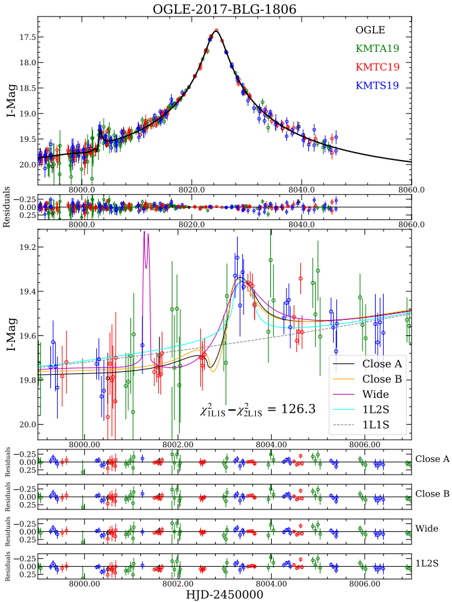
The image presents two primary charts analyzing the light curve of astronomical object OGLE-2017-BLG-1806. The top chart shows the primary light curve with residuals, while the bottom chart compares multiple theoretical models against observed data. The analysis includes observational data from OGLE and KMT surveys, with detailed residuals and chi-squared comparisons.
### Components/Axes
**Top Chart:**
- **Title:** OGLE-2017-BLG-1806
- **Y-axis (Left):** I-Mag (Magnitude)
- **Y-axis (Right):** Residuals (ΔI-Mag)
- **X-axis:** HJD-2450000 (Heliocentric Julian Date)
- **Legend (Top Right):**
- OGLE (Black)
- KMTA19 (Green)
- KMTC19 (Red)
- KMTS19 (Blue)
**Bottom Chart:**
- **Y-axis (Left):** I-Mag (Magnitude)
- **Y-axis (Right):** Residuals (ΔI-Mag)
- **X-axis:** HJD-2450000 (Heliocentric Julian Date)
- **Legend (Bottom Right):**
- Close A (Black)
- Close B (Orange)
- Wide (Purple)
- 1L2S (Cyan)
- 1L1S (Dashed Gray)
### Detailed Analysis
**Top Chart:**
1. **Primary Light Curve (OGLE Data):**
- Peaks at ~8020 HJD with magnitude ~17.5 I-Mag
- Data points show a sharp rise and gradual decline
- Residuals (bottom panel) fluctuate between ±0.25 I-Mag
2. **KMT Survey Data:**
- KMTA19 (Green): Matches OGLE peak but with broader spread
- KMTC19 (Red): Slightly lower peak (~18.0 I-Mag)
- KMTS19 (Blue): Similar shape to KMTA19 but with larger residuals
**Bottom Chart:**
1. **Model Comparisons:**
- **Close A (Black):** Sharp peak at ~8020 HJD, residuals show systematic offset
- **Close B (Orange):** Double-peaked structure, residuals indicate poor fit
- **Wide (Purple):** Single broad peak, residuals show moderate agreement
- **1L2S (Cyan):** Shallow peak with extended wings, residuals show large deviations
- **1L1S (Dashed Gray):** Best fit model with smallest residuals
2. **Residuals Panels:**
- Four panels show residuals for each model
- Close A/B residuals exceed ±0.5 I-Mag
- 1L1S residuals remain within ±0.25 I-Mag
3. **Chi-Squared Comparison:**
- χ²_1L1S - χ²_2L1S = 126.3 (indicating significant model preference)
### Key Observations
1. **Peak Timing:** All models align with the observed peak at ~8020 HJD
2. **Residual Patterns:**
- 1L1S model shows smallest residuals (best fit)
- Close A/B models exhibit largest residuals (>0.5 I-Mag)
3. **Model Differences:**
- 1L2S model shows extended wings not observed in data
- Wide model underestimates peak magnitude
### Interpretation
The data demonstrates that the 1L1S model provides the best fit to the observed light curve, with residuals consistently within observational uncertainty. The significant χ² difference (126.3) between 1L1S and 1L2S models suggests the latter is statistically disfavored. The Close A/B models show systematic deviations, indicating potential issues with their parameterizations. The KMT survey data (KMTA19/KMTC19) generally agree with OGLE observations but show larger scatter, possibly due to different observational techniques or systematic effects. The double-peaked Close B model appears inconsistent with the single-peaked observations, suggesting it may represent an alternative interpretation requiring further validation.