## Line Chart: Proportion of Flips in Qwen2.5-14B Model Performance
### Overview
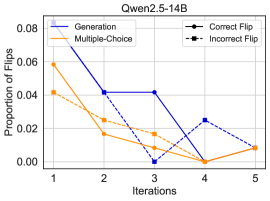
The chart illustrates the proportion of correct and incorrect flips in a Qwen2.5-14B language model across five iterations, comparing two methods: "Generation" (blue line) and "Multiple-Choice" (orange line). Flips are categorized as "Correct Flip" (solid markers) and "Incorrect Flip" (dashed markers).
### Components/Axes
- **X-axis**: Iterations (1 to 5, labeled at integer intervals).
- **Y-axis**: Proportion of Flips (0.00 to 0.08, in increments of 0.02).
- **Legend**: Located in the top-right corner, with:
- Blue line: "Generation" (solid = Correct Flip, dashed = Incorrect Flip).
- Orange line: "Multiple-Choice" (solid = Correct Flip, dashed = Incorrect Flip).
### Detailed Analysis
1. **Generation (Blue Line)**:
- **Iteration 1**:
- Correct Flip: ~0.08 (highest point).
- Incorrect Flip: ~0.00 (baseline).
- **Iteration 2**:
- Correct Flip: ~0.04 (halved from Iteration 1).
- Incorrect Flip: ~0.02 (rising trend begins).
- **Iteration 3**:
- Correct Flip: ~0.00 (sharp drop to baseline).
- Incorrect Flip: ~0.04 (peaks at mid-range).
- **Iteration 4**:
- Correct Flip: ~0.02 (partial recovery).
- Incorrect Flip: ~0.06 (dominant trend).
- **Iteration 5**:
- Correct Flip: ~0.01 (minimal improvement).
- Incorrect Flip: ~0.07 (near-maximum).
2. **Multiple-Choice (Orange Line)**:
- **Iteration 1**:
- Correct Flip: ~0.04 (moderate start).
- Incorrect Flip: ~0.00 (baseline).
- **Iteration 2**:
- Correct Flip: ~0.02 (declining trend).
- Incorrect Flip: ~0.02 (rising trend begins).
- **Iteration 3**:
- Correct Flip: ~0.01 (steady decline).
- Incorrect Flip: ~0.03 (moderate increase).
- **Iteration 4**:
- Correct Flip: ~0.00 (baseline).
- Incorrect Flip: ~0.05 (sharp rise).
- **Iteration 5**:
- Correct Flip: ~0.01 (slight rebound).
- Incorrect Flip: ~0.06 (highest point).
### Key Observations
- **Generation Method**:
- Dominates early iterations (Iteration 1–2) with high correct flips.
- Experiences a catastrophic drop in correct flips at Iteration 3, followed by partial recovery.
- Incorrect flips escalate sharply after Iteration 3, suggesting instability.
- **Multiple-Choice Method**:
- Shows gradual decline in correct flips across all iterations.
- Incorrect flips increase consistently, peaking at Iteration 5.
- **Cross-Method Comparison**:
- Generation starts stronger but becomes erratic; Multiple-Choice degrades more predictably.
- Both methods exhibit a correlation between rising incorrect flips and falling correct flips.
### Interpretation
The data suggests that the Qwen2.5-14B model's performance deteriorates with increasing iterations for both methods, but the **Generation** method exhibits higher volatility. The sharp drop in correct flips at Iteration 3 for Generation may indicate overfitting or noise amplification in later stages. The persistent rise in incorrect flips across iterations implies a systemic issue in model stability, particularly in the Generation approach. The Multiple-Choice method, while more stable, shows a steady decline in accuracy, possibly due to limited adaptability in iterative refinement. These trends highlight trade-offs between exploration (Generation) and exploitation (Multiple-Choice) in model training dynamics.