## Diagram: Abstract Schematic with Triangle and Vertical Lines
### Overview
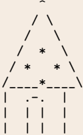
The image displays a simple, monochromatic line drawing composed of two primary geometric sections arranged vertically. The top section is an isosceles triangle containing a pattern of small, asterisk-like symbols. The bottom section consists of a series of parallel, vertical lines. There is no textual information, labels, axes, or legends present in the image.
### Components/Axes
The diagram is segmented into two distinct regions:
1. **Header (Top Region):** An isosceles triangle with its apex pointing upward. The triangle is outlined with a single, continuous line.
2. **Footer (Bottom Region):** A set of vertical lines extending downward from the base of the triangle.
**Legend/Labels:** None present.
**Axis Titles/Markers:** None present.
### Detailed Analysis
**Content Details:**
* **Triangle Interior:** Inside the triangle, there are multiple small symbols resembling asterisks (`*`) or six-pointed stars. They are arranged in a loose, grid-like pattern.
* **Count & Arrangement:** There appear to be approximately 9-11 of these symbols. They are not perfectly aligned but suggest rows and columns. A rough count from top to bottom suggests a pattern of 2, 3, 3, and 2 symbols across four approximate rows.
* **Vertical Lines:** Below the triangle's base, there are 7 distinct, parallel vertical lines.
* **Spacing:** The lines are evenly spaced.
* **Length:** All lines appear to be of equal length.
* **Connection:** The top of each line aligns with the base of the triangle, suggesting they are connected to or emanate from it.
**Data Table:** Not applicable. No numerical data is presented.
**Trends:** Not applicable. This is a static diagram, not a data chart.
### Key Observations
1. **Symbolic Abstraction:** The image contains no literal text or quantitative data. Its meaning is entirely symbolic or schematic.
2. **Structural Relationship:** The composition implies a hierarchical or foundational relationship. The triangle (a stable, pointed form) sits atop the vertical lines (which suggest support, pillars, or a foundation).
3. **Patterned Interior:** The asterisk-like symbols within the triangle are the only elements that break the clean geometry, possibly representing discrete units, data points, or components contained within the triangular structure.
4. **Symmetry and Order:** The overall diagram is highly ordered and symmetrical along a vertical axis, conveying a sense of balance and intentional design.
### Interpretation
This image is a conceptual diagram, not a data visualization. Its interpretation is open-ended but can be analyzed through common symbolic associations:
* **Possible Meanings:**
* **Organizational Chart:** The triangle could represent a leadership or management tier, with the symbols inside denoting individuals or roles. The vertical lines below could represent departments, teams, or the foundational structure supporting that tier.
* **Technical Schematic:** It might abstractly represent a system where a central processing or control unit (triangle) manages multiple discrete data points or signals (asterisks) and interfaces with several parallel output channels or subsystems (vertical lines).
* **Conceptual Model:** It could symbolize a theory or framework where a core idea (triangle) contains multiple constituent concepts (asterisks) and has several direct applications or implications (lines).
* **Relationships:** The primary relationship is **containment and support**. The triangle *contains* the symbols and is *supported by* the lines. This suggests a flow from a unified, complex structure (the triangle with its internal elements) down to a set of parallel, simpler, or more fundamental components (the lines).
* **Notable Anomalies:** The lack of any text is the most significant feature. This forces the viewer to rely entirely on geometric symbolism, making the diagram highly abstract and context-dependent. Its precise meaning would be defined by the surrounding document or field of study in which it appears.
**Conclusion:** The image is a clean, abstract schematic depicting a triangular structure containing multiple internal elements, resting upon a series of parallel vertical supports. It is a template for representing hierarchical, containment, or foundational relationships in a technical, organizational, or conceptual context.