## Diagram: Deep Researcher Agent System Architecture
### Overview
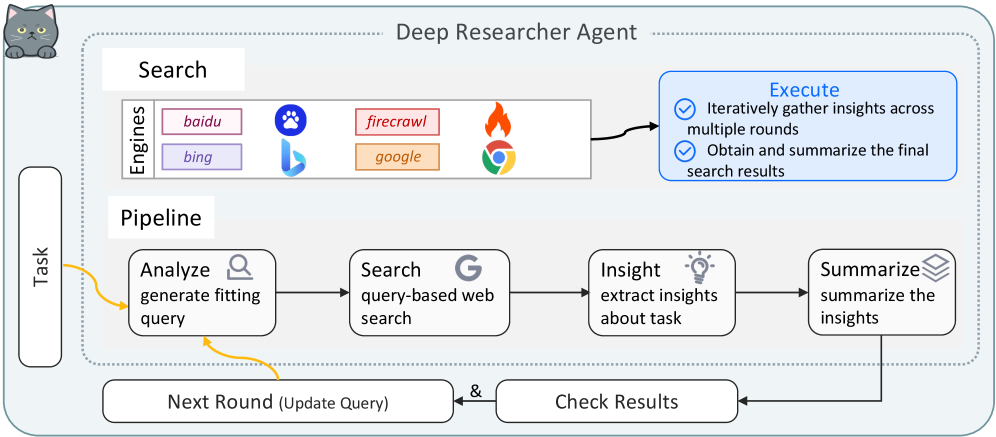
The image is a technical system architecture diagram illustrating the workflow of a "Deep Researcher Agent." It depicts an iterative, multi-step process for conducting deep web research, starting from a task input and cycling through analysis, search, insight extraction, and summarization until satisfactory results are obtained. The diagram uses a combination of labeled boxes, icons, and directional arrows to show the flow of information and control.
### Components/Axes
The diagram is organized into three main visual regions:
1. **Header/Container:** A large, light-blue rounded rectangle labeled "Deep Researcher Agent" at the top center. A small, grey cat icon is positioned in the top-left corner of this container.
2. **Search Module (Top-Left):** A white box labeled "Search" containing a sub-section titled "Engines." This lists four search engines with their logos:
* `baidu` (pink box, blue paw print logo)
* `bing` (purple box, blue 'b' logo)
* `firecrawl` (red box, flame logo)
* `google` (orange box, multicolored 'G' logo)
3. **Execute Module (Top-Right):** A blue-outlined box labeled "Execute" containing two bullet points:
* "Iteratively gather insights across multiple rounds"
* "Obtain and summarize the final search results"
4. **Pipeline (Central Flowchart):** A linear process flow with feedback loops, labeled "Pipeline." The steps, connected by black arrows, are:
* **Task:** A vertical, rounded rectangle on the far left. A yellow arrow originates from it.
* **Analyze:** A box with a magnifying glass icon. Text: "generate fitting query".
* **Search:** A box with a Google 'G' icon. Text: "query-based web search".
* **Insight:** A box with a lightbulb icon. Text: "extract insights about task".
* **Summarize:** A box with a stacked layers icon. Text: "summarize the insights".
* **Check Results:** A box at the bottom right.
* **Next Round (Update Query):** A box at the bottom left. Text: "Next Round (Update Query)".
5. **Flow Arrows:**
* A primary black arrow path flows from **Analyze** -> **Search** -> **Insight** -> **Summarize** -> **Check Results**.
* A yellow arrow flows from **Task** into **Analyze**.
* A yellow feedback arrow flows from **Check Results** back to **Analyze**, passing through the **Next Round (Update Query)** box. An ampersand (`&`) symbol is placed near this feedback loop.
### Detailed Analysis
The diagram details a closed-loop, agentic research system.
* **Process Initiation:** The process begins with a "Task" input.
* **Core Pipeline:** The task enters the "Analyze" stage, where a fitting search query is generated. This query is then sent to the "Search" stage, which performs a "query-based web search" using the engines listed in the Search Module (Baidu, Bing, Firecrawl, Google). The results from the search are processed in the "Insight" stage to "extract insights about task." These insights are then passed to the "Summarize" stage to "summarize the insights."
* **Evaluation and Iteration:** The summarized output goes to "Check Results." Based on this check, the system decides to either conclude or iterate. The feedback loop, indicated by the yellow arrow and the "Next Round (Update Query)" box, shows that the query can be updated based on the checked results, and the process restarts from the "Analyze" stage. This cycle continues until the "Execute" module's goal of obtaining satisfactory final results is met.
* **Execution Context:** The "Execute" box in the top-right defines the overarching goal of the entire pipeline: to iteratively gather insights and produce a final summary.
### Key Observations
1. **Iterative Nature:** The most prominent feature is the feedback loop from "Check Results" back to "Analyze," explicitly labeled for updating the query. This indicates the system is designed for refinement and depth, not a single-pass search.
2. **Multi-Engine Search:** The system is configured to use multiple search engines (Baidu, Bing, Firecrawl, Google), suggesting a strategy for comprehensive coverage and cross-referencing information from different sources.
3. **Clear Stage Separation:** Each step in the pipeline (Analyze, Search, Insight, Summarize) has a distinct function and icon, emphasizing a modular design.
4. **Visual Flow:** The use of different colored arrows (black for primary flow, yellow for task input and feedback) helps distinguish the main process from control and iteration signals.
### Interpretation
This diagram represents a sophisticated AI agent designed for autonomous, in-depth research. It moves beyond a simple "search and present" model to an "analyze, search, synthesize, evaluate, and refine" cycle.
* **The system's purpose** is to tackle complex research tasks that require multiple rounds of information gathering and synthesis. The initial query is just a starting point; the agent learns and refines its approach based on intermediate results.
* **The components relate** in a cyclical, cause-and-effect manner. The quality of the "Analyze" stage directly impacts the "Search" results. The "Insight" extraction is dependent on the search output. The "Check Results" stage acts as a quality gate, determining whether the accumulated insights are sufficient or if the query needs reformulation for another pass.
* **Notable design choices** include the explicit inclusion of "Firecrawl" alongside major search engines, which may indicate a focus on deep web or structured data crawling. The ampersand (`&`) near the feedback loop might symbolize the conjunction of checking results and deciding to update the query, or it could be a stylistic element.
* **Underlying principle:** The architecture embodies an investigative, Peircean abductive reasoning loop—forming hypotheses (queries), testing them against evidence (search results), and refining the hypotheses based on the findings until a coherent summary (the "final search results") is achieved. The system is built not just to find information, but to *understand* a topic through iterative inquiry.