\n
## Diagram: Deep Researcher Agent Workflow
### Overview
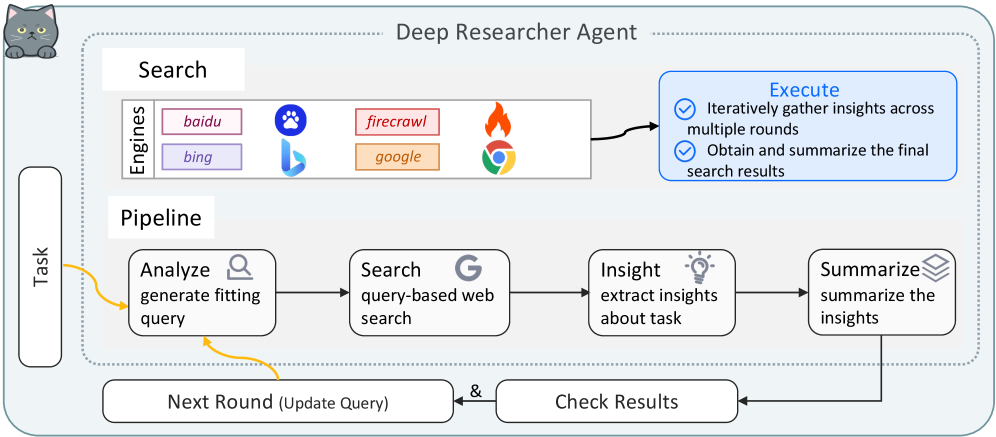
This diagram illustrates the workflow of a "Deep Researcher Agent," outlining the process from task input to search execution and insight summarization. The diagram is divided into two main sections: "Search" and "Pipeline," with feedback loops indicating iterative refinement.
### Components/Axes
The diagram features the following components:
* **Task:** Represented by a rectangular box on the left, serving as the input to the system.
* **Engines:** A vertical label indicating the search engines used.
* **Search Engines:** baidu, bing, firecrawl, google. Each is represented by a logo within a rounded rectangle.
* **Execute:** A light blue rounded rectangle on the right, representing the execution phase. Contains two checkmark icons with the text: "Iteratively gather insights across multiple rounds" and "Obtain and summarize the final search results".
* **Pipeline:** A horizontal section detailing the processing steps.
* **Analyze:** A rounded rectangle with a person icon, labeled "generate fitting query".
* **Search:** A rounded rectangle with a "G" icon, labeled "query-based web search".
* **Insight:** A rounded rectangle with a lightbulb icon, labeled "extract insights about task".
* **Summarize:** A rounded rectangle with a diamond icon, labeled "summarize the insights".
* **Next Round (Update Query):** An arrow pointing from "Summarize" back to "Analyze".
* **Check Results:** An arrow pointing from "Summarize" to "Execute".
* **Arrows:** Connecting the components, indicating the flow of information.
### Detailed Analysis or Content Details
The diagram depicts a sequential process:
1. A "Task" is initiated.
2. The "Pipeline" begins with "Analyze" to generate a fitting query.
3. The query is then used in a "Search" phase.
4. "Insight" is extracted from the search results.
5. The insights are "Summarize"d.
6. The summarized insights are used to "Check Results" and potentially initiate a "Next Round" by updating the query and restarting the "Analyze" phase.
7. The "Search" engines (baidu, bing, firecrawl, google) feed into the "Execute" phase, which iteratively gathers insights and summarizes the final results.
The arrows indicate a clear flow of information from left to right, with feedback loops for iterative refinement. The "Execute" phase appears to be driven by the output of the search engines.
### Key Observations
The diagram emphasizes an iterative approach to research, with the "Next Round" loop suggesting continuous query refinement based on the insights gathered. The inclusion of multiple search engines indicates a comprehensive search strategy. The "Execute" phase is positioned as the final stage, responsible for synthesizing the information gathered throughout the process.
### Interpretation
The diagram represents a closed-loop system for automated research. The "Deep Researcher Agent" is designed to take a task as input, formulate queries, search the web using multiple engines, extract relevant insights, summarize those insights, and then use the summary to refine the search process. This iterative approach suggests a goal of maximizing the quality and relevance of the research results. The system is designed to be self-improving, learning from each iteration to generate more effective queries and extract more valuable insights. The diagram highlights the importance of both breadth (using multiple search engines) and depth (iterative refinement) in the research process. The system is likely intended to automate tasks that would traditionally require significant human effort, such as literature reviews or competitive analysis.